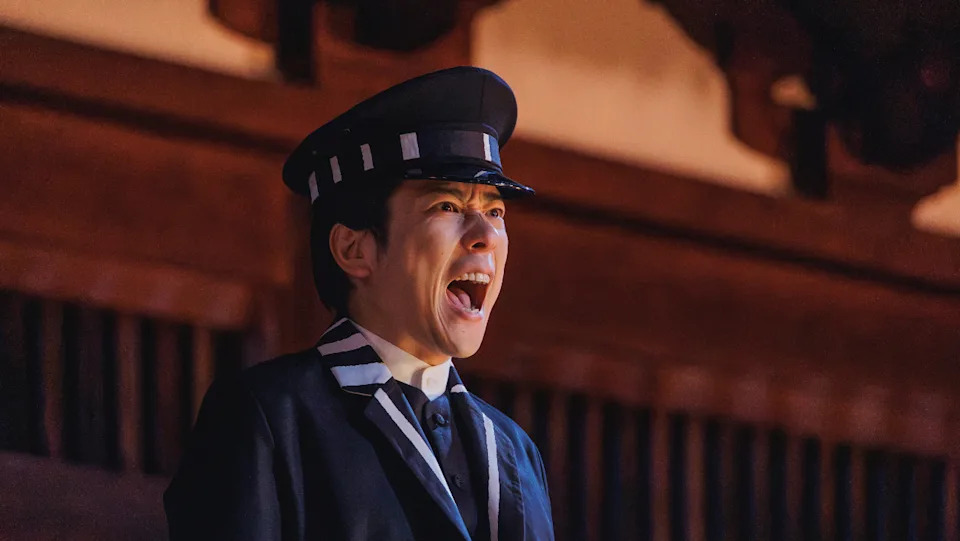
“Shōgun meets Squid Games.” That’s how Japanese actor, producer and action choreographer Junichi Okada describes his new Netflix show Last Samurai Standing, that has already become the talk of social media for its ingenius premise, stunning costumes and production design and intense fight scenes. Critics, too, have been won over by the live-action adaptation of Shogo Imamura’s 2022 historical fiction novel, Ikusagami, that was also adapted into a popular manga series, with the series having the potential to be the next breakout Asian hit for Netflix.
Set in 1878 Japan, Last Samurai Standing takes place in the post-feudal period when the few remaining samurai have become personas non grata, with a rapidly modernizing Japanese society shunning the once great warriors, and outlawing their swords. In this environement, 292, mostly desparate samurai, are drawn to a mysterious tournament with the chance to win 100,000 yen, but first they must fight each other and race to Tokyo. Okada plays Shujiro Saga, the noble, but deadly, samurai at the heart of the series, who must win the prize to save his sick wife and child.
More from The Hollywood Reporter
A feast for genre fans, Last Samurai Standing taps into jidaigeki genre, that is the period samurai dramas, and also has a survival/death game structure that is popular at the moment on top of brutal violence and incredible fight scenes. Currently, the series, which was launch last week, sits at a perfect 100 percent critics score on Rotten Tomatoes, with a 96 percent audience score. The Hollywood Reporter‘s reviewer described the show as having “a catchy premise” and that is delivers “an ample supply of the samurai action that some people — incorrect people — felt was missing from Shōgun.” The review adds, “The first five episodes offered enough bloody, ambitious set pieces and character development to keep me generally engaged, with the sixth episode being the first one to come close to blowing me away with samurai clashing, setting things up intriguingly for a second season that, unlike with Squid Game, is probably necessary.”
Last Samurai Standing also got the all-important, and extremely coveted, Hideo Kojima thumbs up. The legendary game developer, fresh from a brief visit to Hong Kong to announce his new Death Stranding anime series, took the time out of his busy schedule to tweet effusively about Netflix’s new period drama.
Ahead of Last Samurai Standing‘s launch on Netflix, THR spoke to Okada about the making of the series, juggling his roles as lead actor, producer and fight choreographer, his hopes for a second season and how they might incorporate more superhuman elements that were found in Imamura’s source material.
Firstly, congratulations on the show! Let’s start with how you got involved with the project.
Well, I have been working on jidaigeki [samurai period dramas], and I had the fortune of being able to work on these, epic projects here in Japan. Netflix approached me about Last Sumurai Standing. When I got the offer, they talked about me being the lead character and they also talked about me being the action choreographer. So, if I were to work on all these elements, I thought that I would love to also be a producer on this project.
Speaking about these three distinct roles you carried out on Last Samurai Standing, what was the challenge of doing all three? And did each job impact the other and in what way?
Having these three roles, [it’s like] having to use three different brains, so it was very difficult in that sense. As a producer, of course, you have to think about the money or the financial aspects, but a producer is someone who usually asks people to do something, and you’re also in a position to stop a certain things. An action choreographer, you can propose or suggest things that you would like to do or you would like to pull off. And as an actor you’re in this position where you try to become this character, [you try to] believe you are that person… you usually don’t have to mind about what’s going on in your surroundings. But having these three tasks, I knew too much about the surroundings, so as an actor it was definitely a difficult situation.
Regarding your work as an action choreographer, watching the show, there seems to be lots of different fight styles on screen. How many different fight styles are there? And was it difficult to choreograph so many, even within particular fight scenes that shift from martial arts, to swordplay to straight up brawling?
As an actor [and fight choreographer], it’s very important to work on the choreography and the whole structure of those movements, and having that element actually adds to building the character. I value thinking about the concept of the character and conveying that through action choreography. For example, there’s a female character called Iroha [Kaya Kiyohara], you know that she’s a female, so she [may not be that] powerful. In her fights, her fight choreography, there’s an element of yin and yang to it — like what’s apparent and what is not. There are movements, for example, when she sets a bait, but then she actually has a different actual, intended action. So those are the things that I really, carefully, thought about and prepared. Another example [with Iroha], when she’s fighting a very physically large stout male, it’s impossible for her to really fight equally, so we have to think about what would be realistic and how she would be able to pull this off. You have to think about being coherent and you have to think about mixing the right concept, and we gave the utmost care [to that].

But, was there a particular number of fight styles in the series?
Well, we have a huge number. The reason why we have a huge number of these different styles for fighting is because we have the styles per character, and then we have different concepts and ideas and we even have styles per fights and then per sequence too. [That’s] an immense number of these styles, if we were to accumulate all of that. There are instances where in one fight, you have like three to four concepts and then, maybe, in a certain shot there’s more things happening. So in that sense we have a very large number of fighting styles. In one episode, I came up with about 100 [concepts], but most of them are not actually adopted.
Speaking directly about two particular fight scenes. In the second episode, “Awakening,” where your character takes on the black uniformed officers and goes “beast mode,” it’s quite incredible. Could you talk about how you shot that? There’s also the one-shot scene in the seafood restaurant in episode four, “The Mastermind,” could you talk about that too?
About these one shot [fight scenes], when we are working on these period drama pieces, we always try to respect the genre, and our intent and our mission was to update the period drama. As we see in [Akira Kurosawa]’s works there are these long shots, and in his frame the location is also fighting in these battle sequences. We also wanted to do that, and we wanted to connect to that. Personally, myself, I have been training in martial arts and other forms, so I am able to pull this [fight choreography] off on my own, I don’t need a stunt double. I don’t need people to hide my face and pretend that it’s me. I am able to be part of that location in that sequence, and as you mentioned, becoming like a “beast,” we call that an “awakening.” In that one shot [see clip above] we wanted to convey the reality of fighting against people with firearms — you cannot have that much distance, so you have to be much closer. And then I’m also trying to convey the tactics of fighting in that scene as well, [showing that] I’m surrounded by a lot of people. In that one shot, you are able to see a lot of those elements that I’ve been describing so far.
For the [seafood restaurant scene], there is a difference [as there were more people] and skills [on show]. We had to keep in mind how many people we introduced. We considered that scene like a [superhero] type of scene, a moment where just like in the Avengers you’re able to introduce everyone one by one.

It’s a fantastic scene! Regarding the production overall, it seems enormous, by that I mean, the number of sets, the many different costumes, the number of extras. How many people were actually involved in this project? Also in terms of historical accuracy, were you slavishly trying to be as accurate as possible or were trying to just get the spirit of the era right?
On the size and scale of the production, if you were to include actors and all extras, we have this incredible amount of people being a part of this. And because we didn’t have enough time, we had two units. We had unit A and unit B, so it was two times the conventional size, so about 2000 to 3000 people. Talking about the costumes. What happened was that we contacted all the seamstresses in Japan and we had all those houses working for our show. We were working at this incredible scale.
[On the authenticity], we wanted to celebrate Japanese culture, we wanted to elevate the culture to entertainment, but its fiction. [However], we wanted to avoid portraying it as fantasy. The violence was our way of showing how dreadful and scary that era was, but also trying not to make it a fantasy with finishing moves or killer moves for the characters, which were in the original source material. We did not incorporate that, we wanted to keep it more real, having this reality based in historical facts, that’s the care we had in the production. On the other hand, we trying to make more modern, the vocabulary, or the nuances are sometimes updated, and not exactly true to that time.
That’s a neat segue to the manga, actually. Were there major changes from the manga? You just mentioned the violence aspect, but were there other key changes?
The actual source material is the novel, and then there also is a manga, but, in the original, the characters have special powers. For our show, for the first season, we don’t have superpowers [for the characters], But, if Last Samurai Standing is very popular and well received, and if we were to continue on to the second season, there may be a possibility that we might be introducing some of those aspects. But, for the first season, we gave a lot of care and focus into erasing the elements that could be considered fantasy, we concentrated on making it feel more real.
We would have to see how this will go, [but at the moment] I’m more focused on the survival game element. Ikusagami, which is the Japanese original title for Last Samurai Standing novel, has this connection with God. In the first season, we introduced the kagura dance, which is like a spiritual ritual so there is this element of the superhuman power, so we may be able to introduce this divine power.
Last Samurai Standing is unique, but it also has these elements of very popular Japanese films and TV shows, like Battle Royale, Shōgun and Alice in Borderland, were you inspired by these other projects?
The easiest way to describe Last Samurai Standing to the global audience, and for them to have a better understanding of our show, is that it is kind of like a mixture of Squid Games and Shōgun. But we’re actually adding more historical elements, and also because it’s a period drama, we’re going to be portraying and focusing on the livelihoods of these characters, their lives or situations, incorporating elements like fireworks, the artist Hokusai, the kagura dance, elements of faith too. Those are the ideas that we are incorporating in our imagery and we really wanted to give more to the storytelling element. We wanted to show more of the characters and we wanted to emphasize the culture of Japan, too. And because this is a Japanese period piece, we wanted to update that genre to introduce it globally.

Best of The Hollywood Reporter
Sign up for THR’s Newsletter. For the latest news, follow us on Facebook, Twitter, and Instagram.
‘ The preceding article may include information circulated by third parties ’
‘ Some details of this article were extracted from the following source www.yahoo.com ’