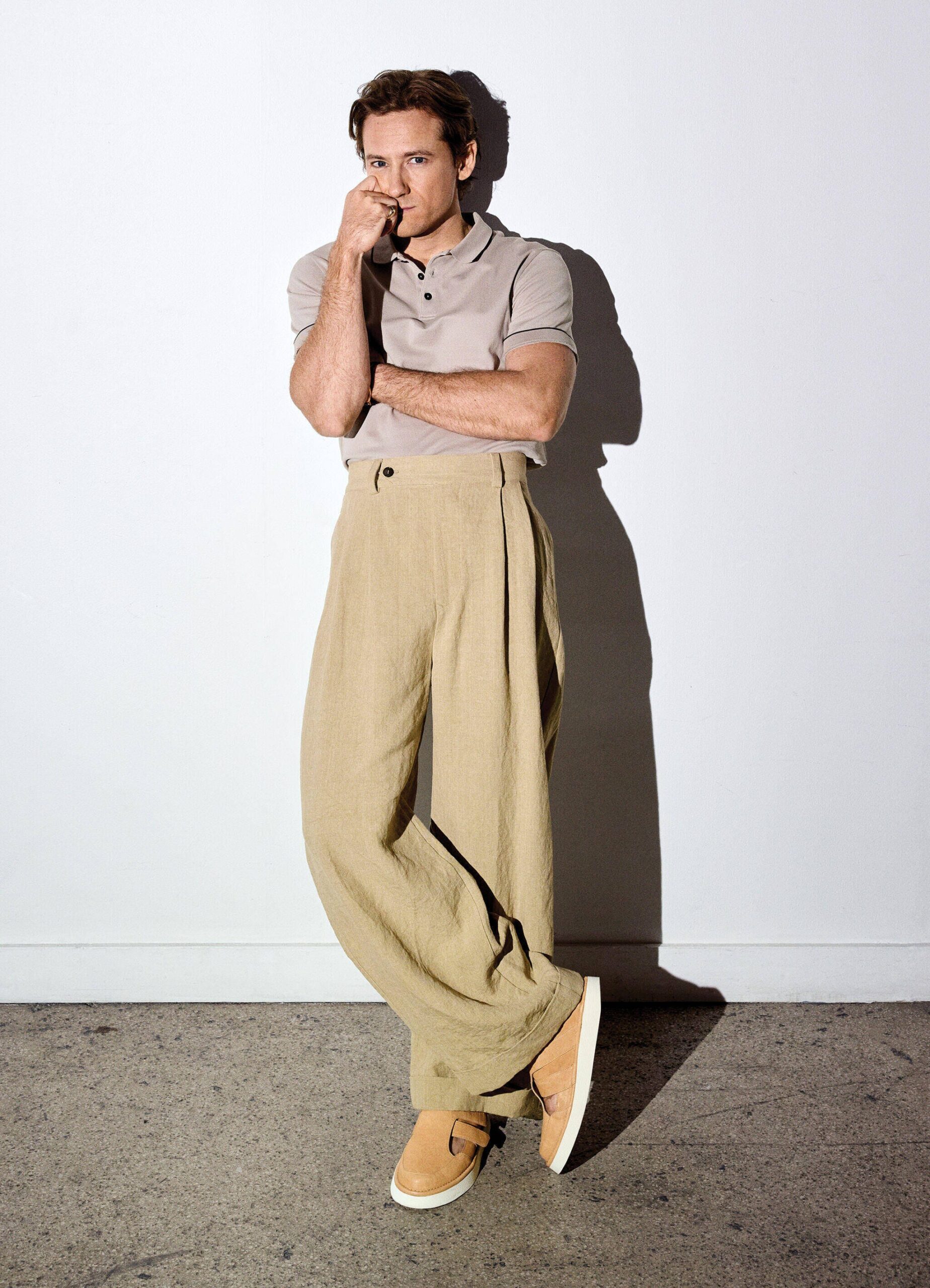
Before Lewis Pullman takes on a new role, he decides whether the difference between who he is and who he’s playing is a worthy challenge—or a warning to heed. “Oftentimes my gut instinct is a rush of hot fear through my blood. I can’t do this,” Pullman says, leaning on the counter at the Dinosaur Coffee shop in Los Angeles, not far from where he calls home. His eyes are slate gray. They’re kind, but a little like twin hurricane swirls. He’s wearing dusty boots, cargo pants, and a frayed button-down flannel over a white T-shirt. Occasionally, his eyes disappear beneath the brim of a bent cap, marked with a red Pegasus. “I have never done anything I’ve been proud of when there hasn’t been any fear behind it,” he concludes.

Jacket ($2,720), sweater ($1,660), trousers ($1,540), and shoes ($975) by Loro Piana; HardWear bracelet ($33,500) by Tiffany & Co.; socks ($28) by Anonymous Ism.
To really understand the kind of actor Pullman has become, you’ve first got to consider the kind of guy he is. He’s practical. Reliable. There’s an easygoing attitude about him, but also no nonsense. That’s why he’s the rare performer who stands out not for being flashy but for his quiet sturdiness, demonstrating strength without declaring it. It’s no wonder Pullman’s most memorable roles are in ensembles, like stalwart friend-to-everybody Lieutenant “Bob” in Top Gun: Maverick; “Bob” again in Marvel’s Thunderbolts*, as the nobody who is engineered into the superhero Sentry; and his most recent work in the historical drama The Testament of Ann Lee, playing the unwavering brother of Amanda Seyfried’s trembling religious prophet. Pullman doesn’t steal scenes from other actors; he protects them, guides them into place, and it’s that quiet resilience that is elevating him from supporting player to leading man.

Sweater, shirt ($940), and jeans ($1,900) by Dior; L.U.C Quattro Mark IV watch ($55,100) by Chopard.
The first thing you might know about the thirty-three-year-old: He’s the son of actor Bill Pullman, the roguish Lone Starr who saved the galaxy in Mel Brooks’s Star Wars parody Spaceballs. (Then helped save it again from roving alien invaders as the inspiring U.S. president in Independence Day.) Lewis grew up not just in L.A. but on the family’s livestock ranch in Montana, where his parents put him to work. “At the time, when you’re a kid, you don’t want to be doing it, but very quickly it became something that I craved and loved,” he recalls. “Doing something physical was such a good feeling.”

Shirt ($330) and trousers ($440) by Officine Générale; sneakers ($60) by Vans; socks ($15) by Apthcry.
Montana is also a place his parents fell in love with while they were falling in love with each other. Lewis pulls out his phone to show off a snapshot of his mom and dad in the late ’70s, visiting the Big Sky State when Bill was a teacher and doing Shakespeare in the Park in a place known for its vast wilderness. Bill and Tamara look like teenagers in the photo, and they’re eating ice cream sandwiches at a gas station, on their way to the future. “You meet your parents wherever you meet them,” Lewis says. “I would kill to meet my mom at that truck stop, you know?”

Jacket ($3,700), sweater ($1,650), trousers ($1,900), sneakers ($1,350), and sunglasses ($861) by Brunello Cucinelli; socks ($15) by Apthcry; Villeret Extraplate watch ($13,100) by Blancpain.
When Pullman went off to college, he majored in social work at Warren Wilson College in rural North Carolina, where manual labor was part of the curriculum. That’s where he learned to be part of a team—perhaps as useful for working on a film as any theater degree. “You would do your regular courses and classes like any other college, but on top of that you have to do a minimum of fifteen hours of work per week towards the school,” he explains. “Physical work. There’s the library crew; there’s weaving crew, where they take the wool from the sheep; there’s paint crew, heavy-duty crew, which is like janitorial work. And there’s land and stuff that needs to be tended. It’s an actual farm. I was on the tractor division of the landscaping crew. So I would work a lot with the farm.”

Shirt ($20,200), tank ($1,625), and trousers ($1,150) by Hermès.
After college, his social-work degree landed him a job at an Asheville homeless shelter, but he eventually returned home and entered the family business. Call him a nepo baby if you like, but Lewis worked hard to prove himself. “It’s all really supportive,” says Pullman, who will act alongside his dad as the son of Lone Starr in the upcoming Spaceballs 2. Although it’s something everyone asks him about, he says he never felt like he was stuck in the old man’s shadow. “We’re both like, How awesome is this that we both love the same thing and we can learn from each other?”
They’ve acted before in movies, back in 2017 when Lewis was just starting out as a performer. They appeared together in the western The Ballad of Lefty Brown and were both cast in the tennis drama Battle of the Sexes, although they didn’t share a scene in that one. Spaceballs 2 reunites them in the movie where he first saw his dad onscreen.

Sweater ($995) and trousers ($595) by Ralph Lauren Purple Label; sneakers ($90) by Converse; Top Gun pilot’s watch ($8,900) by IWC Schaffhausen.
“God, that’s strangely a question I haven’t been asked,” says Lewis, who nibbles on a fingernail while he remembers his first brush with a Bill Pullman movie. “It might be Spaceballs because we weren’t going to be watching While You Were Sleeping or something like that,” he adds with a laugh. “But that’s a comedy and a good kid movie.” He remembers being especially worried about Lone Star in the Mel Brooks spoof because that was his dad … not a character. “As a son, you pay attention to weird things,” Lewis says. “I couldn’t separate them. It was my dad. There are parts where John Candy is Barf and his tail hits my dad in the face. I felt such great empathy for him! All I could think about for the whole movie was, Why did that happen?”
That’s why he believes it’s good that they are playing relatives in the sequel. “It is wild because, as a son, you do have hardwiring to pick up on micro expressions or subterranean mood shifts and stuff like that,” he says. “And to try and cut those wires is hard.”

Jacket ($3,695), sweater ($950), shirt ($595), and trousers ($625) by Canali.
The Testament of Ann Lee was a different challenge. In the film, he plays a secretly gay man in the era of the 1700s when that was not just forbidden but an unforgivable sin, and yet he is among the most faithful to follow his charismatic but volatile sister as she founds the notorious Shaker movement that ventured from the unwelcome confines of Great Britain to the even more dangerous shores of North America, just as revolution is beginning to unfold. It’s not just emotionally taxing, but the movie is also a musical of sorts, filled with melodic incantations adapted from real Shaker hymns.
“I don’t sing,” he says, but director Mona Fastvold (producer and cowriter of The Brutalist) didn’t want her radical pilgrims to sound like pitch-perfect Broadway stars. “That’s me in the movie,” Pullman says. “She wanted to unravel the training and make it feel like it could be your neighbor and your mom or your friend. So there are very organic, warts-and-all voices in there aside from Amanda. I would never do something where they’re like, ‘You’re going to need to be an amazing musician.’ I would say, ‘Well, there’s going to be a million other guys that are better for the job than that.’ ”

Sweater ($995) and trousers ($1,095) by Dolce & Gabbana; shoes by Marsèll; Villeret Extraplate watch by Blancpain; chevron ring ($650) and band ring ($550) by John Hardy.
In the year ahead, Pullman is producing his first film, the surreal romance Wishful Thinking, in which he costars with Maya Hawke as a couple whose turbulent relationship begins to supernaturally affect world events. He’ll appear in the big-screen adaptation of Remarkably Bright Creatures, starring Sally Field as a woman who forms a friendship with an aquarium octopus. You’ll also see him as “Bob”/Sentry again when he returns to the Marvel Cinematic Universe as part of the sprawling cast of Avengers: Doomsday.
“It’s going back to the serum of the human archetypes that our art is built off of,” says Pullman, who notes that despite its vast cast, Doomsday is not just a cameo fest. “Every character has their moment that builds the dimensions of them,” he says. “The Russo brothers did that so well. They do not want anyone just sitting in the background. They really took to heart the responsibility of having some of the best actors in the world all together. There’s a lot of really exciting pair-ups that happen. A lot of fans will be really excited. It’s so fun to dream about. What if A and B would work together? Would B and D would work together? You get to see a lot of those fantasies come into fruition.”

Jacket and jeans, Givenchy by Sarah Burton; Henley by Extreme Cashmere.
He compares the superhero saga to ancient epics but halts before venturing much further. “Talking about Marvel is always such a funny dance of saying nothing while still words are coming out of your mouth,” he says.
There’s only one part of his life that is even more guarded. He’s dating actress Kaia Gerber, who has a famous parentage of her own—her mom is the original supermodel, Cindy Crawford. Despite their being two showbiz kids, their relationship is not on display. It’s the part of Pullman’s world that he politely keeps off-limits to the public. “You find your boundaries between work and life,” he explains. “And you protect those things that are sacred to you as much as you can, because there’s already so much that is out of your control as an actor.”
While Pullman may try to connect some true part of himself to every role he plays, knowing what doesn’t belong to the rest of the world is exactly what brought him here.
Story by Anthony Breznican
Photographs by Jennifer Livingston
Styling by Nick Sullivan
Grooming by Melissa Dezarate using Allies of Skin
Esquire Executive Design Director: Martin Hoops
Esquire Visual Director: James Morris
Esquire Senior Entertainment Director: Andrea Cuttler
Editor in Chief: Michael Sebastian
‘ The preceding article may include information circulated by third parties ’
‘ Some details of this article were extracted from the following source www.esquire.com ’