This was a bountiful summer of chamber music and vocal music events that included an array of offerings from the Santa Fe Chamber Music Festival, the Santa Fe Desert Chorale, Chamber Music at San Miguel Chapel, and Chatter. As we clear our calendars in preparation for the upcoming fall and holiday lineups, the following season retrospective offers a spotlight on the summer’s many highlights — along with a couple of missed notes.
Liv Redpath and George Fu
Santa Fe Chamber Music Festival, July 16
In the festival’s first vocal recital of the summer, soprano Liv Redpath and pianist George Fu collaborated on a nearly perfect program.
Redpath combines seemingly effortless vocal production with an alive-to-the-moment sense of characterization and situation, often expressed with simple but extremely effective means — she gives the sense of simply “being” rather than “doing,” which is a vulnerable performing style.
The duo offered songs by Schubert, Grieg, Wolf, Debussy, and Richard Strauss, in a generously scaled program lasting almost 75 minutes without an intermission. Much of the music in the second half was quite florid, and at one point Redpath’s stamina began to flag a bit.
She and Fu improvised a solution, with the latter performing two short solo works by Debussy in conjunction with the set of his songs that closed the program. They gave Redpath enough time to catch her breath for the program’s demanding conclusion, and it was all executed with honesty and charm.
Mass for the Endangered
Santa Fe Desert Chorale, July 20
The Santa Fe Desert Chorale’s fiscal health has yielded benefits in its artistic ambition. The second program in its 2025 summer season featured two longer works, both accompanied by chamber orchestra, which would have been unimaginable a few years ago.
The first was Caroline Shaw’s To the Hands, from 2016. Its starting point is Dietrich Buxtehude’s cantata Membra Jesu Nostri. Then, as the composer writes, “It expands and colors and breaks this language [to consider] the suffering of those around the world seeking refuge and of our role and responsibilities in these crises.”
It’s a sadly timely message, and the chorale’s performance of this impressive piece was first rate, as was that of the accompanying string quintet.
Sarah Kirkland Snider describes her Mass for the Endangered as taking “the Mass’ musical modes of spiritual contemplation and applying them to concern for non-human life — animals, plants, and the environment.”
Her orchestration adds three winds, harp, piano, and percussion to the string quintet, generating many intriguing sonorities and harmonies, but also making good balances with the singers harder to achieve.
In addition, her text is extremely long and often densely poetic. Here’s a sample stanza:
Sea of cradle, foundling,
current, cold and quelled as morning.
shadowed creche, collapsing.
Not much of it was repeated (a technique often used by Shaw in her vocal works), which, when combined with the cathedral basilica’s resonant acoustics, made verbal comprehension an endangered species as well. This is not a criticism of the chorale, which sang very well, with impressive dynamics and often-lovely vocal colors, but a continuing challenge with much contemporary vocal music in this venue.
(Note: For reasons impenetrable, I am sometimes called Mr. Cranky Pants by my Pasatiempo colleagues. Had Mr. Pants been at this concert, he would have noted that, however much he admired the chorale’s intent to create a welcoming atmosphere, having the combined exhortations by the leadership team last almost 10 minutes before any music was sung was too much of a good thing.)
Ailyn Pérez and Julius Drake
Santa Fe Chamber Music Festival, July 23
Soprano Ailyn Pérez, the superb Rusalka in the Santa Fe Opera’s 2023 season, must have thought she’d be having some well-earned time off here this summer. (She’s married to bass Soloman Howard, who’s featured in both La Bohème and Die Walküre at the opera.)
Instead, she became 2025’s “Is there a soprano in the house?” savior, first stepping in for Emily Pogorelc in this vocal recital and then replacing Marina Monzó as the Countess for the final six performances of The Marriage of Figaro up the hill.
Soprano Ailyn Pérez and collaborative pianist Julius Drake run through some final preparations shortly before their noontime recital for the Santa Fe Chamber Music Festival.
Like Redpath, she’s a superior vocal technician, as well as the possessor of a large, gleaming voice, which she deploys with intense emotionality. Pérez’s approach worked best in the two final song sets, Joaquín Turina’s Three Poems (Tres Poemas), which are highly operatic in style, and Xavier Montsalvatge’s Five Black Songs (Cinco Canciones Negras), which display the Catalonian composer’s fascination with Caribbean musical traditions.
Her opening set, Richard Strauss’ early Girl Flowers (Mädchenblumen), received emphatic readings at times at odds with their restrained emotionality; Robert Schumann’s A Woman’s Love and Life (Frauenliebe und Leben), which traces a young woman’s love, marriage, and early widowhood, benefited from her command of vocal colors, which included some half-sung, half-spoken segments. Julius Drake provided superior pianism throughout.
Miami String Quartet
Santa Fe Chamber Music Festival, July 31
This noontime appearance by the Miami String Quartet fell short of the standards heard in other chamber music festival concerts.
First violinist Benny Kim’s playing wasn’t as accurate as it usually is, especially in the more demanding sections of the Hadyn quartet that opened the program, and Keith Robinson’s cello tone in its higher register was often unfocused and fuzzy. (Robinson was replaced in the quartet’s subsequent performance on August 4.)
The Erwin Schulhoff quartet that closed the program fared somewhat better, but it never really took off, so the concert felt more like a good rehearsal than a totally committed performance.
Roots and Rivers
Santa Fe Desert Chorale, August 1

Composer Shawn Okpebholo, whose The American Road had its world premiere on Desert Chorale’s Roots & Rivers program this summer, was named 2024’s Chicago Classical Musician of the Year for his extensive contributions to the city’s musical life.
Five Desert Chorale commissions comprised the Roots and Rivers program, including the world premiere of Shawn Okpebholo’s The American Road, all superbly sung in anticipation of a recording session scheduled for the end of the group’s summer season.
Reena Esmail’s The Tipping Point from 2021 is a challenging and rewarding piece that used aspects of Indian classical music, including a tabla player and traditional vocal scales, to look forward to the end of the pandemic. Caminante (Traveler) by Jocelyn Hagen also made use of multicultural aspects, in this case Spanish and English texts, in an equally effective manner.
“Sweet Rivers,” by Shawn Kirchner, is a neo-Romantic setting of a poem by John Granade, a Methodist preacher and poet active circa 1800 in Tennessee. Its speaker looks forward to the glories of life everlasting, in music of an inescapably uplifting, Hollywoodesque nature.
The six movements of The American Road draw from spirituals, hymns, and gospel music, including “Shall We Gather at the River” and “This Little Light of Mine” with texts set in a variety of evocative and effective manners. The last two numbers went on longer than was necessary, but overall, it was an impressive and rewarding premiere.
Santa Fe Harp Quartet
Chamber Music at San Miguel Chapel, August 2
The indefatigable Grace Browning, principal harp at the Santa Fe Opera as well the impresaria for the San Miguel series, knows an inescapable opportunity when one arises. She and her three fellow harpists for Die Walküre — Ruth Bennett, Eleanor Kirk, and Phoebe Powell — assembled a program for harp quartet, which featured Bach’s Toccata and Fugue in D Minor as well as music from Bizet’s Carmen, Falla’s La Vide Breve, and Borodin’s Prince Igor, plus the “Magic Fire” music from the end of the Wagner.
Each of the harpists offered an ideal introduction to at least one of the pieces, speaking briefly, informally, and informatively, and the repertory offered an ear-opening look at the range and variety of sounds their instruments can achieve.
Beethoven, Bartók, and Weber
Santa Fe Chamber Music Festival, August 4
Violinist Jennifer Frautschi, violist Scott Lee, and cellist Joseph Johnson opened the concert with Beethoven’s enjoyable and at times surprisingly demanding String Trio in D Major, Op. 9, No. 2, which dates from early in his career.
Frautschi and Shai Wosner then offered an electrifying reading of Béla Bartók’s two-movement Sonata No. 2 for Violin and Piano, which blends harmonic aspects derived from 12-tone composition with the improvisatory qualities of Hungarian folk fiddling.
Frautschi’s performance was very impressive, featuring a wide range of dynamics and tone colors, even though she had to stop for a bit of retuning during the first movement. (Singers aren’t the only performers who suffer from our altitude and lack of humidity — violin tuning pegs sometimes shrink and become loose, which is what happened here.)
She and Wosner were in total command, especially during the challenging and invigorating second movement, which features sudden changes in mood before its haunting ending — an extremely high harmonic note from the violin, along with two notes quietly added by the piano.

Clarinetist David Shifrin (center) demonstrated his prodigious technique in Carl Maria von Weber’s Clarinet Quintet. He is flanked by colleagues Benny Kim (from left), Cathy Meng Robinson, Eric Kim, and Scott Lee.
Scott Chamberlin/courtesy Santa Fe Chamber Music Festival
Clarinetist David Shifrin provided joyous and impeccable playing in Carl Maria von Weber’s Clarinet Quintet, joined by the Miami String Quartet, with Eric Kim replacing cellist Robinson.
It’s virtually a clarinet concerto with the strings functioning as a mini orchestra, giving Shifrin many opportunities to demonstrate his exceptional phrasing and breath control, as well as his facility with fast 128th notes played in echo passages alternating between loud and soft.
Eight Songs for a Mad King and Through Roses
Santa Fe Chamber Music Festival, August 13
The apogee of the chamber music festival season was its presentation of two challenging music-theater works from the late 20th century, Peter Maxwell Davies’ Eight Songs for a Mad King, which premiered in 1969, and Artistic Director Marc Neikrug’s Through Roses, which followed in 1980.
The challenges in producing the former are legion, with the composer himself calling it “absolutely crackers” and saying he’d never written anything like it in his life. When Through Roses premiered in London, it received scathingly negative reviews. Its fate since then is a total reversal. Through Roses is now Neikrug’s most popular work, with well over 500 performances around the globe, along with multiple recordings and film versions.
The pieces share many similarities, making them an ideal double bill. Both feature a small instrumental ensemble, both treat their texts in unusual fashions, and both scores make use of pastiche — the intentional use of earlier music or musical styles.
Both characters are elderly men who are haunted by their pasts — the now-insane “Mad King” George III of England and a Jewish violinist who was kept alive at an extermination camp to perform for those heading to their deaths, quite possibly including his wife.
The biggest difference is in the word-setting techniques, which are at opposite ends of the spectrum. Through Roses began as an experiment in combining purely spoken text with instrumental accompaniment, while George III sings in an enormous variety of nontraditional techniques, ranging over a span of almost five octaves.

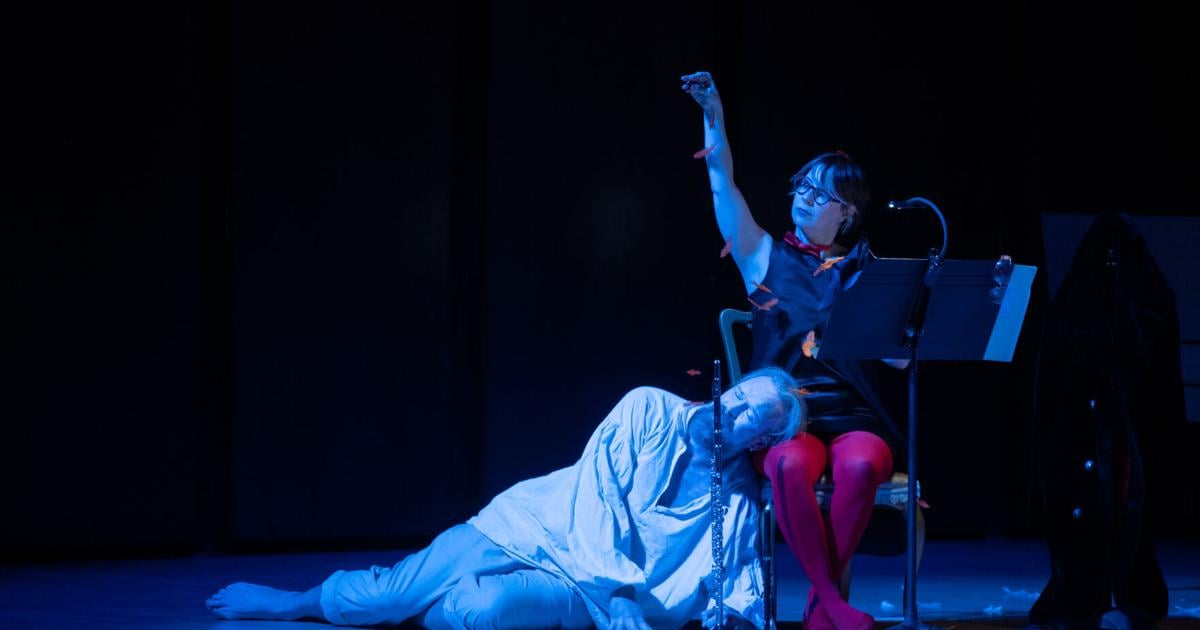
Eight Songs for a Mad King by Peter Maxwell Davies (circa 1970, the time of its composition) was performed on a chamber music festival double bill with Marc Neikrug’s Through Roses.
Another important difference: In Eight Songs for a Mad King, the six ensemble members become bird-like participants in the drama and interact with the monarch in various avian ways; in Through Roses the ensemble is upstage behind a scrim, suggesting the gauzy tissue of its protagonist’s mental state.
Stage director Tara Khozein worked wonders with Eight Songs, especially given the small amount of rehearsal time available to stage it and the fact that it was being performed without a conductor.
Khozein was aided by the Chatter ensemble’s whole-hearted embrace of their stage personae, especially flutist Jesse Tatum in her non-relationship with the King and David Felberg, whose violin was smashed by the King at the work’s climax.
Baritone Michael Hix offered an intense, commanding interpretation of George III, shifting performance attitudes and vocal styles with dizzying regularity. It’s considered one of the most challenging music-theater roles ever written, and, as fine as Hix’s performance was, I felt it was missing one aspect that would move it into true greatness — the opportunity for the audience to connect with the king’s humanity through his occasional realizations that he was, in fact, mad.
The distinguished actor and singer John Rubinstein reunited with Neikrug for Through Roses. They’ve previously performed it in Seattle, Santa Fe, and elsewhere, and their 2025 iteration produced emotionally devastating results.
The circa 45-minute piece ended to total silence in the auditorium, which continued for at least 45 long seconds. A single audience member began to applaud, hesitantly, then stopped.
Another long silence followed, until the audience sensed it was finally time to respond. It was an evening and an event I’ll long remember. ◀
A Carleton College alumnus, Mark Tiarks studied opera and theater in London as a Watson Foundation fellow, then served as artistic administrator of Opera Theatre of Saint Louis, producing director of Chicago’s Court Theater, general director of Chicago Opera Theater, and the director of strategic planning and marketing for the Santa Fe Opera.
Look for Pasatiempo’s fall arts and performance preview in the September 12 issue.
‘ The preceding article may include information circulated by third parties ’
‘ Some details of this article were extracted from the following source www.santafenewmexican.com ’