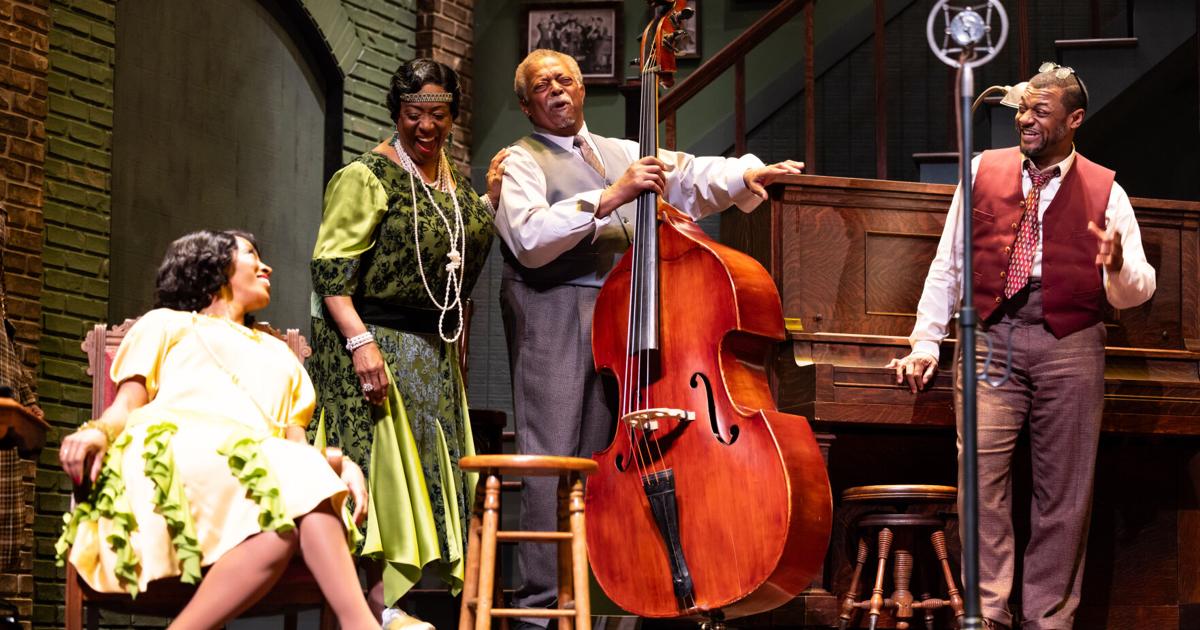
August Wilson’s plays sometimes make me impatient. His characters have so much to say and take up so much time saying it that their conversations can come across as extraneous or excessive.
Such is not the case with the superb revival of “Ma Rainey’s Black Bottom” at the Goodman Theatre as part of its centennial season. Chuck Smith, who directed the theater’s original production in 1997, is back and has such a complete command of Wilson’s style and tone that everything fits together perfectly. He’s teamed up with Harry J. Lennix, who played the troubled trumpeter Levee the first time around and here serves as associate and music director.
“Ma Rainey” also is a fitting choice for the 100th anniversary because the Goodman was the first theater in the world to produce all ten of the plays in Wilson’s Century Cycle exploring Black life, decade by decade, in the 20th century. Unlike the others, which take place in Pittsburgh’s Hill District, it is set in Chicago, in a recording studio in 1927.
Linda Buchanan’s set design visually and symbolically establishes the hierarchy at work here. At the top of the studio is a small control booth, the domain of the racist white producer Sturdyvant (Matt DeCaro), where Ma’s white manager, Irvin (Marc Grapey), sometimes hangs out. He tries to balance everyone’s needs and repeatedly tells Sturdy to leave everything to him, but the way he refers to the band as “boys” reveals his only slightly more subtle brand of discrimination.
In the middle is the main part of the studio, where Ma (E. Faye Butler) — or “Madame” as she insists on being called — rules once she arrives (late) with her “gal” Dussie Mae (Tiffany Renee Johnson) and her nephew Sylvester (Jabari Khaliq), who stutters. Down some steps is the basement, the band’s rehearsal space furnished with a piano, a row of metal lockers and some benches and chairs. The outside world is suggested by shadows of El tracks and street sounds courtesy of lighting designer Jared Gooding and sound designers Rob Milburn and Michael Bodeen.
Instructed to arrive at 1 p.m., the band members settle in the basement to wait for Ma so the recording session can start. They include guitar and trombone player Cutler (David Alan Anderson), the unofficial leader of the group, bass player Slow Drag (Cedric Young), who just wants to get the job done and go home, and piano player Toledo (Kelvin Roston Jr.), the only one who can read. They’re in their fifties, while Levee (Al’Jaleel McGhee), who turns up a bit later, is a couple of decades younger and hopes to form his own band to play his own songs, which Sturdyvant has promised to record, or so Levee thinks.
McGhee’s complicated, explosive, highly physical performance as Levee makes the show worth seeing all by itself. His relationship with his bandmates begins with a certain amount of levity, as they tease him about things like the new shoes he buys with money partly won from Cutler playing craps and whether or not he can spell “music.” But tensions, especially with Toledo, escalate after his revelation of a horrific incident, and the levee holding back his rage eventually bursts, sparking a misguided act of violence.
The other not-to-be-missed performance comes from the incomparable Butler in the title role. Totally aware of her power as an in-demand performer and her fragility as a Black woman in a world of greedy white men, she’s a tyrant whether she’s confronting the policeman who tries to arrest her as she arrives at the studio or making demands of Irvin, such as refusing to sing until she gets an ice-cold Coke.
Her default mode is screeching until she is obeyed, but she has gentler tones for those closer to her, especially the hapless Sylvester. She hopes to coax him out of his stutter by having him record the spoken opening on the title recording, “Ma Rainey’s Black Bottom,” much to the annoyance of the others who have to suffer through the many takes required.
Ma’s beef with Levee over which versions of her songs to play contributes to the play’s strife and ongoing drama, but director Smith mines the script’s considerable humor, too. I don’t know what the real “Mother of the Blues” — born Gertrude Pridgett (1886-1939) — was like, but Butler’s force-of-nature version of the woman who, unlike most of her contemporaries, wrote many of her own songs is a winner. She also eventually gets to sing a couple of them, which is icing on the cake.
‘ The preceding article may include information circulated by third parties ’
‘ Some details of this article were extracted from the following source www.hpherald.com ’