Raised in an environment of strong family bonds, constant travels and lively summers spent in Morocco with her cousins, it’s no wonder Manal Benchlikha developed a deep sense of both nostalgia and empathy. These qualities naturally shaped her into the artist she is today.“This emotional intelligence and psychological strength allowed me to separate my artistic and personal lives, and empowered me to face life’s challenges with steadfastness”, shares the singer artistically only known by Manal. Speaking of her latest release this month, Carton Rouge, she adds with a lot of assurance: “This song represents my way of dealing with people who no longer deserve a place in our lives without explanation – we simply give them a red card. It’s a risk for me to come back after a year with this style, but that’s exactly what excites me with every release: reinventing myself and discovering new colours.”
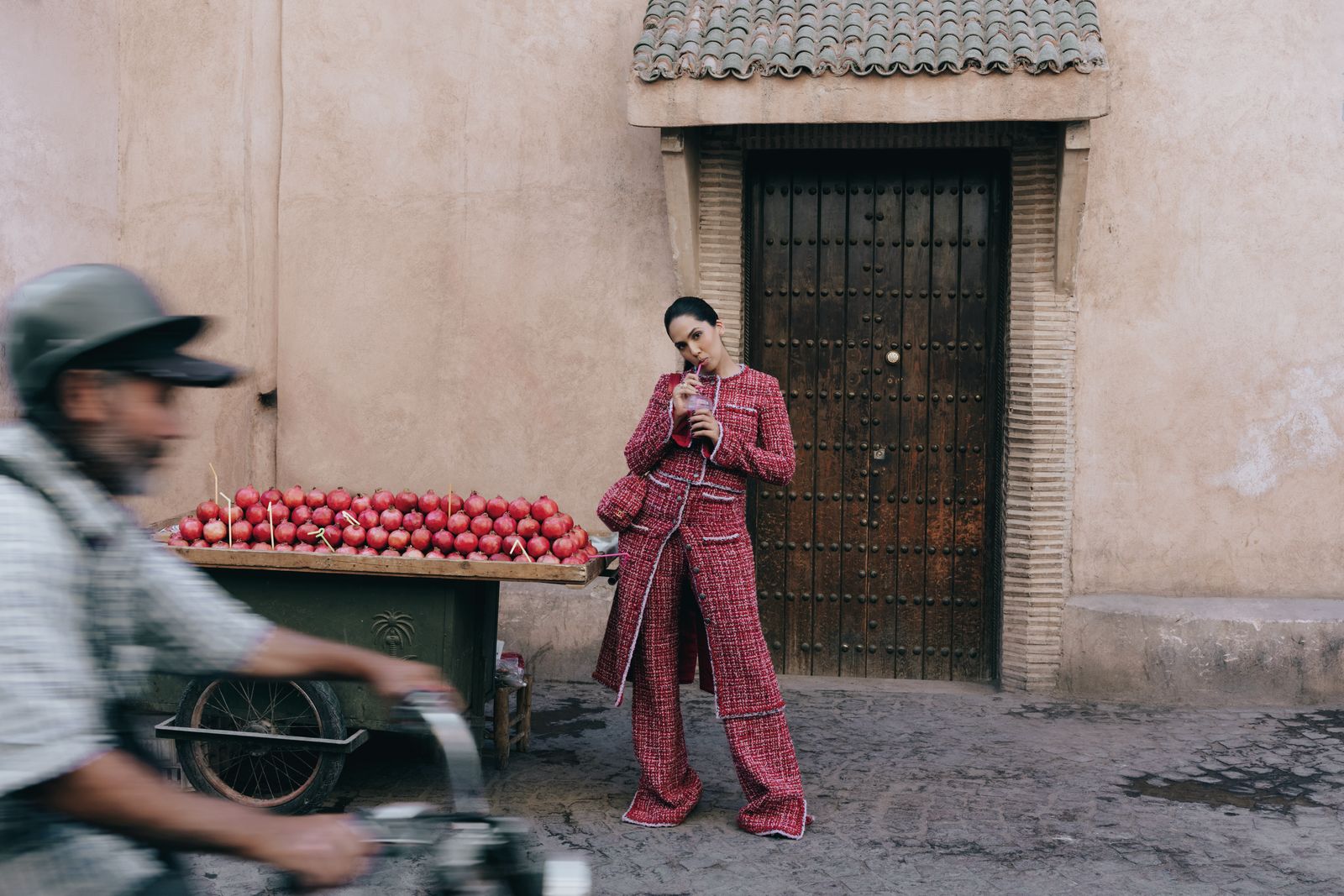
On a warm day in the medina, wearing head-to-toe red Chanel next to a pomegranate stand, she reflects on the profound impact of her father’s passing, describing it as a wound that “remains particularly deep in a daughter’s life.” This loss, while a source of immense grief, ultimately gave her a strength she would never have found otherwise. His absence taught her a harsh but valuable lesson about the fleeting nature of life: an experience which, rather than breaking her, helped mould her into the resilient woman she is today. She continues to be guided by his advice, calling it a “human compass” that always pointed her toward the importance of education and hard work. Her mother, too, was a pillar of strength, teaching her timeless lessons in modesty and sincerity. “What they taught me goes beyond words to form the unique foundations of my personality,” reveals Manal.
From her debut with the heartfelt single Denia in 2015, Manal has evolved into a powerhouse in the Arab music scene. Her early success with tracks like Kulshi Ban and Taj set the stage for her first album, 360 in 2021, which gained millions of views and cemented her as a major musical force. 2022 was a landmark year for Manal – she collaborated with rapper Tagne on the hit song Maak and made history as the first Arab artist to perform on the Colours platform with her track 3ARI. She also contributed to the official World Cup anthem and delivered a stunning performance at the closing ceremony. The singer’s 2024 album, Arabian Heartbreak, marked a new artistic direction, exploring the emotional lives of Arab women. Her work has earned her international recognition, including the Nickelodeon Artist of the Year and Billboard Arabia awards, showcasing her significant influence in Arab music.


Over the past 15 years, Manal has matured both as an artist and as an individual, completely transforming her relationship with music. While it once served as a refuge from pain, it has now become a way for her to celebrate joy and happiness. Manal recalls her debut single, Denia, which she wrote in 2010 with her mother, a person who believed in her daughter since gifting her a guitar when she was a child, and who later on produced her Kulshi Ban video. This early work was a deeply personal expression of her grief, after her father’s passing. Family support was a key foundation to her career and stability; it helped her achieve stardom and artistic maturity, allowing her to explore new genres like rap in songs such as Taj and Slay, breaking free from her previous “good girl” image. As she puts it, “Music has no limits. I never hesitated in trying new types of music.”
Manal’s Moroccan identity is a natural part of her music; it doesn’t require any forced effort. She believes that simply by writing in the Moroccan dialect and using traditional Moroccan beats, she can showcase her country’s rich culture. As a young artist, she feels it’s her duty to lead, break barriers and pave the way for future generations. “I want to be a pioneer,” she says, “to take risks and to leave room for those who come after me to offer more and go further.”


With an international spirit, a commitment to high quality and deep pride in her country, she feels a responsibility to promote Moroccan music and help it reach a global audience. In her songs, Manal shares personal experiences in a way that resonates universally, connecting with her listeners’ own stories. “I am always inspired by stories of people around me,” she says. “Listeners feel that I am singing about their own experiences, not just mine.”
‘ The preceding article may include information circulated by third parties ’
‘ Some details of this article were extracted from the following source www.voguearabia.com ’