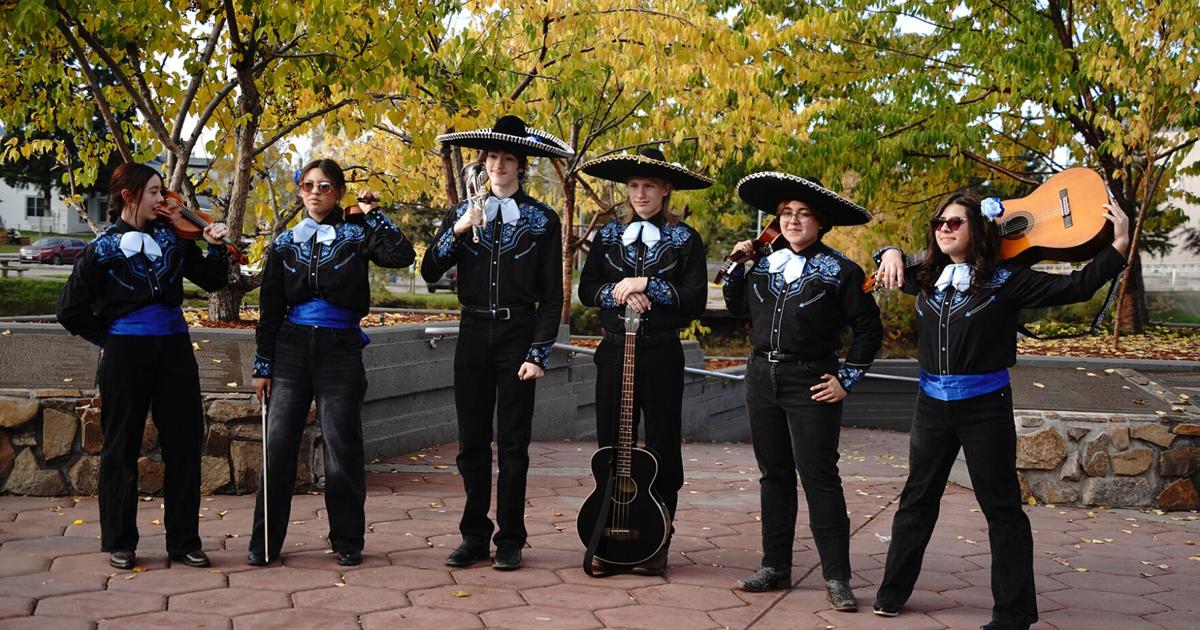
Mariachi music has deep, rich roots in Mexican culture — and a distinctly unique mark on the Fairbanks landscape after a West Valley High School student took a bold leap for a world music assignment a few years ago.
During an interview with Alaska Live’s Lori Neufeld at the KUAC Alaska Live Archive Studio, five members of the band were prepping for their performance.
Erika Sabarzo-Bernal formed Mariachi Nomeolvides in her sophomore year as an option for a West Valley music class. The band is named after Forget-me-not (or Nomeolvides), Alaska’s official state flower.
“I thought, why not start a mariachi band if I’m allowed?” Sabarzo-Bernal said. With the help of music teacher Gwendolyn Brazier, she put together a group to perform.
Now a senior, the lead vocalist and guitarist has formed an emerging band of fellow students that cements itself as Fairbanks’ first mariachi band.
Sabarzo-Bernal said she grew up with “so much music,” including mariachi. She said she sang along to mariachi music with her father on drives to Anchorage or growing up in Arizona, learning guitar with her mother and for church performances.
“The ability to perform and be able to share this with the Fairbanks community is just wonderful,” Sabarzo-Bernal said. From her perspective, mariachi is a blend of folk and classical music.
“You can hear the notes sliding into notes and a wide bravado, which are two styles put together,” she said. “The trumpet is the only brass, the rest are all strings, so having it there makes mariachi such a wonderfully combined ensemble.”
She described the singing as a whole as “rough around the edges” and bold.
“Even if you’re singing in a group, everybody is meant to be heard,” she said. “You want to show your emotion, so a lot of belting and bravado is very common.”
Mariachi Nombreolvides has garnered some recognition, including winning Fairbanks Got Talent, high school music competitions, and performing in large shows such as Dark Winter Nights. Since then, the band has grown its reputation and its schedule.
“We’re pretty swamped this year,” Sabarzo-Bernal said. “It took us some time to get these opportunities.”
During the band’s Alaska Live performance, five of its members were decked out in matching blue floral-accented shirts with matching blue ties, with Sabarzo-Bernal and violinists Sophia Potter and Leia Hulbert wearing blue ties, while trumpeter Drake Neilling and vihuelista Nahoa Kalani Hoodecheck were wearing black sombreros.
Neufeld, a veteran broadcaster, directed the band on which microphones would be used and which ones the members would speak into.
“I will name him mic Gary,” an energetic Hoodecheck said of the nearby performance mic. “Gary will help me through this.” The interview microphone: Vanessa. “I feel like Vannesa will be the translator.”
Hoodecheck, a Fairbanksan whose family comes from Hawai’i, said a lot of his music bears Pacific Islander influence. Mariachi was a genre foreign to him before he joined the band. However, he noted the ukulele and vihuela share similarities.
“I leveled up a string, but the transition was easy,” he said.
Hoodecheck knows Sabarzo-Bernal from when he was a dancer performing at her quinceañera. It was Sabarzo-Bernal who invited him into the band in March 2025 and first played in the Dark Winter Nights performance.
“It’s like she was scouting me for the past three years,” Hoodecheck said. Aside from string instruments, he also plays percussion instruments.
Hoodecheck’s interests lie in ecology, stemming from a childhood passion for consuming documentaries and National Geographic magazines.
Before the live broadcast, Sabarzo-Bernal chatted with Neufeld about attending an Alaska Live concert of “Choir! Choir! Choir!” a few years ago as part of a class.
“It was a folk music band,” Sabarzo-Bernal said. “That was cool.”
Sabarzo-Bernal said the band only knew three or four songs when starting out and it was a learning process, especially for songs performed in Spanish. She is responsible for selecting the repertoire of songs, a task she undertakes with the help of her parents.
“Usually, I’ll scour for music,” Sabarzo-Bernal said. “Some of them I know and some I’ve never heard before.”
Violinists Sophia Potter and Leia Hulbert joined Mariachi Nomeolvides at the same time. Both grew up training together with an emphasis on Suzuki and classical technique.
Potter was performing a classical piece at the same musical competition as the band when she became curious.
“Mariachi opened up my eyes to different kinds of music, because Leia and I only played classical music before we were invited to play in the mariachi band,” Potter said.
Potter said mariachi music has a much wider bravado on the violin compared to classical music.
“A big difference is we’re allowed to improvise and make our own parts,” Potter said. “With orchestral style, we’re supposed to stay strictly to the composer.”
Hulbert said Sabarzo-Bernal was the inspiration to join Mariachi Nomeolvides after its founding violinist graduated from West Valley.
“I was sitting with Sophia and remember everybody mentioning how loud and well-projected Erika’s voice was,” Hulbert said. “Kids from Anchorage were looking at each other and going ‘holy cow.’ She didn’t have a mic or anything, just full-on projection into this giant auditorium in West Anchorage.”
She said the music ignited an interest in her.
“Joining with Sophia definitely made it easier with the transition of music style,” Hulbert said. “I was very used to just following the dynamics and suggestions of composers. Being in a mariachi band sometimes made me quite frustrated. How am I supposed to know what do?”
Above being lead vocalist and band leader, Sabarzo-Bernal decides the songs and song order, introduces the band members and serves as wardrobe designer. Hulbert noted that Sabarzo-Bernal “put a lot of effort into making us look professional.”
“These are not traditional mariachi outfits, because those are very expensive,” Sabarzo-Bernal said. “They are often entire suits that are embroidered on the side with metal.”
Sabarzo-Bernal said she’s pleased that Mariachi Nomeolvides’ wardrobe is something “that is not so traditional.”
“These are more like banda outfits with a mariachi twist,” she said.
Listening to mariachi music offered a solution for improvisation.
Neilling, the only other original band member, has played trumpet for seven years. He joined both the Lathrop jazz band and Mariachi Nomeolvides as a freshman. He also participates in Lathrop’s symphonic band “and many other things.”
“When I started high school, I began opening up to a lot of new genres,” Neilling said. “I learned to play by listening to mariachi trumpet and recordings, as well as looking up online tutorials. A single in-depth explanation helped immediately.”
Sabarzo-Bernal, now a senior, graduates in May. She noted that some of her band members intend to leave Alaska when they graduate in a few years. Sabarzo-Bernal said she may as well if presented with the opportunity “if a good scholarship opens up or I get to join a famous mariachi band.”
“I also wouldn’t mind staying here an extra year with these guys since some of them are still juniors,” she said. “I hope that if I ever reach a professional level, I do want to keep the same spirit of the band. You never see a famous mariachi band from Alaska.”
‘ The preceding article may include information circulated by third parties ’
‘ Some details of this article were extracted from the following source www.newsminer.com ’