Some say that the original reason for the tradition of clinking glasses is that wine incorporates all the senses except sound. We look and we smell, there’s taste when the liquid touches our tongue and touch with the feel of the glass against the fingers. But sound, the logic goes, is not part of the experience. Champagne is the exception. The pop of the cork, the busy hiss of the bubbles announce an important truth: fine champagne is easy on the ears as well as on the palate.
The champagne house Krug has long known this, and has translated its love of music, together with its belief that it can pair with its champagne just as well as food can, into various collaborative projects. To mark the exceptional 2008 vintage, Krug’s cellar master Julie Cavil has worked with the composer, pianist and producer Max Richter to create a dialogue that is, in every sense, fruitful. Every Note Counts is a triple celebration of the 2008 harvest. There is a solo piece to express the single grape variety of Krug Clos d’Ambonnay 2008. A chamber piece, to recreate the lime-zest purity of Krug 2008. And Richter has composed a symphony to celebrate the Grande Cuvée 164ème edition, the house’s fullest expression, which was assembled from 127 wines across 11 vintages.
Creating these three expressions of Krug, all so enticingly easy to drink, required a great deal of hard work. “Max is very serious, he is obsessed with detail,” Cavil says. “But when you listen to his music, it’s effortless.” She was enchanted by his talent for experimentation in works like Sleep, a mellow composition that lasts over eight hours, and is intended to be listened to by people who are … asleep. “His music is classical with a twist,” she says, and that is how she sees the 2008 vintage. On the one hand, it was a quintessential cool-climate vintage, and the wines are as elegant, pure and restrained as you’d expect — the twist being that, given climate change, there will probably be vanishingly few vintages like that in future.
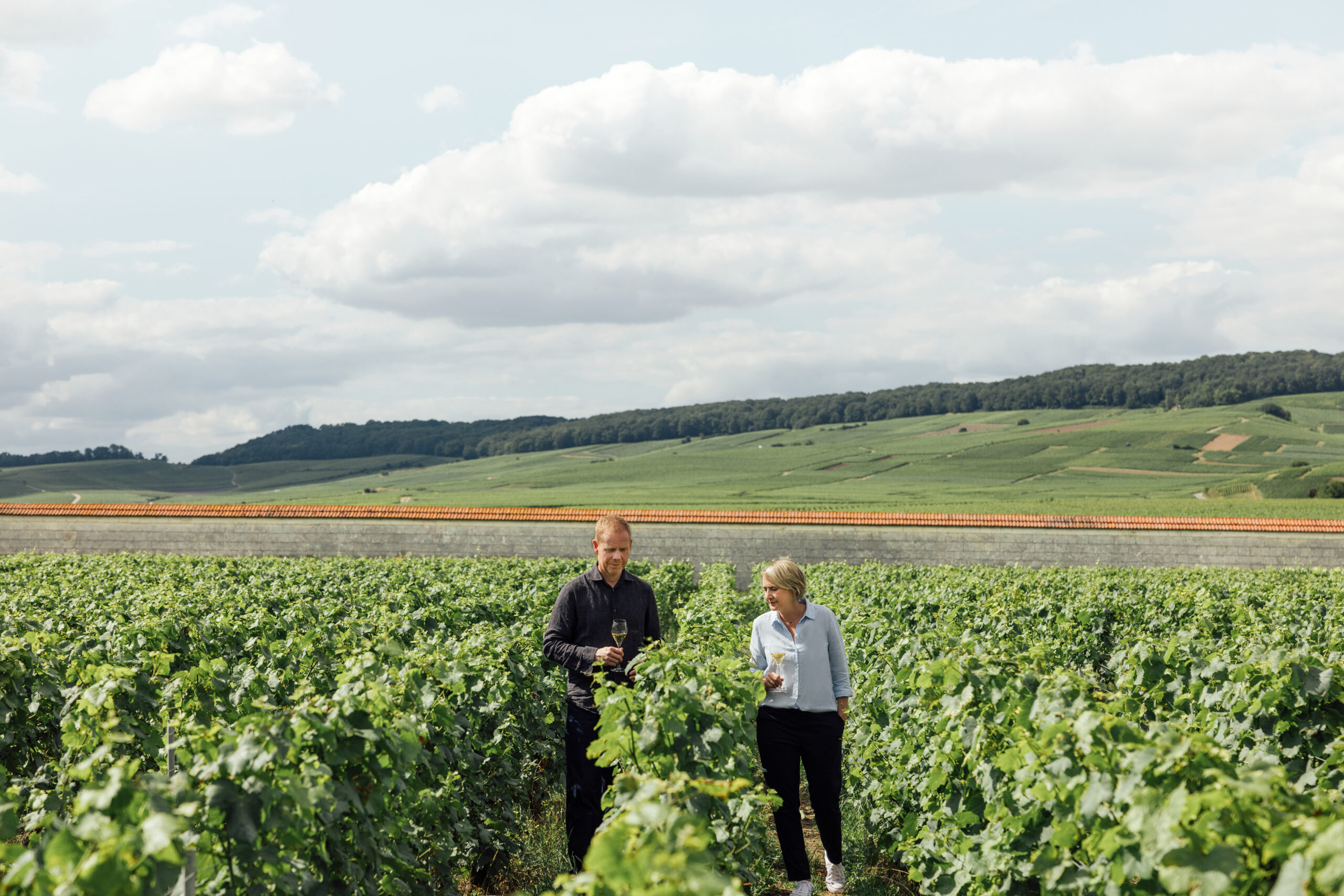
Max Richter and Julie Cavil
“I think that Krug does have a kind of a classicism, if I look at it through the lens of music,” Richter says. Music, after all, is a historical form. “We learn from the music of the past, we remake it by pushing at the boundaries of that pre-existing language, enlarging it and repurposing it for our own time.” He was struck by the same spirit of discovery at Krug.
There is the human element too. “You have very dedicated, passionate people making the fullest use of their craft and curatorial vision,” Richter says. “And I thought that was really beautiful.”
To prepare for the project, Cavil visited Richter in his Oxfordshire studio, and he went to the Krug house in Rheims and toured its magnificent new facilities in Ambonnay, a village famous for its pinot noir. “We went to see the old cellars, which hold incredible bottles from decades or centuries ago, and then the new winery, located right in the vineyard, which is so special. It’s an immersion in a different universe.” It reminded Richter a little of his studio. “Normally as a composer you write your music and then go elsewhere to record it. But we’ve built this studio in the woods where I can do absolutely everything.”
Cavil too was surprised by the similarities, in two entirely different places designed for such supposedly dissimilar areas of creativity. “What amazed me in Max’s studios were the views — it’s very connected with nature.” Just like at the Krug tasting room, which looks out onto the Ambonnay vines, there’s a direct connection between land and vision and flavour. “Max told me that when he tasted Krug, he saw that landscape.”

Krug x Max Richter’s three expressions to celebrate the 2008 harvest
They both learnt a lot. “I don’t speak the language of music,” Cavil says. “I don’t have that vocabulary. And Max doesn’t know exactly what is behind every note or flavour we encounter in the tasting room. But it was obvious to me that each plot has its own sound, and we worked a lot on pinning that down. If it’s a chardonnay from the Côte des Blancs, it could be a clarinet, while perhaps the same variety from Marmery would be a bassoon.” This way of thinking with music helped her to realise that when she is tasting the different component wines that go into the Grande Cuvée, working out which should be included and in what proportion, she is essentially composing a symphony.
“Now, when I think about Krug, I have a view in my mind, as well as a taste,” Cavil says. “I can see the colour and the texture, and I can also hear the sound.” And for Richter, while the experience of drinking is fundamental to Krug, “it isn’t just about that”. His third child was born in 2008, an event that was toasted, as all his children’s births have been, with a glass of Krug. “You open a bottle of Krug at a special moment for a special time or person, and it’s associated with joy. That luminosity, that brightness, was very important in the music. That dictated the orchestration and the way I used the instruments throughout the composition, so that the music feels bright. I tried to reflect that feeling of the light hitting the glass. And there’s also the sparkle: you try to find that.”
Champagne, after all, has always made music, and now here are three pieces of music that make new sense of champagne.
Krug’s three 2008 expressions are available from Oct 15. Max Richter’s musical pieces, along with a documentary about the Krug x Max Richter collaboration, will be revealed in February 2026
‘ The preceding article may include information circulated by third parties ’
‘ Some details of this article were extracted from the following source www.thetimes.com ’