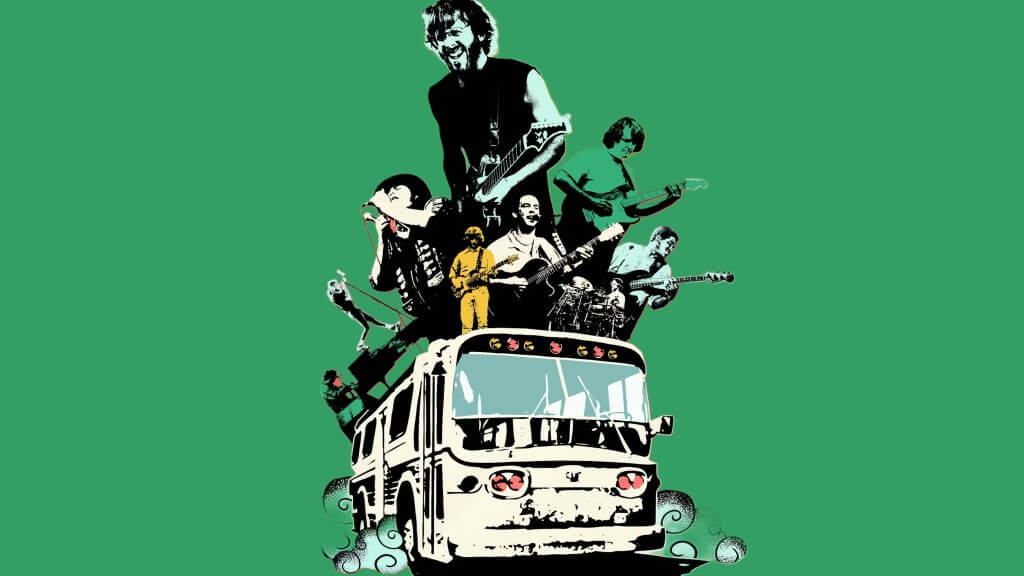
Audio Books is a column focused on the latest books about music. Every other month, Grant Sharples sits down with authors, journalists, and poets to discuss the latest music memoirs, biographies, essay collections, and more.
Allow me to preface this by saying that I am not a jam band guy. Even as a devout music obsessive, I feel like jam bands occupy a world of their own. It’s a type of fandom that seems to require a dense, encyclopedic knowledge of the most niche information. Which year in what city has the best performance of this random B-side? Do you have four hours to spare to listen to a relatively inessential bootleg? What are your twenty favorite Grateful Dead shows? Where does a jam band neophyte even begin?
But for a realm that seems so daunting and impenetrable, the jam band universe, paradoxically, seems rather welcoming. It’s a deep-rooted community that gathers around a shared love of a particular cohort of artists. There are progenitors like the Dead, Phish, and Widespread Panic; and there’s the new-school vanguard led by Billy Strings, Goose, King Gizzard and the Lizard Wizard; and there’s a Nineties faction in Blues Traveler, Spin Doctors, and Dave Matthews Band. Mike Ayers’ oral history, Sharing in the Groove, concerns itself with this latter group. Until his book, this was a heretofore undocumented scene that flirted with radio success only to shirk it for cult followings. For the layman, these artists were one-hit wonders, but, as Ayers demonstrates, they’re much more than that. This book is ultimately about the unifying power of creative communities, how an underlying impulse for artistic expression can bond people who may have otherwise never met.
For this month’s Audio Books column, Ayers joined me over Zoom to talk about how he got into jam bands, why he wanted to focus on the Nineties crop in particular, how these groups navigated radio success, how “jam band” went from a pejorative term to something to be embraced, and where the jam band-curious can dive properly into this world.
******
Paste Magazine: Do you feel like there’s been a shift away from “jam band” being a pejorative term, similar to how “emo” was, to something beloved and even charming?
Mike Ayers: It’s a good word to describe it, like being a charming thing to be a part of. Whereas, you know, thirty years ago in the Nineties, it was underground. You think of Pavement and indie rock and Elliott Smith and all those sorts of things driving the underground. But all these acts that were coming of age in the Nineties, most of them didn’t have a lot of radio ambitions. They didn’t have a lot of MTV ambitions. They lived on college campuses. Their music was spread organically through fans, through like trading tapes. It was done outside of these very traditional means. And, yeah, the sounds were different from Fugazi. The sounds and the lyrics were different. They dressed differently, but a lot of it was the same as any other underground music act.
Fast forward to thirty years later: The fruits of being so ripe on college campuses… now, the people that were in college at that time are in their late thirties, forties, fifties, and they like what they like. They can still go see these acts. They still are crushing it live and playing as much as they could, and people still show up. Now you have acts that grew up listening to them. They were playing small places. Now they’re playing in big places. I mean, Billy Strings is a perfect example of an act that’s playing on Ringo Starr’s albums but also sits in with Phish and sat in with [Widespread] Panic, and vice versa. The older fan base is excited again, the younger fan bases that are all about Billy and maybe weren’t old enough to travel around and see Phish and Panic in the Nineties, you know, gets them rediscovered. You’re discovering the bands that their new heroes love. Goose is the same way, but Goose will cover the National, Radiohead, and Echo & the Bunnymen in a show. Two years prior, they were touring with Trey [Anastasio] from Phish. There’s a lot of nice, mutual respect going.
I was wondering where you saw jam bands’ culture today, and Billy Strings and Goose are both excellent examples of that. Billy Strings has that hometown Michigan festival, for instance. Do you see that community going down through generations, like a passing of the torch?
Kind of, yeah. Phish is a great example of a band that was existing outside the mainstream, did things their own way through a festival in the middle of New York State in 1996, and there’s very little media attention. It was way off the beaten path, and seventy thousand people showed up with virtually no marketing while Lollapalooza and all those things are these national touring festivals that are hitting up every amphitheater. Phish could do it with seventy thousand people in one place. Fast forward to now: Goose is playing Mexico [in May], King Gizzard and the Lizard Wizard, who aren’t super jammy but have cultivated a jammy following, have a festival that is now in, I think, Buena Vista, Colorado. It’s every summer now; last summer was the first one. It was so successful. They are doing another one this summer. And I was out in Colorado a few days after that happened, and I met some people… it was as if they had, like, seen the Second Coming, like they were talking about this as some sort of Mecca utopia for Giz fans. A stream ran through everything, and it was just so serene.
But then Gizzard was crushing it for a couple days, and it was in the middle of nowhere, and all of that stuff. It speaks of what Phish was doing because they thought it was like the right thing to do for fans, and if it failed, it failed. That was their thing, like, “OK, if it doesn’t work, it doesn’t work. That’s cool.” But eighty-five thousand fans showed up in the Everglades for the start of the New Year, from 1999 to 2000, where they played all night. They hit something, and people kept showing up. So, yeah, I think Billy’s a good example. Gizzard is another example of these bands that are just doing it themselves. It’s just like this very DIY ethos. The tape-trading thing that Phish and [Widespread] Panic and all those bands had back in the Nineties doesn’t really exist these days. I mean, you can get anything you want online as downloads. But King Gizzard has been saying, “Yeah, you can bootleg our shows and put it on vinyl and sell whatever amazing variant you want. Just send us one.” It harkens back to that community ethos of sharing music. Back in the day, though, there was a big, strict code where you couldn’t make a profit on it. Gizzard isn’t even saying, “Don’t make a profit on it.” Like, if I’m a record store and I want to print five hundred copies of their show on vinyl that has alligators all over it, I can do that and sell it. Just send them one.
That almost kind of encourages the communal aspect of it, too, where it’s like, “We also want to be a part of it. Send it to us. and share it with people.” It’s almost like a version of the tape-trading thing.
Totally, yeah. So like these little community-building things, it’s not the same, but it has connective tissue. I think it has connective threads. Billy is so pro-fan. I can’t go a month without seeing an Instagram Reel that pops up in my feed of Billy at somebody’s barbecue or in the parking lot before the show playing with fans or singing. Phish used to do that.
I know someone who has seen Billy Strings, I think, twenty-something times. And I remember hearing that at first and thinking like, “Oh my god. This is jam-band, Phish-level, Grateful Dead-level, hardcore fandom. And the live aspect of it seems as important, if not more important, than the studio recordings.
It is, yeah. They love studio records. I mean, they grew up on them. Any musician you know is going to love a studio record. I think now more than ever, at the end of the day, they know that [live shows are] where their fan base exists, that’s where the community is, and that’s where they find meaning. They find meaning with each other and find meaning with the music and seeing it happen in real time and not knowing what’s going to be played. It continues to spark this fandom that can be casual, but it also can be super obsessive in a good way.
It can be very obsessive and almost impenetrable, but it also seems very welcoming, like that’s such an interesting dichotomy. Do you think that welcoming aspect almost offsets the insularity of it a little bit?
Yeah, it does. Just to go back to the tape-trading: When I would get a tape of some show that I thought was incredible, my friends or people I knew in my life that either liked Phish or needed something to get them into it, I knew their tastes, and I could say, “You will love this. I promise you.” Having me sign off on something and saying, like, “I know I know you and I know you will like this. You may not like Phish, but listen to them cover the White Album and tell me that this is not incredible.” That’s the kind of mentality. The Billy thing, like, I was down in Baltimore for one of his shows back in the fall, and I met this couple beforehand, and they were like, “This is our twenty-second Billy show.” I was like, “Damn, that’s a lot. Good for you.” And they were like, “Yeah, this is our ninth this fall.” They had planned their PTO and did a bunch of his shows in Europe.
The artists also know, at least in this world, they don’t have to tour every single night. Once they get to a certain level, they don’t have to play every single night and be on the bus and play one show, one show, one show, one show. Like Billy, if you look at his tour itinerary now, he’s really just doing weekends, right? So he knows people can fly in and make a weekend out of it. [Widespread] Panic has been doing this for a long time, where they don’t really [do] a traditional tour anymore. They just have weekends throughout the years, and some of them are in places they haven’t played in a while, and some of them are just iconic places in jam-band and Panic lore, like Red Rocks [Amphitheatre] at the end of June three nights for the last like twenty-five to thirty years. That’s what they do. People plan around that. Phish is kind of the same way at this point. So I guess these are the older acts, but they’re just smarter about how they’re touring right now and leaning into how fans want to experience music, and they won’t play the same [set] if you show up on a Friday and are going to see shows on Friday, Saturday, and Sunday. They will not play the same song, like you will not hear a repeat. That’s also attractive.
And that’s a huge incentive to go to all three of the nights, too.
Metallica has been branding that, as well. They did a no-repeat weekend at MetLife Stadium a few years ago. I don’t know how it stands now, but when they first announced the first month of the Sphere later this year, it was a no-repeat thing, right? Those are artists that, typically, you don’t really go into that world.
It’s a novelty for them.
Yeah, it’s a novelty. But they actually know at this point that’s a huge selling point to their fans. Their fans would love that. Fans want to hear the deep cuts. With the jam community, they know that fans savor that sort of stuff, that uniqueness, and you even see it with how bands play their classic album, like an anniversary. I feel like, like, ten to fifteen, years ago, it was kind of looked down upon. Do you think that? Do you remember that?
I’ve noticed that, and I feel like lately, one gets announced every few months. The past five years, it’s been like that.
I think people want it. I saw Cat Power do The Greatest a few weeks ago, and that’s one of my favorite albums ever, and I hadn’t listened to it in probably two or three years. I didn’t need to. I showed up, and I knew every single moment of that album, because I had listened to it. It was just such a part of my life when it had come out, and it was wonderful. I never thought Bright Eyes would be doing that, but now they’re doing that this year for [I’m] Wide Awake, [It’s Morning] and Digital Ash [in a Digital Urn].
So I’m curious how you got into this scene itself. Where do you remember first hearing jam bands?
In high school in the early Nineties, everybody was obsessing about what we called “classic rock” at that point: Pink Floyd and the Dead and Led Zeppelin and the Beatles and the Doors, all that sort of stuff. The Dead were still touring, so I went to my first Dead show in ‘93, and I just thought it was wild. I loved it, and the energy was amazing. I really started to go down the Dead path. They had so much you could learn, and you could still see them, which was obviously a huge selling point. I started reading Relix Magazine and got that at Tower Records. I think they had an ad for Phish’s Hoist, which came out in ‘94. I wasn’t able to hear it, but I bought it because Relix was saying it was great. That’s how I started getting into Phish. When I got to college, it exploded. I went to college at Virginia Tech, and Dave Matthews was just coming up, and he was from Charlottesville, two hours away. So everybody on campus was talking about Dave Matthews. And so there was this scene starting to bubble up. I’d go to these early Dead and Phish forums, like the precursor to Reddit, called like, rec dot music, dot fish and rec dot music, dot dead, and you’d see people posting set lists and talking about that night’s show or whatever. You’d see John Popper sat in. So you start to connect threads on these early online message boards. I started to go out and see these bands as much as I could. That’s how I spent the Nineties.
Is that why you wanted to hone in on the Nineties jam bands, given that it’s the era you’re most familiar with? Also, from my perspective, their story hadn’t really been documented all that much compared to their progenitors.
Yeah, it hadn’t really been told. I liked the idea of the end of 1999. It was such a unique time. It was almost like this end of—it sounds corny to say—but this end of a certain age, or end of a certain innocence/ Napster was about to crush the music industry, right? Y2K was this crazy thing where you thought everything was going to fall from the sky and we were going to not be able to eat for years and not be able to get money out of an ATM. We didn’t have a camera in our pocket. We didn’t have the ability to communicate with everybody all the time. So it was this last breath of air before things really started to change. Four years later, Facebook started out as a university site. Those are the early days of social networking.
Here we are, twenty years later, and it’s still a whole different story. But that was the end of this time that people just weren’t connected to each other the way they would be even just a few years later, and they were connecting to people in real life, and connecting to bands, like getting in the car and driving five hours to see a band, and that was considered a short trip or totally worth it. All of those things that were amazing but also fueled this culture. It fueled these artists to have a career then and still have a career now. Whatever music you discover when you’re coming of age, it grabs you. And you may let go of it for a bit, but there’s a good chance it’s going to come back around and continue to grab you. It’s great.
So how did you settle on the oral history format? At what point during putting this book together did you decide how to structure this?
Right from the beginning, before I even did interviews. I like those books. I like Meet Me in the Bathroom. I think that’s a great book. Please Kill Me is an oral history Bible. It’s a really fun way to get into a narrative. I could tell a story, but at the end of the day, I felt like people would rather hear from the people’s mouths that were there, and I don’t think they were disappointed.
You’re letting them tell the story, but you’re also organizing all of the information and framing it. What was that process like? You did so many interviews, so how did you go about finding a coherent narrative to present all of this?
That’s a good question. I had these signposts before I started that I knew were these really big moments in that world, and they could have been big moments in my memory, but not everybody else’s. I guess that was a gamble, but I did know that there were big moments that were really interesting [and] I could talk to people about and start pulling these threads: getting on MTV, signing a record deal, getting in a van and playing your first show outside of your city, Jerry Garcia dying, Y2K… [Widespread] Panic played a free show in Athens in April 1998 that one hundred thousand people showed up to. That’s a signpost. There are these moments that just felt like they were really big moments. So I would start with that, like asking folks about that.
I also thought that asking folks about their first recording experiences was important because a lot of them were starting in the Eighties, and that was the path. The path was: you made a record, and the record was a type of ticket. Now, they practiced live and played live incessantly. That became a focal point of their fandom and where they excelled. But they all were trying to record a great demo, record a great studio album, send those out to clubs for booking, send those out for radio. They didn’t have a means of distribution that existed anything like it is today. It was small. You had to get your music out there, and the radio station isn’t going to pay attention to a bootleg set. So we had these signposts. Through interviews, people would tell me things that I didn’t really know about, and then that would open up new chapters and new ideas that I could ask other people about, as well.You had to go in knowing that you want to hit these things but be okay with not knowing what’s going to come because you’re going to get unexpected stuff that you need to start pulling on with other people. It was fun. Different things stand out to different people in their memories.
It’s interesting that you mentioned the radio not playing bootlegs. But this Nineties crop of bands had hits on the radio, like Spin Doctors and Blues Traveler. How did they navigate those two worlds that almost seemed contradictory to each other?
Well, the radio and MTV swallowed up the Spin Doctors. They were playing on the H.O.R.D.E. tour in ‘92, and then in ‘93 they played with Soul Asylum and Screaming Trees on the MTV Alternative Nation tour. There was this hard left branding that the label, the band, and a collection of folks leaned into. Blues Traveler, when they broke, already had three records out. For Spin Doctors, that was their debut album. I don’t know if you remember, but the drummer from Blues Traveler, Brendan Hill, was like, “I will sometimes be in a Walmart or an elevator and I’ll hear the Muzak version or even the real version of ‘Run-Around,’ and I’m still incredibly proud that we are associated with the fabric of that decade.”
Whether or not you’re a super hardcore fan, or your memory is saying they were a one-hit wonder, they had such a mark on that culture. I was thinking of the Mazzy Star record this morning with “Fade Into You.” I bet most people, a vast majority of people, just consider Hope Sandoval and Mazzy Star a one-hit wonder. [So Tonight That I Might See] from front to back is one of the most incredible things. “Five String Serenade” was the song for me then. I guess as time passes on, people have certain memories of what was what in terms of pop culture or whatever. [Some people] heard them in the Gap, but for other people, Blues Traveler was on New Year’s Eve. In 1996 they went to Madison Square Garden and rocked out for a couple hours.A bar band in New York City five years later is playing the Garden, for New Year’s.
The whole one-hit wonder label is so fascinating simply because, to a lot of people, maybe they are a one-hit wonder, But to a lot of other people, they’re a great band with a lot of killer songs. Somebody asked me years ago when “The Middle” came on. They’re like, “Oh, is this a one-hit wonder?” And I was like, “Absolutely not!” I went to bat for Jimmy Eat World. I guess for some people, Spin Doctors or Blues Traveler would be a one-hit wonder, but with jam bands, there’s a whole community of people that would argue otherwise.
One hundred percent. Oasis is another great example. A lot of people will probably be like, “Oh yeah, the ‘Champagne Supernova,’ ‘Wonderwall’ band.” But I went and saw one of those recent shows, and it was a two-hour singalong for every single lyric. Sixty thousand people were there. Dave Matthews Band was probably the same way. They were probably considered a radio band as the Nineties wore on. But they’re still selling out arenas, and their fans love the hits, love the Nineties stuff, but they obsess about the deep cuts, as well.
If somebody is daunted by jam bands, but maybe they’re jam band-curious, what would you tell them? How would you recommend that they get into this world?
It matters what world you come from. If you’re coming from the indie world, you probably could come to the Dead through Real Estate and the National. They did a Dead cover album, it was massive. In 2014 the National curated it, and there were great indie artists on it. And then you could go into My Morning Jacket. They’re very jam-adjacent. I don’t think their songs go over ten minutes, but then you could go into [Widespread] Panic if you like Neil Young. If you’re into Pavement, and you like the indie stuff, and you like Ween, then maybe you could go into Phish, or if you like King Gizzard, you could start dabbling into Phish’s back catalog. The good news is that the sky’s the limit on the influences they have. I saw a clip circulating a couple years ago, Trey from Phish played a benefit [show] or something, and he covered one of Mitski’s best songs. They’ve been doing a cover of TV On The Radio’s “Golden Age” for like thirteen years at this point, which can stretch into twenty-five minutes, twenty minutes. Their tastes are very omnivorous. Trey is a huge Big Thief fan. When I interviewed him for this book, at the end, he was like, “What are you listening to?” and I was like, “Big Thief.” And I was like, “What are you all about right now?” And he was like, “Geese.” Not Goose, but Geese.
Not the jam band?
Yeah. He likes Goose, but right now, it’s about Geese. And he was like, “Do you know 3D Country?” And I was like, “No, I don’t.” He was like, “That’s your homework. Go listen to it.” This was way before Getting Killed. He’s such a champion of creativity and is looking for people doing creative things. So there’s these indie bands, and there’s all sorts of bands that flirt with these worlds. And I know it all kind of runs together at this point, which is cool.
I still remember when Phish covered “White Winter Hymnal,” and there were headlines all over the internet about it.
I think they did it a cappella, as well. I remember Robin Pecknold posting something about it. It all kind of blurs together now. I think that’s cool. If there’s one good thing about the internet, it’s at least given people a little bit more access to different sounds.
All the bootlegs are right there at any time.
They are, man! I scour Archive.org almost every day at this point. It’s just a wealth of stuff that people are constantly uploading. In January, some guy uploaded every single Jerry Garcia Band show in circulation, from the early Seventies all the way to ‘93 when they stopped playing. It was insane. But yesterday, I was like, “I want Ween soundboards, but I only want 1999 and 2000 when they were playing White Pepper stuff.” And of course,I’ve gone through three already.
It’s a continuation, like you said, of the tape-trading, but a lot of it is now scouring a website or message boards or discussion forums.
Yeah, exactly. It’s knowing where to look. There’s people that are doing incredible things, like altruistic things, in terms of tape-trading and the internet and providing stuff for free for fans. There’s a Dead taper who’s the master at cleaning up and making pristine-sounding audio from live sources that he gets. And he’s still doing it and still uploading stuff all the time. I downloaded some random show from ‘79 the other day. The sound is incredible, and the performance was incredible. It was just some random show from August of ‘79 that he had worked on to really clean up. He puts a lot of care and time into all the stuff. And that’s the culture; it’s very altruistic.
It’s like an art form in and of itself.
It’s cool when things pop up like that. I took my daughter to see Taylor Swift a couple years ago. And trading bracelets was a big thing. It’s just being a fan, making new friends. It’s a very simplistic human transaction that means so much to people.
Sharing in the Groove: The Untold Story of the ’90s Jam Band Explosion and the Scene That Followed is out now via St. Martin’s Press/Macmillan.
Grant Sharples is a writer, journalist and critic. His work has also appeared in Interview, Uproxx, Pitchfork, Stereogum, The Ringer, NME, and other publications. He lives in Kansas City.
‘ The preceding article may include information circulated by third parties ’
‘ Some details of this article were extracted from the following source www.pastemagazine.com ’