First of all, Ian, how did the idea for Music on Request come about?

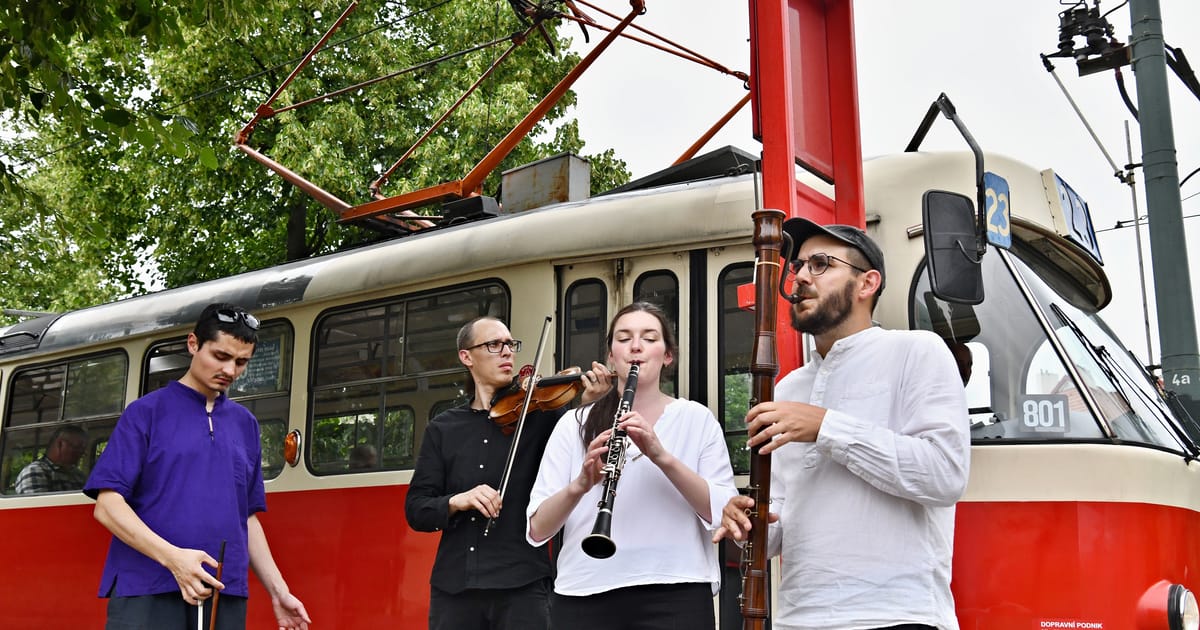
“I’ve had this idea floating around in my head for probably about ten years. There was a very specific moment I remember—I was taking the 22 tram from the centre, from Malostranská, up towards Prague Castle. There’s a moment when it turns onto Chotkova Street, and you get a few seconds of a beautiful view of Prague before the tram continues.
“It’s really only four or five seconds, but it’s something I always look forward to on that particular tram ride. One day, I waited for the view, enjoyed it, and then thought it would be great to write a piece about this moment—about this view on the ride.

“One day, I waited for the view, enjoyed it, and then thought it would be great to write a piece about this moment—about this view on the 22 tram ride.”
“Then I started brainstorming more generally about writing music—not just for listening on a bus or train, but for a particular ride with a specific duration and the landscape around it. About three years ago, I brought the idea to Nikolá Štefková, a producer at Prague Quiet Music Collective. She really liked it, and we decided to approach Czech Radio. That’s when things really got going.”
How many composers took part in the project? And how did you choose them?
“There were six composers in total, working with seven cities. Two pieces were in Prague, and then one each in Karlovy Vary, Ostrava, Olomouc, Brno, and Ústí nad Labem.
“Generally, we work with composers who share our aesthetic—quiet, reduced, often slowed-down or pared-back. But for this project, the idea from Czech Radio’s Vltava station was to expand geographically, to avoid making it Prague-centric and to encompass the whole country.

“So we commissioned composers who weren’t always stylistically close to our usual aesthetic, opening up the possibilities. We generally chose people with a relationship to the city and its public transport, though not always a straightforward one.

“For example, Jakub Rataj chose the bus in Karlovy Vary that he took as a teenager to rehearsals with his band—it inspired him. Daniel Skála has lived in Ostrava his whole life, and the trolleybus goes from the conservatory where he studied and now teaches. Lucie Páchová hasn’t spent much time in Ústí, but the city attracts her.
“Eden Lonsdale, who wrote the second Prague piece, lives in Berlin. He came to Prague for a short residency and spent a few days riding trams, metros, and buses. By coincidence, the line he took included the stretch of the 22 I mentioned, with its beautiful view. It’s a lovely ride—popular with both tourists and Prague residents.”

When you approached the composers, did you give them any specific instructions about the length, the form, or how the music should sound, or did you leave it entirely up to them?
“The sound of the music was entirely up to them. The instructions we did give were that the piece had to be for a tram ride, and that there would be two versions—one including a sound recording of the ride, so you hear the tram, the stops, and all the other sounds.
“The other version is just the instruments, so people can listen directly on the tram. We didn’t specify the length precisely, but most pieces ended up around 5 to 15 minutes, which is ideal for the project.
“We also specified that the pieces should be as site-specific as possible—they shouldn’t just be autonomous compositions you could play anywhere, but should incorporate the element of the ride.”
Tell us more about this, because as you said, there are two versions. One is purely instrumental, while the other includes the sounds of traffic and the ride itself. How does it actually work?

“You can find both versions online on the Czech Radio website and elsewhere. If you want to listen at home with an idea of how it works with the ride, you can play the version with the sound recording.
“But the main goal is to take the version with only instruments. You put on headphones—ideally noise-cancelling or enclosed, but still letting in some outside sound—wait for the 22 at Malovanka, press play as it arrives, and experience it on the site.
“The recordings are freely available and will remain so. Our dream is that, over the next few years, someone might go to a festival in Ostrava or visit Karlovy Vary and listen to a piece on the tram or bus—gradually working through all seven compositions.”
How will people find out about the project unless they listen to or follow Czech Radio’s Vltava station? Will they actually discover it on the tram or metro?
“We discovered during production that it’s virtually impossible to put advertisements on specific public transport lines—the logistics just aren’t geared for that, and advertisers generally don’t need it.
“There will be some ads on trams, buses, and trains, but not—unfortunately—on the 22. Or if there are, it will be by accident.”
You mentioned that you were initially inspired by tram number 22, but your composition in this project, Four Stations, was inspired by Prague’s Metro A line. What drew your inspiration there?

“I already mentioned the 22-line that inspired the project. When we were assigning lines to composers, it was clear which one I would do. Eden, leaving Prague after his residency, said he wanted to do this line. I laughed, told him that was my plan, and we discussed whether we might both do the same line.
“My plan was to capture the way the line rises, which is beautiful. Eden focused on the route from Malovanka, an almost suburban part of Prague, around the castle, then down into the city, where it gets busier, and the piece mirrors that trajectory.
“Even during rush hour, the Prague subway is still a pretty calm experience. People are generally quiet, and the trains have a slow, smooth sonic character.”
“In the end, I chose the main public transport method not yet covered by the project—the metro. And since these two pieces are in Prague, I imagined a connection that made sense with the first piece: you could take the 22 from Malovanka with Eden’s piece, walk through Kampa back to Malostranská, and then ride four stations from Malostranská to Náměstí Míru, where you can also visit Czech Radio.
“The Prague Metro is actually quite inspiring for me. I have a book of poems from almost ten years ago that includes some about the sound of the Prague Metro, and I’ve used that material in some pieces as well. It’s generally a very calm metro. I studied in London and Berlin, and even during rush hour, the Prague subway is still a pretty calm experience. People are generally quiet, and the trains have a slow, smooth sonic character. The Tube in London sounds much more chaotic—it changes constantly—but Prague’s metro is very consistent, with this calm atmosphere.
“The piece really takes that as its blueprint. It follows the slow wave of the metro as it speeds up, then engages the brakes, producing a high pitch. The clarinet material reflects that, while the viola imitates the friction of the train accelerating and slowing down. Everything else in the composition develops from that foundation.”

It occurs to me that when riding the metro, the sound is more consistent than that of trams, which vary depending on the specific tram…
“Absolutely. That consistency allowed me to make a precise piece—the score has most entrances timed to the second, using a stopwatch during recording.
“There are specific times, like 48 seconds, and instructions such as starting when the doors open. It follows the recording closely, though a small mismatch is inevitable once you’re actually on the train.
“Most other pieces handle time more loosely, leaving room for variation. For example, Marek Keprt’s piece uses spoken word and wordplay with stop names—sometimes the stops are slightly off in timing, creating a playful element that reveals itself as you ride.”
Eden Lonsdale is the only person who had no previous connection to Prague or to any of these cities. Why was he invited to take part in the project? And can you tell us a bit more about his piece?

“Eden is a composer and a friend of mine. We studied together in London and have kept in touch. I really love his music—that’s reason number one—and it fits perfectly with the overall aesthetic of the project.
“In a way, I thought that since we were expanding the range of composers stylistically, and including Czech composers connected to their cities, it made sense to have one outlier—someone who was the opposite: very close to us stylistically, but without a personal connection to Prague.
“I also liked the idea that not everyone should focus on their childhood tram ride to school. I wanted a diversity of relationships to these places. There’s something special about someone coming to Prague—not entirely for the first time, but seeing it mainly through the lens of public transport. I think it worked really well in the end.
“Eden’s piece is a fascinating combination of structure and openness. There’s a lot of harmony—many harmonic combinations—but it doesn’t always follow a single vertical line. Each player moves at their own pace. In some sections, the instructions bring us closer together and synchronize; in others, the music drifts apart. You get this feeling of sounds spreading out and seeping into each other, which I think fits perfectly with the progression of a tram ride.
Video of Eden Lonsdale: passing notes
“There’s also significant dynamic development in the piece. It might begin in a way that feels familiar to listeners of our music—long notes, quiet harmonics—but quite a lot happens dynamically. There are beautiful, very quiet pizzicato sections toward the end.
“Rather than imitating the sound of the tram or bus, which some pieces in the project do, Eden’s work reflects the visual experience—the transformation of what’s happening around you as you travel.”
Did you have a chance to listen to all the pieces where they were meant to be heard?
“Unfortunately, not. So far, I’ve only heard the Prague ones in situ. There’s been too much work finalizing the project, but I’m looking forward to experiencing the others.”
Where were the recordings made, and who recorded all the pieces?
“All the pieces were recorded by our ensemble, the Prague Quiet Music Collective, with our standard line-up: myself on guitars and viola da gamba, Milan Kárník Jakeš on violin and viola, Anna Paulová on clarinet and bass clarinet, and Luan Gonçalves on double bass. We recorded everything at the Czech Radio studios in Karlín, with Petr Strejc as music director.”

Was there any piece that surprised you?
“Yes, definitely. Going back to your question about whether we told the composers how to write, the clearest evidence that we didn’t is Jakub Rataj’s piece. It’s a great work, a real outlier in our repertoire. Its two dynamic levels are basically ‘loud’ and ‘very loud.’ It features distorted guitar, intense bass clarinet, and double bass—sounds we rarely use in this ensemble. Yet, it still has a character that connects it with the rest of the project. I really like how it works in the recording.
“Two other pieces were also beautiful surprises. I already mentioned Marek Keprt’s piece uses spoken word and wordplay—a really unexpected and poetic element. It transforms the tram ride in Olomouc, one that I and many others know well, from a set of ordinary stops into a playful, poetic map full of associations, correspondences, and little jokes. It completely changes how I experience that ride, even just listening to it—hearing the tram announcements intertwined with Marek’s voice playing around them.
“The biggest surprise came from Lucie Páchová’s piece, set in Ústí nad Labem. It’s the only piece that doesn’t exist in two versions. While it covers one segment between two stops, she used field recordings—cutting and looping them to form the foundation for the material we play or improvise on. These loops often include the sounds of the trolleybus, the passengers, and snippets of conversation. Sometimes it even reminds me of Janáček—but in a very modern way.”
Finally, is this a one-off project, or do you plan to add more compositions in the future?
“Our dream is that, over the next few years, someone might go to a festival in Ostrava or visit Karlovy Vary and listen to a piece on the tram or bus—gradually working through all seven compositions.”
“For now, it’s a one-off project. But as we’ve been finalizing it, I’ve started imagining related ideas—perhaps a longer piece for a train ride, or even something inspired by air travel. We recently went to Sweden with the ensemble, and during the flights, I caught myself thinking about how a piece of music could work with that experience. So, we’ll see what the future brings.”
Our dream is that over the next few years, someone might go to a festival in Ostrava, or visit Karlovy Vary, and listen to a piece on the tram or bus, gradually working through all seven compositions.”

‘ The preceding article may include information circulated by third parties ’
‘ Some details of this article were extracted from the following source english.radio.cz ’