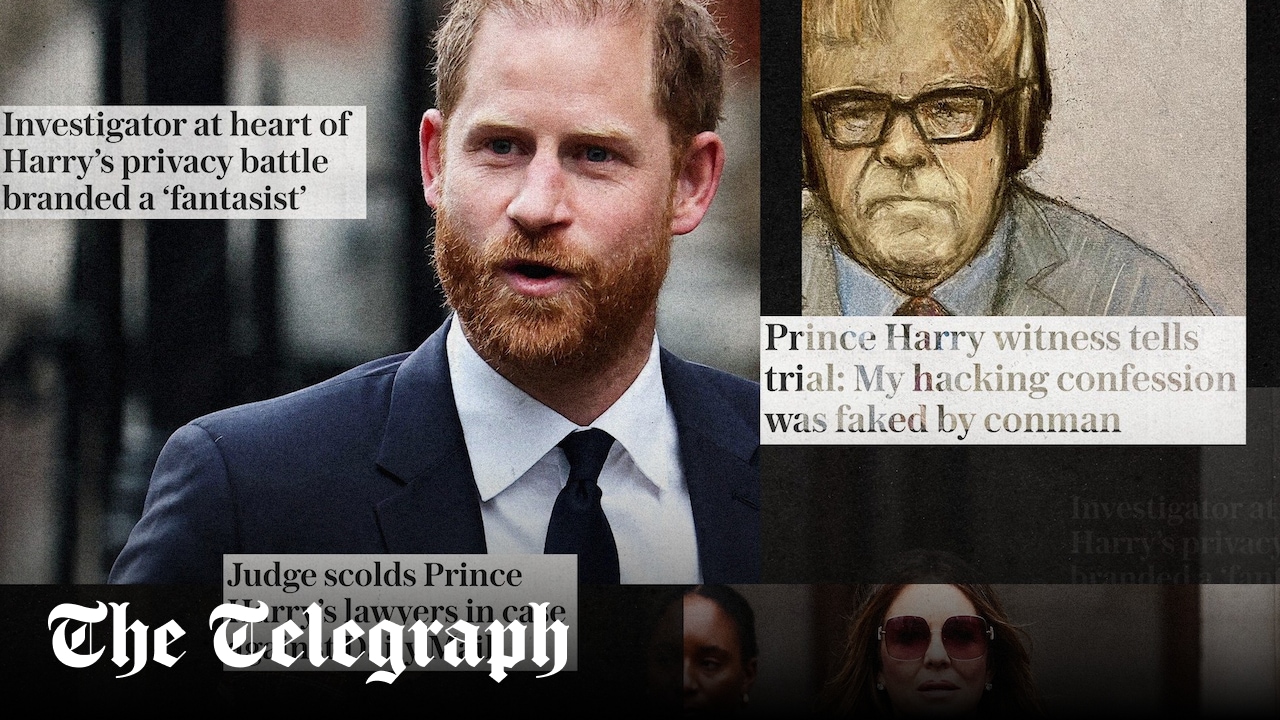
Dr Harris described Ms Hart as a “fantasist” who was “obsessed with Hugh Grant”.
Perhaps Daniel Portley-Hanks, a US-based private investigator, would prove more useful.
The American, commonly known as Detective Danno, told the judge he “did unlawful stuff” in relation to Prince Harry for the Daily Mail and the Mail on Sunday, but could not “recall what exactly”.
Mr Portley-Hanks was paid £6,000 by Johnson, plus additional sums of up to £290 ($400) a day for his “time”.
Mr White said in written submissions there was “a clear picture of purported evidence being obtained through financial inducements and threats”.
Analysing payment records
Next came the journalists, who variously described allegations that they had hacked phones or blagged information “nonsense” and “absolute b——s”.
Faced with the prospect of Mr Burrows’s evidence being entirely disregarded, Mr Sherborne sought to cast his net wider, endlessly analysing payment records relating to other private investigators.
With each journalist sworn in, Mr Sherborne followed a similar pattern, showing them various invoices which no one could remember.
There was little that obviously linked any specific payment to any specific story, forcing the barrister to simply make assumptions.
“I suggest to you …” was the repeated refrain as he accused each reporter of obtaining their stories via phone hacking and blagging.
Sharon Churcher, the Mail on Sunday’s former chief US correspondent, perhaps best summed up the general response.
A formidable character, she had no intention of being bossed about by Mr Sherborne.
“You can suggest all you like, but what you are suggesting isn’t true,” she said.
“It’s ludicrous,” she later added about a bizarre story involving Mr Portley-Hanks tracking someone by planting a helium balloon in their mailbox. “If you put it on Netflix, I think people would switch off.”
She told Mr Sherborne she would give as fulsome responses as she chose, so furious was she at the “lies” being advanced.
“Please stop cutting me off,” she told him.
Others simply chuckled at the absurdity of it all, telling Mr Sherborne that he was clutching at straws. “You’re just talking nonsense, I’m sorry,” Richard Simpson, the former showbiz reporter, said.
“Some of this stuff is just incredible,” Peter Wright, the former editor of the Mail on Sunday, volunteered. “No, you’re wrong.”
Closing arguments
As Mr Sherborne summed up his case this week, he appeared to suggest that it was down to the publisher to prove that its stories had been obtained lawfully, likening the case to a valuable watch being stolen from a locked safe.
If the watch were to appear in the hands of the defendant, he said, it would not be down to the claimant to prove how it came to be there.
“I don’t find that example particularly helpful,” the judge admitted.
Mr Sherborne tried again. “If someone is injured by a van, if you can’t identify the driver and the make and model of the van, it doesn’t mean you don’t have a claim.”
The judge warned that he was coming “perilously close to reversing the burden of proof”.
“It’s for you to demonstrate that there has been a wrong,” he told the barrister.
Whether he has successfully done so remains to be seen.
‘ The preceding article may include information circulated by third parties ’
‘ Some details of this article were extracted from the following source www.telegraph.co.uk ’