(Welcome to my weekly streaming ratings report, the single best guide to what’s popular in streaming TV and what isn’t. I’m the Entertainment Strategy Guy, a former streaming executive who now analyzes business strategy in the entertainment industry. If you were forwarded this email, please subscribe to get these insights each week.)
I have a quick prediction before we start today’s article:
You might see this data in future news articles.
Not my specific charts or analysis, but the core trend I’ve been monitoring—Netflix is having a lackluster Q2—will become inescapable. Often, folks want to know “What does the data say?” Well, that’s what it says.
I haven’t seen this analysis hit the trades really yet, but I have a feeling some other outlets are going to start making this case soon. Remember, you read it here first.
You probably have read about the problems facing superhero films at the box office this weekend. Well, this week, I explore whether superheroes are dying on TV as well! And the data says: definitely maybe!
We have a lot to cover in today’s Streaming Ratings Report, which covers the two weeks of 18-May and 25-May. Today, I’m just looking at TV, like Netflix’s disappointing Q2, superhero shows underwhelming, a few TV shows dropping off the charts, The Pitt finally ending its epic run on the viewership charts (and whether “view counts” change its status as one of the biggest shows of all time), all the flops, bombs and misses, and a whole lot more. Tomorrow, I’ve got a great rundown of the film side of things.
Let’s dive right in!
(Reminder: The streaming ratings report focuses on the U.S. market and compiles data from Nielsen’s weekly top ten viewership ranks, Luminate’s Top Ten Data, Showlabs, TV Time trend data, Samba TV household viewership, company datecdotes, Netflix hours viewed data, Google Trends, and IMDb to determine the most popular content. While most data points are current, Nielsen’s data covers the weeks of May 18th to May 31st, 2026.
You can find a link to my terminology here.)
Having analyzed streaming ratings for going on half a decade, I have learned to trust my gut, but I’m always relieved when I can find actual data to back it up.
For example, after a string of very popular shows like Stranger Things, Bridgerton, The Lincoln Lawyer and The Night Agent came out, week after week, in January and February, my gut wondered if Netflix had enough new and returning TV shows to sustain them throughout the year.
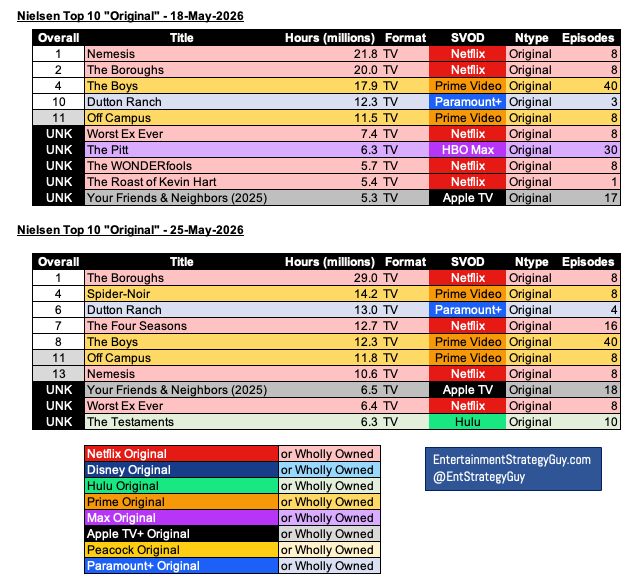
Since then, Netflix’s post-March slate of shows has not impressed me. This week seemed to feature a potential new hit, but then, like a classic Duffer Bros. TV show, there was a twist. I speak of The Boroughs, Netflix’s latest (and last) Duffer Bros. produced show. The pitch is “Stranger Things with older actors”. And it topped the Nielsen charts:
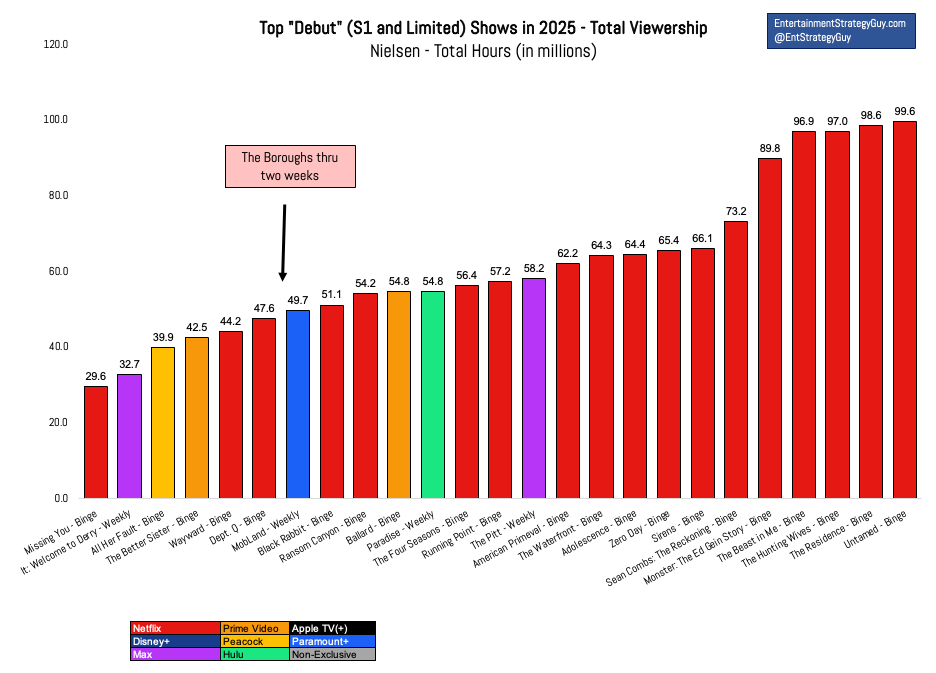
With just two weeks of viewership, The Boroughs would have been a top 25 debut show last year:
But here’s the twist: Netflix has already cancelled The Boroughs!
What happened?
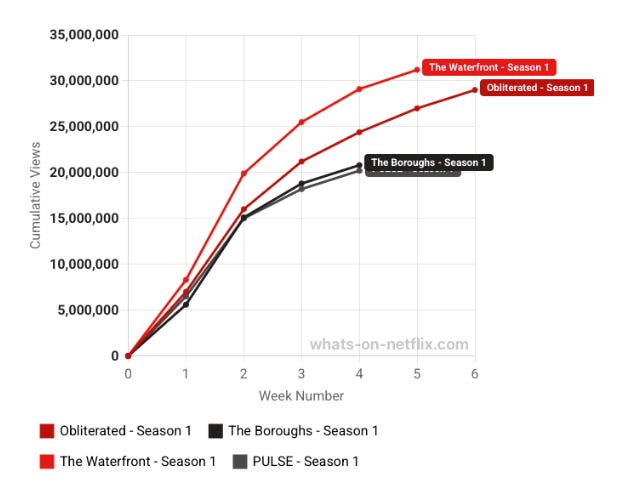
Likely a few things. First, the show didn’t do as well globally as it did in the US. As What’s on Netflix showed, it lagged behind several other shows that got cancelled.
Second, its completion rate was likely low; after an initial burst of interest, it quickly dropped off on the Samba TV and Luminate charts.
Third, the Duffer Bros. left Netflix for Paramount, and that may have factored into Netflix’s decision here. (Though I tend to believe that if a show is doing well, Netflix would have kept greenlighting seasons.)
Still, just because I can explain why Netflix may have cancelled this show doesn’t mean I’m justifying it. In particular, as I’ve noted before, Netflix is losing a lot of their bigger shows as they reach their natural ends, and they need to replace those shows. This show had the hallmarks of a big new genre show, and it’s their biggest hit of the last few months (in the US at least), but now it’s done.
Netflix’s other show this week—The Four Seasons, the second season of the “hit” show from last year—definitely disappointed. Its sophomore season had about half the viewership of the first, only 12.7 million hours. It also only had a two week run on Samba TV, and its numbers were all down on Luminate too.
In other words, even with two successes, the Q2 slump for Netflix looks real:
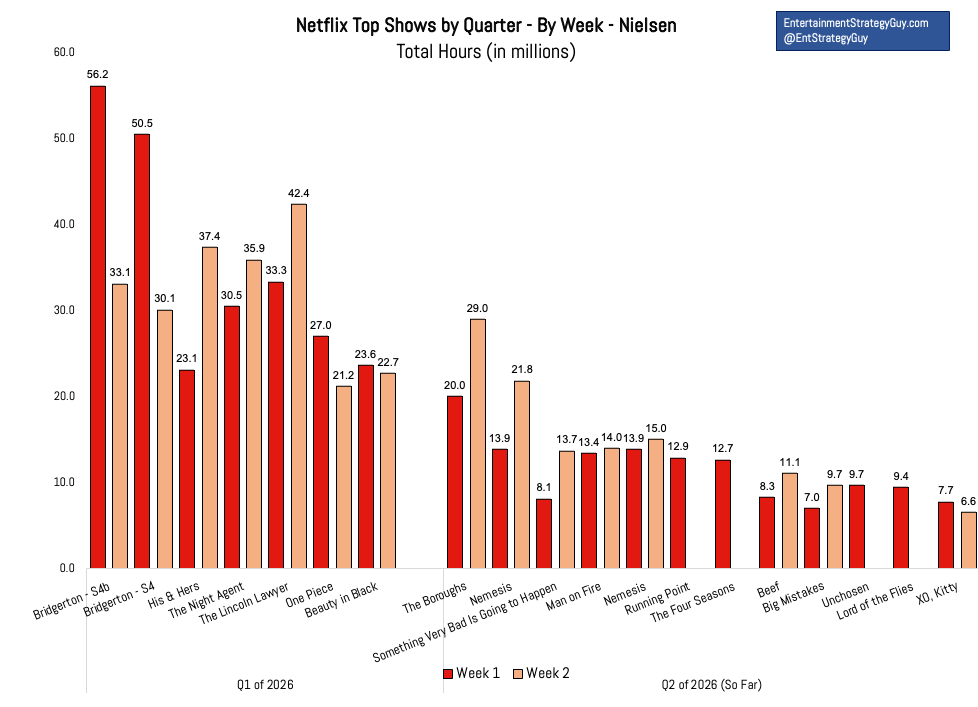
I could add to the list of disappointments:
Both Lord of the Files and Man on Fire had short runs on the Nielsen charts.
Running Point’s sophomore season also opened to about half its viewership, similar to The Four Seasons.
A Good Girl’s Guide to Murder’s second season—see below—didn’t even make any of the three viewership charts I track, unlike the first season.
Netflix is absolutely having a dismal second three months of 2026. If this Nielsen data is any indication, and I think it is, I think this will show up in Netflix’s engagement report, and maybe even their financial outcomes.
And the rest of June doesn’t look much better. We have two hit shows coming back—Sweet Magnolias, one of their quietest big shows, and Avatar: The Last Airbender, a big hit for them in 2024—but the other big swings are limited series crime thrillers i.e. no future season potential.
Like I said above, sometimes when I uncover a juicy nugget like this, other outlets end up writing very similar articles mimicking the data without credit. We’ll see if that happens this time!
When I first heard the pitch for Spider-Noir—a Sony TV show on Prime Video that binge-released eight episodes first on MGM+ then on Prime Video two days later—I had my doubts. It’s a live-action Spider-Man show set in the 1930s, starring Nicholas Cage, based on a cameo of a character in Spider-Man: Into the Spider-Verse.
No, seriously, that’s the pitch.
That could either go terrifically well or horribly wrong. Great because, Spider-Man. He’s the biggest superhero we have. I’ve seen tracking numbers that put the new Spider-Man: Brand New Day as the blockbuster of the year and initial pre-sales back that up. And yet this Spider-Noir pitch feels very esoteric. (Also, the eight-episode binge release feels very “Amazon copying Netflix” again.)
So what’s the data say? And what does this say about the future of superhero shows?
‘ The preceding article may include information circulated by third parties ’
‘ Some details of this article were extracted from the following source entertainment.substack.com ’