TAHLEQUAH – A new documentary from the Cherokee Nation explores the legacy and generational impact of post-removal seminaries established for young Cherokees in the mid-1800s.
Jen Loren, senior director of Cherokee Film, checks out a historical display May 7 at Northeastern State University before the premiere of a documentary called “The Seminarians: Sovereignty Through Education.”
“I think this documentary really shows the Cherokee Nation’s commitment to education,” said Jen Loren, senior director of Cherokee Film. “When we moved into Indian Territory post-removal, it was so quick that we started up the seminaries. That shows our dedication. But then you also see that continuing and not stopping. So, I think it just goes to show the importance of education in the Cherokee Nation. People will really get a sense of that through this documentary.”
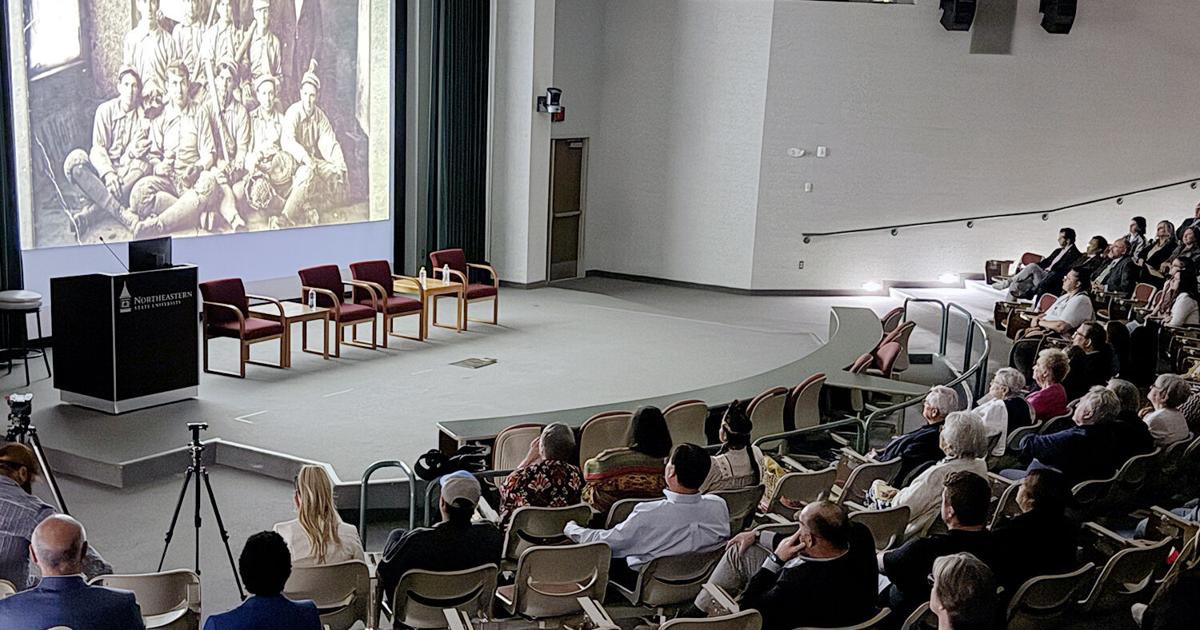
Titled “The Seminarians: Sovereignty Through Education,” the 30-minute documentary from Cherokee Film Productions was screened on the Northeastern State University campus, home of Seminary Hall, on May 7.
“It’s a big part of NSU’s history. It’s a big part of Tahlequah, too,” said NSU archivist Blain McLain, who was interviewed for the film and also provided documentation and photographs. “I think Tahlequah is shaped pretty heavily by the university, and that was shaped very heavily by the seminaries.”
THE SEMINARY STORY

Northeastern State University’s historic Seminary Hall is seen May 7.
Authorized by the Cherokee National Council in 1846, male and female seminaries opened in different locations near Tahlequah in 1851.
“In identical, three-story brick structures, the Cherokee Nation offered students a high school education,” the Oklahoma Historical Society says.
With its lineage traced to the original Cherokee National Female Seminary, present-day NSU holds the distinction as Oklahoma’s oldest institution of higher learning.
“The original (female) seminary was built in Park Hill south of Tahlequah and destroyed by fire on Easter Sunday 1887,” the university says.
The original female seminary grounds – and three surviving columns – are today home to the Cherokee Heritage Center. A new Cherokee National Female Seminary was dedicated north of Tahlequah on May 7, 1889.
“Seminary Hall is now the historic centerpiece of Northeastern State, and each year on May 7, descendants of seminarians gather to observe a Seminaries Homecoming in honor of our first students,” the university notes.

A display of Cherokee seminary-related items is seen May 7 at Northeastern State University.
Kristen Snell-Thomas, president of the NSU Descendants of Cherokee Seminarians Association, said the female seminary served young Cherokee students for another two decades “up until statehood.”
“Then it continued to be the (Northeastern State) Normal School, and its legacy still grows strongly through what we now know as Northeastern State University and Seminary Hall,” she said.
AN ENDURING EDUCATION
The Cherokee Nation’s lasting commitment to education was spearheaded by then-Principal Chief John Ross and the Cherokee National Council just 12 years after the Trail of Tears.

Cherokee Nation Principal Chief Chuck Hoskin Jr. offers remarks May 7 at the premiere of a new documentary called “The Seminarians: Sovereignty Through Education.”
“Certainly, our people had a commitment to education pre-removal,” current Cherokee Nation Principal Chief Chuck Hoskin Jr. said. “But post-removal, really this is a robust, direct effort to not only do basic education, but to really move towards a concept of higher education in a dormitory-type setting where there’s really a holistic view of what education could be for both men and women. So, it was very progressive for its time. I think it was very forward-looking, and it really kept us optimistic about what the future could be.”
Familiar with the history, archivist McLain noted the seminaries provided an extraordinary education.
“There was nothing this far west anywhere near what the Cherokees were doing at that time,” he said. “There are several prominent women, especially, that didn’t have families, and their legacy still lives on just because of what they did for their communities and locally. They got their educations here.”
Interviewed for the film, Cherokee historian and former Tribal Councilor Jack Baker noted the institutions, “particularly the female seminaries,” provided teachers for the Cherokee national schools established throughout the reservation.
“The graduates of the male seminary, while some of them became teachers, the majority of them became leaders in our tribal government in the future years,” Baker said.
FROM A DIFFERENT VIEW
In the documentary, descendants of seminarians, like Snell-Thomas, tell the tale, which she says is “not a stagnant history.”
“It’s still very much living, still very happening,” she said.
The documentary premiered on May 7, a “special day” to the seminarian descendants, who for more than 100 years have hosted an annual homecoming event.
“Today is just that more special being able to premiere this film documentary that highlights both the history of the seminaries, as well as the descendants’ association that’s still happening,” Snell-Thomas said. “Now that all the seminarians have passed, the celebration really has come to focus on their legacy through the descendants.”
Snell-Thomas noted that Cherokee seminaries represent “more than schools.”
“They reflect a foundational commitment to education, identity and self-governance that continues to shape our people,” she said. “This documentary helps preserve those stories and ensures future generations understand the role the seminarians played in strengthening Cherokee Nation.”
PRESERVING THE PAST
Hoskin said it’s important the Cherokee Nation tells its own stories.

Blain McLain, archivist at Northeastern State University, helped gather historical artifacts for the premiere of “The Seminarians: Sovereignty Through Education.”
“Often what happens is there’s a superficial look at Cherokee history if there’s any look at all,” he said. “There’s such a rich history from 1839 to the turn of the 20th century in which we were doing what we’ve always been capable of doing, which is really creating a great society by investing in each other. Telling the story of the seminaries is essential to that. If we’re not telling that story, though, it really often gets lost or obscured.”
Loren, the documentary’s executive producer, said Cherokee Film Productions strives to “protect and preserve” Cherokee stories and culture. “The Seminarians: Sovereignty Through Education” is now “an archival piece of material that people can look at forever,” she added.
“Having the ability as Cherokees to tell our own stories and choosing what’s important to bring to the public … I’m so glad our leadership values that,” she said.
The documentary is available at https://www.youtube.com/watch?v=xFJp1e_ODUc on the Cherokee Nation’s YouTube page.
‘ The preceding article may include information circulated by third parties ’
‘ Some details of this article were extracted from the following source www.cherokeephoenix.org ’