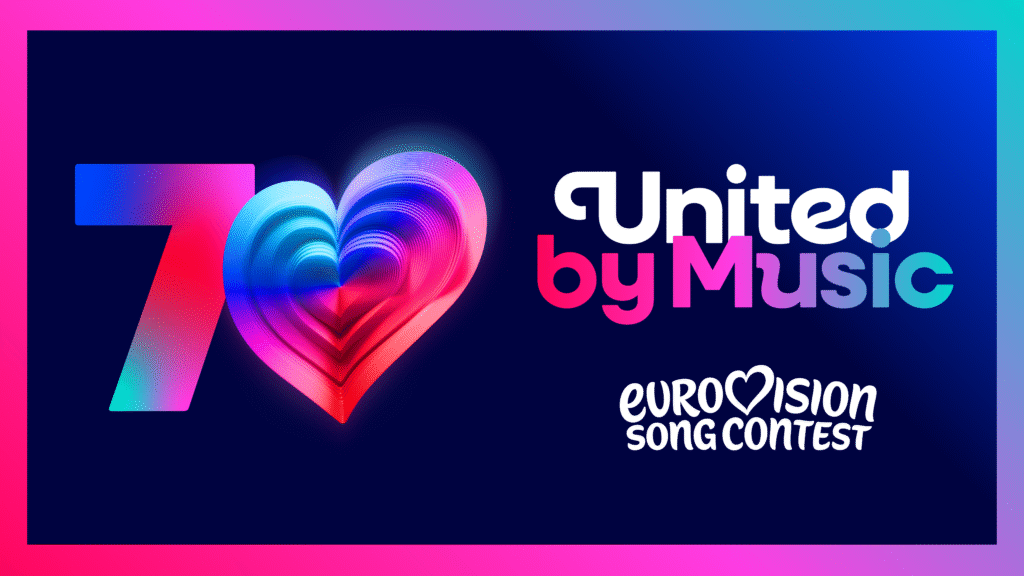
The European Broadcasting Union has revealed the new logo for the Eurovision Song Contest ahead of the 70th edition of the competition next May.
The new branding has been created by the European Broadcasting Union in collaboration with PALS, a branding studio based in the United Kingdom who were involved when creating the brand concept for the 2023 contest held in Liverpool.
The new logo of the contest incorporates features of the existing logo which was first seen in 2004 and modified in 2014. The familiar handwriting font for the word “Eurovision” is still visible in a refined way while still using the famous heart where the current host country’s flag will sit. For the first time however the “Song Contest” aspect of the logo is more dominant and in keeping in side to Eurovision to further identify the brand as “Eurovision Song Contest” instead of simply “Eurovision.
The heart that fans have grown to love is still heavily identified as a graphic asset in the refresh. Incorporating it as a stand alone within the brand identity itself, with the opportunity to adapt the shape of the heart with different textures and patterns to suit the need of the content while remaining recognisable as the Eurovision brand. For example, the heart is now incorporated in the visuals for celebrating the 70th anniversary of the contest, where it can be seen in 70 different layers to represent each year of the contest.
The refresh also further implements the EBU’s commitment to “United By Music” as an ongoing permanent slogan for the contest.
Director of the Eurovision Song Contest, Martin Green CBE said:
“The Eurovision Song Contest has always been about evolution – musical, cultural, and creative. This refresh honours 70 amazing years while taking the brand forward to an exciting future. It’s bold, playful, and full of heart – just like the Contest itself. We’re so proud to unveil it to the world.”
“Our new logo and look have been designed to make the Eurovision Song Contest brand clearer on digital platforms, bring our family of projects all into one space, and protect the brand globally for EBU Members as the Contest continues to attract new audiences across the world.
“You’ll start to see more of our new brand identity as we head towards next year’s Eurovision Song Contest and there’ll be more surprises, and details on all the activities celebrating 70 years of being United by Music, coming in the months ahead.”
The new look of the contest will be in first use at the upcoming Eurovision Song Contest 2026 which is due to be held in May 2026 in Austria, with the host city expected imminently. It is expected that the new look will then be rolled out for accompanying shows for Eurovision such as the Junior Eurovision Song Contest thereafter.
The History of the Eurovision Song Contest Logo
For the first 48 years of the Eurovision Song Contest, the competition lacked a unified appearance. During this time, a new design was created by each host broadcaster, with no unifying theme among the logos used. The competition itself was also displayed with various names as well, including Eurosong in 1996, when NRK attempted to bring the Eurovision Song Contest up to date.

The Eurovision Song Contest has had a unified logo since 2004, when the heart design that has been in use ever since was first created for the 49th Eurovision Song Contest in Istanbul, Turkey. The Heart has displayed the flag of the host country of every edition of the competition since.

The last time that the Eurovision Song Contest logo was refreshed was in 2015 to mark the 60th edition of the competition. Speaking about the original 2004 logo, Sietse Bakker, Event Supervisor at the time, explained:
“The heart, the combination between the friendly handwritten ‘Eurovision’ word mark and a more contemporary sub-title – they had to stay. They reflect the ‘modern classic’ the Eurovision Song Contest essentially is. Also, the logo had some challenges; it’s grungy edges, odd details and loss of detail when shown in small dimensions, particularly the city and year designation.”
Cornelis Jacobs and the Amsterdam-based Cityzen Agency refreshed the logo, creating a cleaner and clearer typeface which kept its appearance better on TV and in print compared to the first logo.
Image source: EBU | Source: EBU

‘ The preceding article may include information circulated by third parties ’
‘ Some details of this article were extracted from the following source eurovoix.com ’