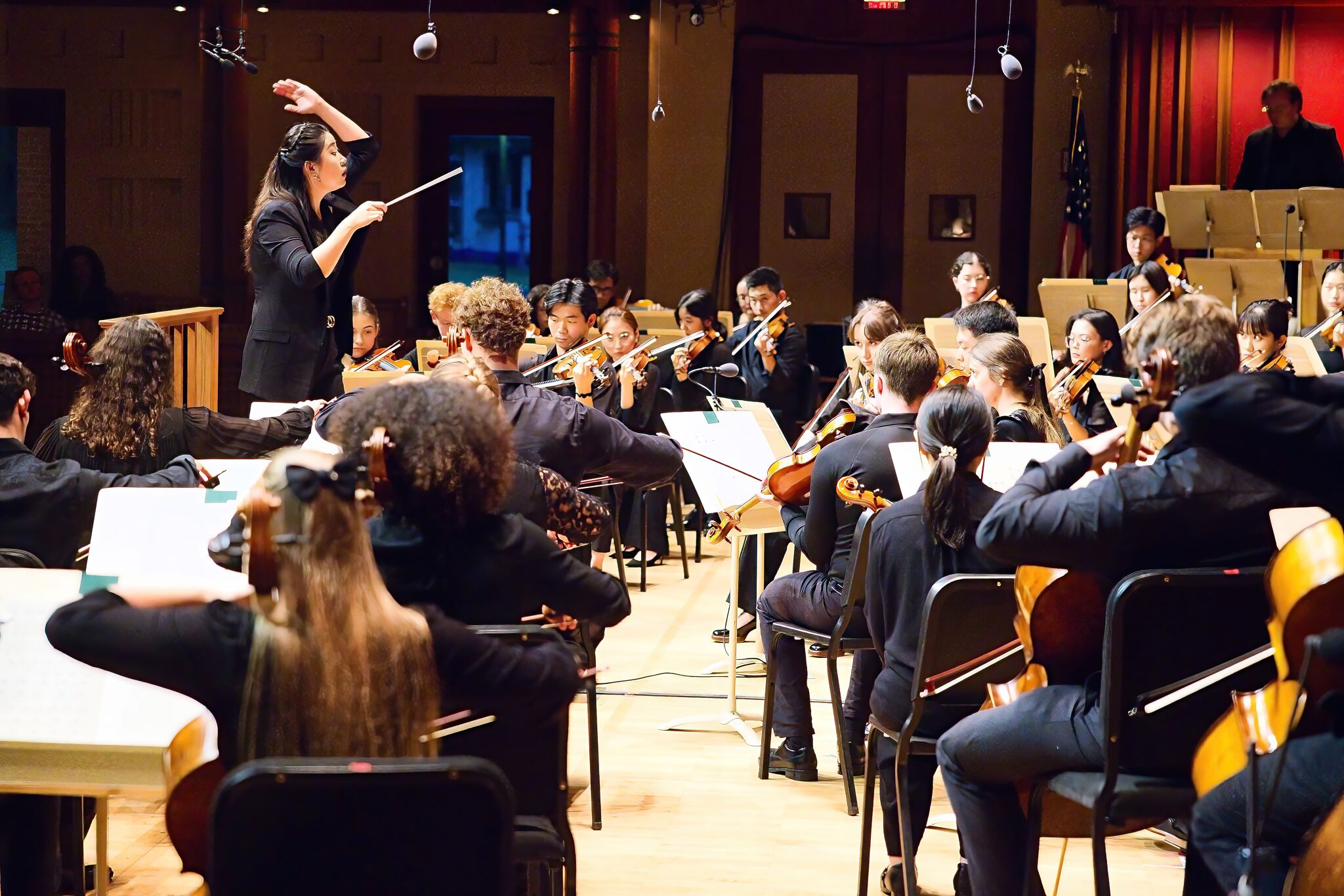

Yiran Zhao conducts the Tanglewood Music Center Orchestra in “Bioluminescence Chaconne” by Gabriella Smith.


In the always enticing summer arts calendar of the Berkshires, there were two back-to-back opportunities to sample the newest music, Tanglewood’s five-day Festival of Contemporary Music, which ran July 24-28, and Bang a Can’s Loud Weekend at MASS MoCA that ended on Aug. 2. Taken alone or together, these events offer enough to satisfy even the most avid devotee.
My habit most years is to attend the final concert at Tanglewood’s journey into the new, which usually occurs on a Monday evening in Ozawa Hall and is performed by the immense and highly skilled Tanglewood Music Center Orchestra. As the wrap-up of the festival, the selection of works usually reflects the different styles and streams touched on during the preceding week.
Article continues below this ad
But things were different this summer, the second under the leadership of Ed Gazouleas, the director of the Tanglewood Music Center, who enlisted composer Gabriela Ortiz as director and curator of the festival. Their focus was on the rich traditions and current goings-on in Mexican music, mainly as seen through the career and influences of Ortiz herself. Over the course of six concerts, 26 pieces were performed, and 15 of them were by Ortiz.
I can’t recall any season that was so focused on a single composer, with one big exception. The entire 2008 festival featured music by Elliott Carter, who was there to celebrate his 100th birthday. Granted, a numerical analysis isn’t the best way to judge concert programming. Yet I can’t help wondering if the limited scope of this year’s festival explained the relatively small audience for the typically well-attended final night.
At least one tradition continued — going out with a bang (Bang on a Can doesn’t own that word). All four works in the July 28 concert were big, ambitious and demanding. Gabriella Smith’s “Bioluminescence Chaconne” started with strict layering of interlocking percussive lines for a sustained, post-minimalist effect. As the steady pulse persisted, the grid eventually gave way to more expressive and organic gestures. Smith’s structure and theme strongly evoked composer and naturalist John Luther Adams, in particular his “Become Ocean,” which won the Pulitzer Prize in 2014.
Ellen Reid’s “When the World as You’ve Known it Doesn’t Exist” was just as weighty in substance yet completely unrestrained and emotionally extravagant, like a more clangorous version of Mahler. It was daring and it worked.
Article continues below this ad
The concert’s high point was Ortiz’s “Altar de Viento” (Altar of the Wind), a concerto for flute, written for and performed by Alejandro Escuer, who is the composer’s husband. Alternative sounding techniques on the flute (clicking keys, airy blasts through the mouthpiece, etc.) are nothing new, but I’ve never heard them in such profusion and with such piercing gusto. It was a lively showcase for Escuer, who savored every moment.
After intermission came Ortiz’s “Hominum: Concerto for Orchestra,” which wore out its welcome long before its 30-minute duration came to a close. All four movements were deployed by the orchestra in a thick and propulsive fashion. The opening had numerous references in coloring and contour to Stravinsky’s “Rite of Spring” and “Petrushka” in the opening, but all the frenetic activity grew fatiguing. The young players, led by conductor Thomas Wilkins, gave it their all.
Bang on a Can’s Loud Weekend
One of the trademarks of Bang on a Can has been marathon concerts. In recent years, that’s been adjusted to have multiple performances occur simultaneously on separate stages, creating a daylong experience that the expansive Mass MoCA complex can accommodate. Arriving in late afternoon on Friday, Aug.1, I thought I’d be able to take in more than I did.
Article continues below this ad
In the museum’s vast open space known as Building 5, I encountered the muted but persistent percussion music of Jason Treuting who performed with about half a dozen other drummers. The music made a fine complement to the many sculptures and installations by Jeffrey Gibson, which, like the music, were colorful without being imposing. Treuting’s piece was called “Amid the Noise/Go Placidly with Haste.”
It began with a very Bang on a Can moment. As the drumming and drones found their groove, one of the performers started passing around sheets of typing paper. The first to receive the sheets began waving them in the air and thus adding a soft sound to the mix. There were around 50 people who were standing or, since there were no chairs, camped out on the concrete floor. The wispy sound of the papers grew as everyone got in on the act. The tiny whooshes climaxed and the piece moved as other instruments were integrated. Simple, short and participatory, its paper chorus made me smile.
Seeing blank white paper in an art museum reminded me of the late artist Felix Gonzalez-Torres, who created impermanent sculptures out of reams of paper or piles of wrapped candy. Viewers were encouraged to take the paper or the candy. I call it “take some with you” art. Music is kind of like that. Take it and enjoy before it’s all gone.
In the large auditorium known as the Hunter Center, composer Ted Hearne conducted his piece “Authority” for 12 players. This was an updated form of chamber music mixing standard instruments with synthesizer and electric guitar. Though the electronic instruments often dominated the sound, the effects weren’t the sole focus but rather one aspect of the composition, which resembled a living patchwork. There were clashing tones and a general oddness, but I sensed an underlying intelligence and vision at work.
Article continues below this ad
The festival’s little fold-up program guide was colorful and clever, but not particularly easy to work with, so I wound up mistakenly catching the final minutes of a few other performances. Then came a generous dinner break. I lingered for the evening’s only concert, a tribute to the late Japanese film composer Ryuichi Sakamoto performed by the Bang on a Can All Stars and instrumentalists from the fellowship program held on site over the previous three weeks.
This wasn’t a fresh take on Sakamoto’s music like I expected. I was hoping for something along the order of John Zorn’s 1986 album “The Big Gundown,” a radical and raucous take on the film scores of Ennio Morricone. Instead, it was clarinetist Ken Thomson’s new and very loyal arrangement of Sakamoto’s own suite of his greatest hits. The performance was slow, conventional and not particularly well played. It felt like entertainment on a cruise ship. Deciding it was time to head home, I left after three numbers.
I’ve been going to contemporary music concerts and festivals all my life. Disappointments won’t keep me away. Look for me next summer.
Article continues below this ad
‘ The preceding article may include information circulated by third parties ’
‘ Some details of this article were extracted from the following source www.timesunion.com ’