Romance isn’t quite the right word, but the romantic narrative is that jazz was born in Storyville, the French Quarter-adjacent designated sector for sin from 1897 to 1917.
In the New Orleans Jazz Museum exhibit “The District: Music and Musicians in Storyville,” that narrative is corrected.
“It was happening in Storyville as we know it, but there was also jazz that was flowering everywhere in New Orleans,” said David Kunian, music curator for the museum. “It was Uptown, downtown, back of town, in the Quarter, in the Treme. This was happening everywhere.”
That the new genre was proliferating beyond Basin Street, and the rugged blocks behind it, also elevates its evolution.
“Though jazz and vice have been associated together for a long time, that cheapens the music and makes people think, ‘Oh, you know, jazz is just whorehouse music, and of course it’s much more,’” Kunian said. “So, the way I wanted to approach it, especially because we’re a music museum, is to focus less on the vice and the prostitution — though you have to have a little bit of that — and more on the music and where the music was played.”
The District’s ‘professors’
Jazz bands rarely entertained brothel customers. Rather, madams mostly employed solo pianists for their parlors, to better focus the commerce in other rooms of the sporting houses. Jelly Roll Morton, Tony Jackson, Kid Ross and Manuel Manetta were some of those players, often referred to as “professors.”
“Most of that was because these guys had to play whatever anyone wanted to hear,” Kunian said. “It wasn’t just kind of early jazz, ragtime, blues, but there were operas, opera themes, arias, mazurkas … all sorts of different kinds of music depending on what the patrons of these places wanted to hear.”
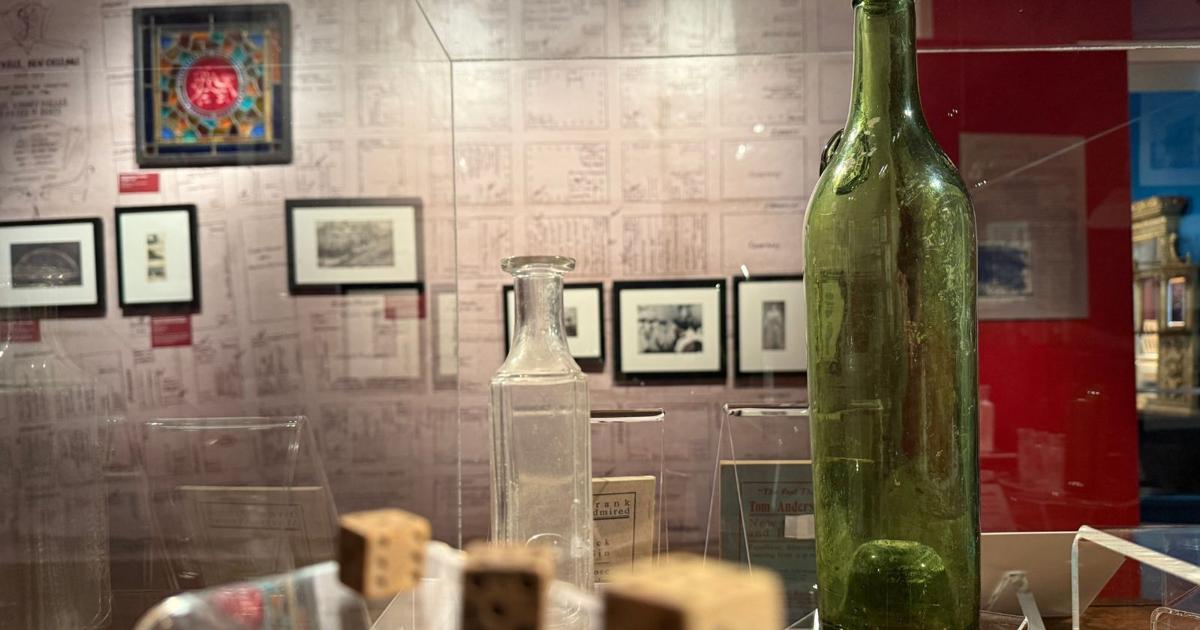
A map of the Storyville neighborhood in the exhibit “The District: Music and Musicians in Storyville” at the New Orleans Jazz Museum.
Venues in segregated Black Storyville, located a few blocks toward Uptown, featured spaces where larger bands would perform. The saloons, cabarets and dance halls located behind Basin’s bordello mansions were also hotbeds of ensemble playing. Enduring compositions with ties to Storyville or Black Storyville include “Mahogany Hall Stomp,” “Basin Street Blues,” “Funky Butt Blues” and Louis Jordan’s “Saturday Night Fish Fry.”
The District, as it was known to the musicians, was nicknamed Storyville by its patrons for Sidney Story, the politician whose 1897 ordinance established the District’s boundaries in an attempt to consolidate the city’s vice into one neighborhood. Like the New Orleans Storyville Museum on Conti Street, the exhibit doesn’t back down from the dark side of the lives of the sector’s sex workers.
“In reality, the District was squalid, with dirty cribs and open gutters,” says descriptive wall text. “Beyond the environmental conditions, drug addiction was common; it was easy to get heroin, morphine and cocaine, often at the neighborhood pharmacy. … Sexually transmitted disease was prevalent, with people turning to ineffective patent medicines. In summary, Storyville was nothing like the elegant depictions of popular culture.”
Key objects in the exhibit include patent-medicine bottles and a pair of dice excavated from the Storyville site, furniture and fashions seen in the houses, and a video display demonstrating some of the steps that would’ve been danced to the music performed there.

Detail of the Josie Arlington costume
“I don’t think there was a whole lot of dancing (in) the brothels, but there was some and certainly at the saloons and cabarets and music establishments of the District,” Kunian said. “These are the kind of dances that they were doing to the period music.”
Along with music, oral histories and interviews with musicians who were firsthand witnesses to the District’s establishments play in the exhibit.
One of the marquee objects on view is the carriage stone from the entrance of Lulu White’s Mahogany Hall. An early find by a member of the New Orleans Jazz Club (whose collection makes up much of the museum’s holdings), the stone has been in storage basically since Hurricane Katrina.
“I’ve been wanting to bring this out ever since I started at the museum almost 10 years ago,” Kunian said. “It was the carriage stone outside Lulu White’s, where people would get out of their carriages and step on this to avoid stepping in the gutter or the grass or whatever and then step onto the sidewalk and then into Lulu’s.
“You never know who might have stepped on this while walking into one of the fanciest brothels in the country.”
New Orleans museum exhibits calendar
- The Ogden Museum of Southern Art will mark Martin Luther King Jr. Day with free admission and family-friendly activities from 10 a.m. to 2 p.m. Monday. ogdenmuseum.org.
- Friends of the Cabildo will screen the film “Member of the Club: Black Aristocracy through the Eyes of an African American Debutante and her Matriarchal Family” at 6 p.m. Wednesday at the New Orleans Jazz Museum. friendsofthecabildo.org.
- The New Orleans Museum of Art will host a stop-action animation workshop at 5 p.m. Wednesday. noma.org.
- The Museum of the Southern Jewish Experience will present an event marking the closing of the exhibit “Most Fortunate Unfortunates: The Jewish Orphans’ Home of New Orleans” at 6 p.m. Thursday. The free event will be offered in-person and online. msje.org.
- An International Holocaust Remembrance Day commemorative program will take place Jan. 27 at the National WWII Museum. A 5 p.m. reception will precede the free 6 p.m. program, which will be presented in-person and online. nationalww2museum.org.
- The exhibit “Origins of New Orleans Black Carnival Society: The Story of the Illinois Clubs” will open Jan. 29 at the Presbytere. louisianastatemuseum.org.
‘ The preceding article may include information circulated by third parties ’
‘ Some details of this article were extracted from the following source www.nola.com ’