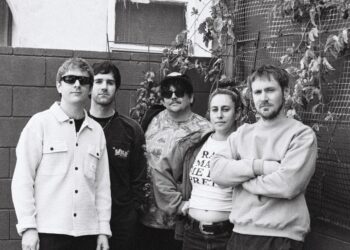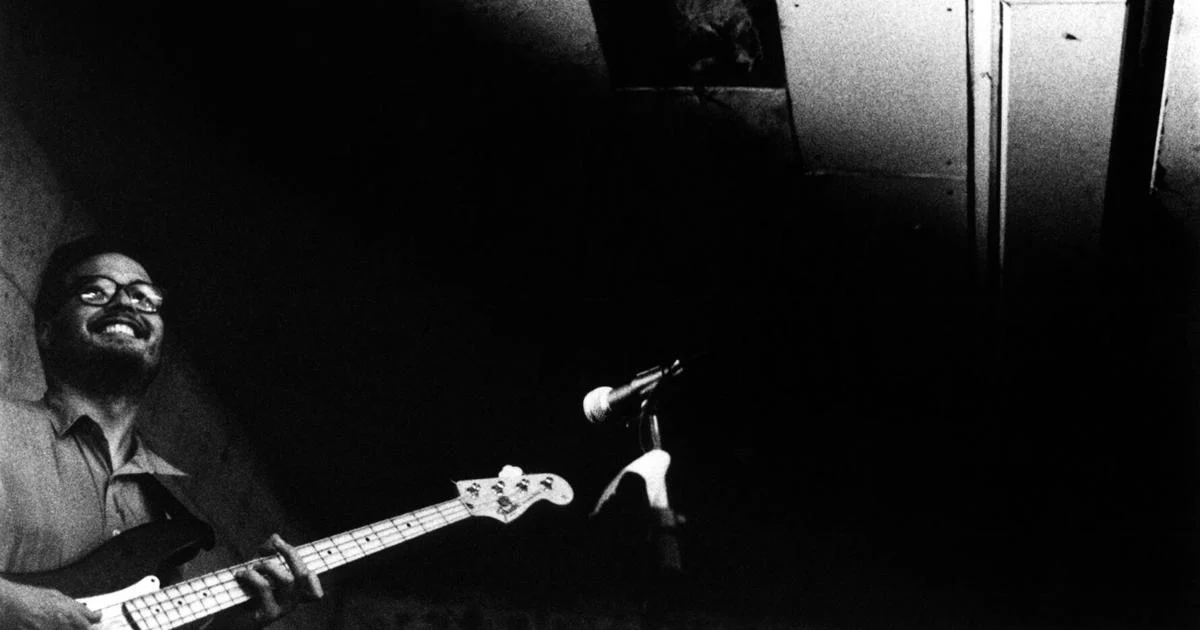
In the late ’90s, bassist and vocalist Jake Springfield and his Jai Alai bandmate, drummer Jay Abbott, split a double camelback shotgun house on Cortez Street between Banks and Palmyra. With Springfield and his then-girlfriend on one side and Abbott and a roommate on the other, it was cheap, and there was plenty of space to practice in the giant house.
“I was thinking about it — and you don’t hear this anymore — but we’d walk to Mona’s (Cafe on Banks Street) and we would hear three bands practicing,” Springfield says. “That certainly has changed. I think there’s more practice spaces available than there were, but housing was so cheap, you didn’t need another practice space.”
From around 1998 to 2005, Springfield anchored the indie rock band Jai Alai, which included Abbott, guitarist David Dismukes, percussionist Dave Greengold, guitarist Tim Perkins and other musicians in different lineups during its run.
The band was active in the era’s small indie rock scene, frequently playing the Mermaid Lounge and touring regionally with a couple of trips to the East and West coasts. And Jai Alai recorded a full-length and a couple of EPs of meditative indie rock with post-rock and math-rock leanings.
But as is often the case, life took people in different directions, Jai Alai slowed down, and Hurricane Katrina turned the page on the band. Jai Alai reunited at least once, in 2011 for a tribute night to the Mermaid Lounge, which had closed in 2004, but there hadn’t been much heard from the band prior to this year.
New Orleans label Strange Daisy Records, though, decided to start this year by reissuing three Jai Alai releases: the band’s first cassette, “99,” the 2000 EP “Division” and a 7-inch with two songs. There also are hopes, Springfield says, to throw a Jai Alai reunion show this year.
For Strange Daisy’s Patrick Bailey, these releases fulfill a goal he set when he started the label, which has released music from some of the city’s best indie rock and punk bands. There were two dream albums he wanted to release.
He checked off one in late 2022 when Strange Daisy and Community Records re-issued the influential self-titled album by the band Community — which led to the band reforming.
Jai Alai’s “Division” was his second goal.
Around 2004, Bailey’s brother, who was at Tulane and a DJ around town, gave him a burned CD of “Division,” and “I just loved it,” Bailey says. “I never got to see them. But I’ve always been a big fan of a math-rock, post-rock type of sound, and [‘Division’] just impressed me.”
“Division” was a CD he kept on repeat, and “it was kind of like only for me in a way, because I didn’t know anything about the band, and none of my friends knew about them,” Bailey says.
And in the MySpace days, he connected with Springfield, who also pointed Bailey to Jai Alai’s 2003 full-length album, “Drive Safe.” That album is available through the label SunSeaSky.
Years later, when he started Strange Daisy, “Division” and Community’s 2001 self-titled album were on his mind. He wanted to hear them on vinyl.
In late 2022, Strange Daisy partnered with Community Records to reissue Community’s album, giving the record a full release with new cover art, a vinyl run and digital release. The indie rock band also reunited for the first time in close to 20 years, and Community has continued to play shows.
Bailey early last year decided to turn his attention to “Division.” He reached out to Springfield, who lives in New Orleans, and although Springfield was onboard with the re-issue and tracked down Abbott and Dismukes for their blessings, Katrina flooding had destroyed most of his Jai Alai materials.
But through DJ and label owner Brice Nice, who Bailey works with at the New Orleans Record Press, Bailey was connected to NOLA ‘Nacular’s Anthony DelRosario, who had an original “Division” CD, the 7-inch — and a copy of the “99” cassette, a release Bailey hadn’t known about.
“I got to bring it home, and it was a whole other EP,” Bailey says. “It was this lost album by one of my favorite local bands that I didn’t know much about. It was this special find.”
The “99” cassette also was a surprise for Springfield. In fact, Dismukes, who now lives in New Orleans, had to jog his memory.
“When I got together with Dave, he was like, ‘Oh my gosh, you recorded this on 4-track.’ I was like, ‘I did?’” Springfield says. “He reminded me we recorded the 4-track and then bounced [the tracks] down to this little, very, very early digital recorder that was really for samples. But you could layer like eight tracks instead of four — or whatever it was, I don’t remember. But we took from this 4-track, we transferred each track to this digital thing and we mixed it to make this demo. That was all recorded at our house we rented in Mid-City.”
Springfield had grown up in Gainesville, Florida, and came to New Orleans to attend Tulane. Over time, he met Dismukes, who was from Slidell, and Abbott, from Little Rock, Arkansas, and the three started playing together in late ’98 and landed on the name Jai Alai.
The band was steeped in a lot of ’90s post-rock and older, complicated prog-rock, and their instrumentation would softly settle into repeating riffs. Although Jai Alai initially started as an instrumental trio, Springfield began introducing quiet vocals, resulting in a mesmerizing sound that unfolds over the course of the song.
“I think we had the intent of doing something mellow when we first started,” Springfield says. “There was a little bit of, let’s not have distortion, let’s just make it about how we can interweave these two instruments (bass and guitar).”
Community Records and Strange Daisy Records are reissuing Community’s influential self-titled album with new cover art, a vinyl run and digital release.
During his time at Tulane, Springfield also met DelRosario while they both worked at WTUL 91.5 FM, and DelRosario would book Jai Alai to play the Mermaid Lounge.
While there was an indie scene at the time, it was small and there weren’t many New Orleans indie rock bands, giving Jai Alai a chance to play often.
If touring bands were large enough, they may end up at places like House of Blues or Tipitina’s, but “the Mermaid was kind of the only place booking [smaller] indie bands,” Springfield says. “That was great for us. We got to meet lots of bands, and just because of that we felt we could record an album, too.”
Jai Alai worked with Scott Magee to record “Division,” and Jeff Treffinger, one of the former Mermaid Lounge owners, mixed the 2000 release. Later the band recorded the subsequent 7-inch at the Mermaid, which had a little studio in the back.
Following “Division,” the Jai Alai lineup changed across the 2000s as people started new bands, left town or as Jai Alai “kept trying new things and meeting new people and expanding what we were doing,” Springfield says.
Around the time Jai Alai released its 2003 album “Drive Safe,” the band included bassist-vocalist Springfield, guitarists Tim Perkins and Adam Kennedy, drummer Mike Hurley and percussionist Dave Greengold.
Along with playing the Mermaid and a few other small clubs around New Orleans, Jai Alai occasionally left town on quick trips to play Baton Rouge, Lafayette, Memphis and Hattiesburg, Mississippi. In 2000, they played South By Southwest, and another time the band got onto the CMJ Music Marathon in New York. There also were a couple of East Coast tours, a few trips to Chicago and, with “Drive Safe” in tow, Jai Alai spent a month on a self-booked tour around the country.
When the band returned to New Orleans after the album tour, the members decided to take a break. Springfield relocated to Florida for graduate school, a couple of members decided to leave town or travel, and life went on. They all stayed in touch, though, and members would meet back up in New Orleans ever six months or so to start working on another Jai Alai release.
Then Hurricane Katrina struck — Springfield had actually bought a house and moved back to New Orleans only a month before the hurricane and the federal levee failures flooded his new home. Jai Alai faded out after the disaster, and Springfield moved away from making music into other creative fields. He’s now the director of photography for the production company Tempt Films.
Springfield is glad to have these Jai Alai tracks back out into the world, he says. And it’s helped him revisit that era and reconnect with former bandmakes like Dismukes and Abbott.
If something you’ve made has an impact on “one person, with something you’ve made at 23 years old, that’s amazing,” he says.
For Bailey, “I just wanted this stuff to exist,” he says. “This is my goal: to have this exist. If one other person finds this and they like it, then awesome. And I know that’s happened already.”
Find Jai Alai and links to the music on Instagram: @jaialaiband.

‘ The preceding article may include information circulated by third parties ’
‘ Some details of this article were extracted from the following source www.nola.com ’