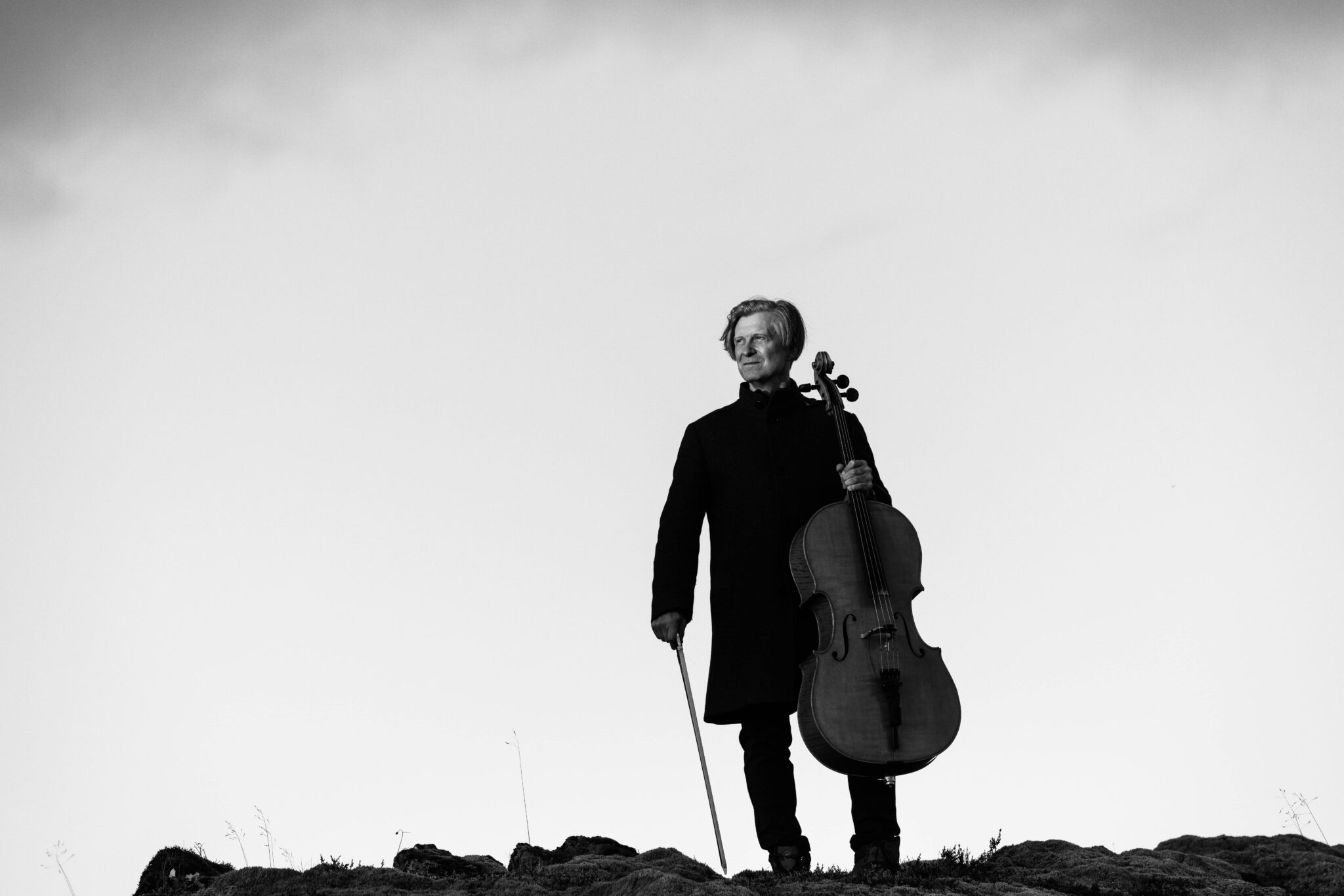
Icelandic cellist and composer Eythor Arnalds continues his exploration of minimalist, cinematic sound on the expansive new ten-track album Music for Walking, released via Alda Music. Framed as both a listening experience and a meditation on movement, the record is designed as a “soundtrack for walking” not only through physical landscapes, but through thought, memory, and emotional transition.
Blending contemporary classical writing with ambient textures, Arnalds situates himself within a lineage that includes Max Richter, Ólafur Arnalds, Brian Eno, Nils Frahm, and Hildur Guðnadóttir, while maintaining a distinct voice shaped by stillness and gradual transformation. The album was recorded with the Reykjavík Symphony Orchestra at Harpa Concert Hall, and produced with Grammy-nominated engineer Bergur Þórisson.
At the centre of the release is the focus track ‘Progression’, accompanied by a new visual film directed by filmmaker and explorer Karim Iliya. Built around slowly unfolding broken chords, the piece layers drifting violin lines over harp and piano ostinatos, while the cello emerges gradually, creating a sense of quiet internal movement. The accompanying track Progression functions less as a destination than an unfolding process.
“Life is a progression. It is a mental journey,” Arnalds explains. “In many ways walking is symbolic of our life. The walking may have a destination, but it has meaning in itself. The experience of walking makes our thoughts progress, like seeds into a plant. A progression in a state of no words, listening to music is a form of meditation which I like to do with my headphones, preferably on a mountain in Iceland. The album Music for Walking is made for such experiences. No words, pure music and walking. In the current age of sensational news and polarisation, it should be a break from that noise and bring waves of tranquility and calm.”
Across Music for Walking, tracks such as ‘Body of Water’, ‘Opening’, and Promenade No. 7′ are shaped by repetition, breath-like phrasing, and evolving harmonic patterns that mirror the rhythm of footsteps. Rather than building toward dramatic climaxes, the album favors immersion and slow attention, encouraging a reflective state of listening.
The visual world of Progression extends this sensibility into Iceland’s elemental landscapes. Shot across glaciers, volcanic plains, and shifting Arctic skies, the film presents nature not as backdrop but as active presence, a living system constantly moving, eroding, and reforming. As Iliya notes, even frozen environments contain motion, from drifting icebergs to cloud-wrapped mountains.
In positioning walking as both physical act and metaphorical structure, Arnalds’ Music for Walking offers a restrained counterpoint to modern overstimulation, a work that asks not for attention in bursts, but for time, pace, and presence.
Related
‘ The preceding article may include information circulated by third parties ’
‘ Some details of this article were extracted from the following source www.backseatmafia.com ’