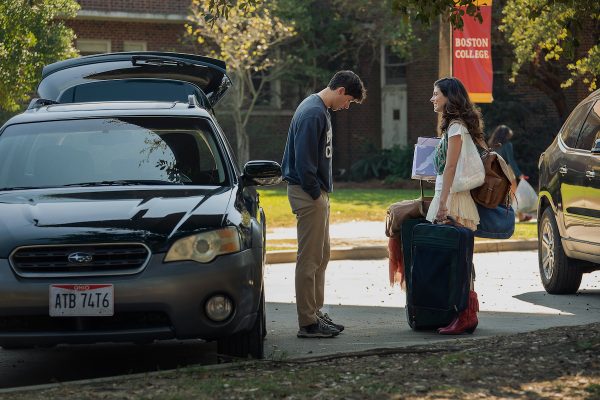
Moderate spoilers for “People We Meet On Vacation” ahead.
Released on Netflix on Jan. 9, “People We Meet On Vacation” is the perfect combination of alluring, sentimental and outright funny. Being the namesake film adaptation of bestseller author Emily Henry’s 2021 book, the movie has been highly anticipated by her fans since the film’s first announcement in October of 2022. Additionally, with the expertise of fellow romance author Yulin Kuang as one of the screenplay adaptors, “People We Meet On Vacation” captures every single element required for the perfect rom-com.
The movie is centered around the love story of Poppy Wright (Emily Bader) and Alex Nilsen (Tom Blyth), best friends who have been taking weeklong vacations together each summer since they met in college. However, this changes when they have a falling out one vacation that leads to a two-year silence from both ends. The film’s structure is similar to the book: scenes alternate between Poppy and Alex’s previous summers together and present-day, where the two reunite at Alex’s brother’s destination wedding. In addition, the true cause behind Poppy and Alex’s falling out is not revealed until later in both the movie and the book, an impeccable choice that allows anticipation and curiosity to build throughout the course of the story.

The film is visually enchanting, credited to a combination of costuming and set choices that are not only aesthetically pleasing, but also notably relevant to the plot and character development. This is first apparent through Poppy’s exciting — and highly coveted — wardrobe. Each of her looks are playful and bold with a combination of textures, colors and styles — reflecting her exuberant personality. Poppy’s style also frequently evolves through each summer, reflecting her itch to jet-set around the globe and her tendency to absorb the styles around her easily. In comparison, Alex sticks to functional and unpatterned looks that are representative of his withdrawn, often passive disposition. His choices stay consistent throughout the film, only growing adventurous when accompanying Poppy. This ties into his desire to keep everything in his life stable, but also Poppy’s ability to pull him out of his shell. Their costumes’ colors are consistently complimenting each other — a subtle way of keeping the attention on the two leads and emphasizing how they fit together.

Set lighting is also significant to the emotions and storyline of the film, as it exemplifies how the function of color emphasizes each scene’s emotions. Notably, the hazy pink light feels dreamy and romantic during the couple’s improvised dance routine at a bar in New Orleans — a scene that Bader later pinpointed as the moment Poppy falls in love with Alex. This is also noted by the presence of yellow lighting during several sentimental scenes between the two, including several conversations filled with vulnerability and emotion from both Poppy and Alex. In contrast to the cloudy pink used during a lighthearted exchange, the sharper yellow indicates the intensity of the scenes it is used in. When the two finally kiss, they are shrouded by a more prominent yellow glow that completely envelops them: a perfect usage of lighting to convey emotion.
Additionally, Bader and Blyth’s chemistry is off the charts, as the two are incredible at communicating emotions like yearning, anger and hurt solely through their eyes and body language. When Poppy nearly kisses Alex and is unable to confess how she really feels, the tension is radiating off of the two; Poppy’s desperate, teary gaze matches Alex’s equally heartbroken stare. She apologizes and tells him he’s her best friend — a boundary both want to cross but are too scared to admit. Seeing as Poppy and Alex are unable to communicate their emotions verbally, the actors do not need to rely on dialogue to convey their feelings, instead delivering a strong performance that speaks much louder than words.

Poppy and Alex’s feelings may be unspoken, but they are luckily not left unsung. Several scenes are centered around songs in order to emphasize their relevance to the moment, including the bar dance scene to Paula Abdul’s “Forever Your Girl.” While the upbeat tune compliments the duo’s ridiculous dance moves, the title also hints at how despite the decades worth of slow-burn and conflict between Poppy and Alex, ultimately they are forever tied to each other. Henry also credits the “melancholy and longing” of Taylor Swift’s “august” in the film as a perfect descriptor of Poppy’s emotions, describing the song as “exactly what she’s feeling and thinking as she’s looking at this person who she loves more than anyone else in the world.”
Unfortunately, like most book-to-film adaptations, the book is once again better than the movie. The changes the movie implemented to stick to its brief two-hour runtime are disappointing, as the book has several scenes exploring more emotional nuance and backstory for both characters that the movie left out. Poppy’s struggle with feeling “too much” is barely touched on until her grand gesture to Alex at the end of the film, and Alex’s deeply explored abandonment issues in the book are never translated to the screen. Furthermore, the movie lacks a strong performance from the rest of the cast, as the personalities of Poppy’s friend Rachel and Alex’s brothers and their importance to the storyline is completely erased. This results in a weak understanding of the two leads and a slow-burn that only simmers on low heat for those unfamiliar with the book, and a definite downgrade in depth for its fans.

Despite this incongruity, “People We Meet On Vacation” manages to flourish through its intricate visual symbolism and stellar lead performances. The film is a stunning collaborative effort between both cast and crew, and each moment is perfectly crafted to create an overall masterpiece. The story between Alex and Poppy is just as beautiful as it was when Henry first shared it with the world in 2021; its film adaptation still feels tender, sweet and laugh-out-loud funny — the epitome of what a rom-com should be.
RATING: 4.5 / 5
‘ The preceding article may include information circulated by third parties ’
‘ Some details of this article were extracted from the following source elestoque.org ’








![Keep Pouring [Poppy Playtime Comic Dub] Artist: @Dark_Kyrtsal](https://celebrity.land/en/wp-content/uploads/2026/02/1771553848_maxresdefault-120x86.jpg)