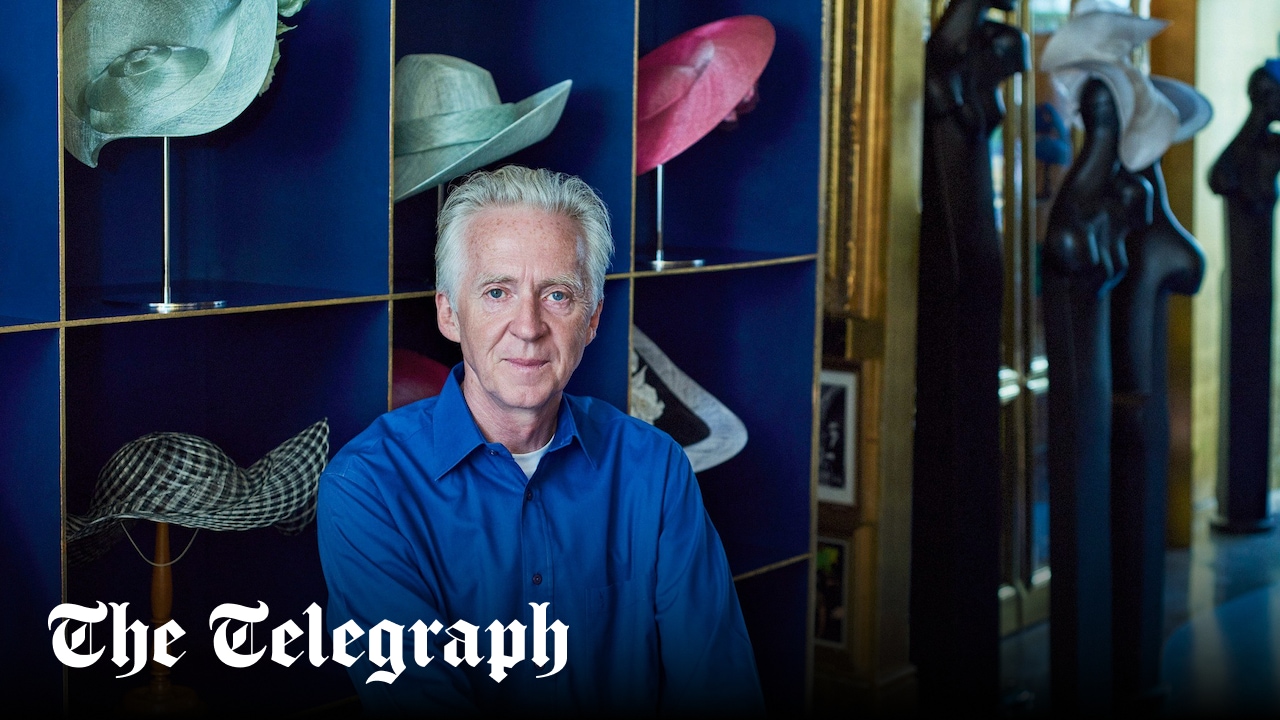
Under the wing of Blow, Treacy was immersed in fashion in its purest form. “This was at a moment when people didn’t applaud extrovert dressers at all, like they do now,” he recalls. “If Isabella decided we’d go to a restaurant, I’d have to take a sharp intake of breath before we walked in because the whole restaurant would just stop, and they didn’t look thrilled… But she didn’t see that.” He thinks growing up in a village in Ireland, where he was the second youngest of eight children, made him accept life with Blow easily: “It’s full of eccentrics, so I was well prepared.”
Blow’s other protégé was the designer Lee Alexander McQueen, the son of an East End cabbie, who has gone on to achieve mythical status, particularly since he also died by suicide, three years after Blow in 2010. Like Treacy, McQueen had a space in the Belgravia house, and Blow also made powerful introductions for him, “because we were not so eloquent, really” – which eventually landed him the creative director job at Givenchy. The milliner had “a front row seat” for the designer’s rise as a fashion provocateur. “She [Isabella] played a huge part of Alexander McQueen, huge. Whether he wanted to admit it or not,” he
says. His words hint at the rift that emerged between Blow and McQueen as their paths later diverged.
“Now Alexander McQueen is this great icon of design, and he deserves all of that, but he wasn’t for many years,” Treacy continues. He remembers McQueen’s early controversies, and his later embrace by the fashion establishment. “He got the job at Givenchy, and [the press] have to like him because he’s good. That was interesting to see how things can evolve. It makes you think about how you’re perceived in a different way when you die, rose-tinted glasses.”
This is not the only time in our conversation that Treacy ruminates on how death alters perceptions. But then when two of the people who shaped your life are gone and you live on to bear witness, it’s a subject with vivid repercussions. “Isabella was like our mum, our success was her success.”
For Treacy, it seems like it has been less about “getting over” Blow’s death, than living alongside it. “She’s very much in the air. She still inspires me,” he says. And it’s a battle to claw back the truth about someone who has been endlessly sensationalised. “The great misconception about Isabella is that she was a sad, tragic person, and in fact, she was the funniest person I’ve ever met, and even in her darkest moments, she was really funny.”
Blow and McQueen remain cultural obsessions to the point that there are two films in the works centred on Blow’s life. One starring Andrea Riseborough called The Queen of Fashion, which will feature clothes and hats from Blow’s own archive – now owned by Daphne Guinness – has been filmed in part at Hilles House, Detmar Blow’s family seat in the Cotswolds. Another, Wild Bird, sees Blow played by Olivia Colman.
‘ The preceding article may include information circulated by third parties ’
‘ Some details of this article were extracted from the following source www.telegraph.co.uk ’