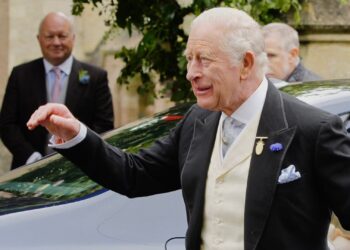
The Prince moved into the 120-room mansion, where he lives with the Duchess and their two children, Lady Louise Windsor and James, the Earl of Wessex, in March 1998.
The Duke, then Earl of Wessex, boasted that Ardent would become one of the country’s leading production firms when it was launched in 1993.
However, the ill-fated company was never far from controversy.
Its first choice of documentary subject was the aristocratic game of Real Tennis – an indoor racquet sport that has only a few thousand players in the UK – which set the tone for accusations that Ardent was simply a vanity project.
Prince Edward was also accused of abusing his position by making a string of programmes about the Royal family, including a documentary about the restoration of Windsor Castle and a history of his great uncle, Edward VIII, called Edward on Edward.
He stepped down as joint managing editor in 2002 after Ardent was forced to apologise for sending a camera crew to St Andrews while Prince William, his nephew, was at university there, in breach of privacy guidelines agreed by media companies.
When the production company – which was initially funded by £200,000 from the Prince himself and investments from Tom Farmer, chairman of Kwik Fit, Michael Kirkham, owner of the furniture chain DFS – closed in 2009, investors were left with just £40.27, according to documents published in 2011.
Royal family housing under scrutiny
The housing arrangements of the Royal family have come under increasing scrutiny after it was revealed that Andrew Mountbatten-Windsor paid a “peppercorn” rent on Royal Lodge for decades.
Last week, the NAO released a detailed report on the leases that the Royal family held on Crown Estate properties, dating back to 2018.
The report will form the basis of an inquiry by the public accounts committee, expected later this month.
The Crown Estate’s property portfolio belongs to the reigning monarch “in right of the crown” but is run as an independent business, with profits paid directly to the Treasury.
Some of the money is then handed to the Royal family to support its official duties as the Sovereign Grant.
The report marked the first time the leases had been scrutinised since a NAO report was published in 2005, two years before Prince Edward’s lease was renegotiated in 2007.
Initially, the Prince had paid £5,000 a year in rent – based on his spending more than £1.3m on refurbishments – before this rose to £90,000 a year once the works were completed. This was described as “market rent” by the Crown Estate.
But after the terms were renegotiated in 2007, Prince Edward paid a peppercorn rent on the home, having paid £5m upfront for a 150-year lease.
In 2002, the couple stepped back from the business, during which Elizabeth II reportedly made a one-off £250,000 payment to compensate them for the loss of income.
The lease is legally owned by a dormant company called Eclipse Nominees Ltd, over which the Duke retains control, but the beneficial ownership of the mansion lies with the third son of the late Queen, meaning he is individually responsible for any tax bills.
Directors for the company include a university friend of the Prince, alongside legal representatives.
Unlike other royal leases, including that of Mr Mountbatten-Windsor, and Prince William’s on Forest Lodge in Windsor Great Park, there are no restrictions on the sale of the lease beyond that the new tenant would be able to afford it. This means that Prince Edward could choose to sell the lease to a non-royal.
Elsewhere in the documents, the Prince was permitted to let out the flat above the Stable – alongside Sunningdale Lodge – as a domestic residence to a member of his staff without rent, or to a “permitted” tenant.
The remainder of the stables could be let out as office space, according to the terms of his lease.
‘ The preceding article may include information circulated by third parties ’
‘ Some details of this article were extracted from the following source www.telegraph.co.uk ’