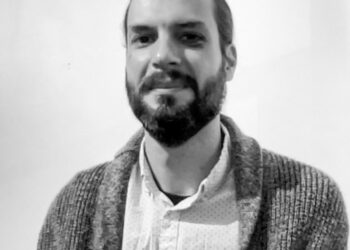
Keller Williams will play a solo show at Belly Up Aspen on Sunday. He plays acoustic guitar while using live phrase sampling in which he creates complex and layered musical soundscapes with guitar, bass, percussion and other instruments, effectively turning himself into a band.
Keller Williams is one of the first artists who broke out as a “one-man band” by using live phrase sampling in which he creates complex and layered musical soundscapes with guitar, bass, percussion and other instruments and accompanies those musical creations with his own live playing, effectively turning himself into a band.
Williams will go back to his roots on Sunday night for a solo show at Belly Up Aspen with his looping skills on full display. His career took off once he started looping and he scored a minor hit with his song “Freeker by the Speaker” off his 2002 debut album “Breathe.”
Williams has released 30 solo albums, all with one-word titles. Along the way, he has played in several different ensembles from a longstanding collaboration with String Cheese Incident, to Keller and the Keels, and most recently Keller Williams and Grateful Gospel.
The latter band recently released a live recording from a show at Greenfield Lake Amphitheater in Wilmington, North Carolina, on Easter Sunday 2025.
“It was also 4/20,” Keller pointed out. “That was a pretty special confluence and Greenfield Lake is a wonderful little amphitheater I’ve been playing for years. It was just one of those nights and we happened to be munti-tracking so we’re proud to have it out there.”
The live album is Gospel versions of four Jerry Garcia Band Songs (“Run for the Roses,” “Midnight Moonlight,” “My Sisters and My Brothers” and “Don’t Let Go”) and two Grateful Dead songs (“And We Bid You Goodnight” and “Here Comes Sunshine”).
Playing with Bobby
Williams was a hardcore Dead Head in the late 1980s and early 1990s (one of his most famous songs “Gate Crashers” involves a canceled Dead show in Indianapolis) and he achieved every Dead Head’s dream when he went from checking out the band to playing in the band. Williams collaborated with Bob Weir dozens of times beginning in 2001.
The first time the two played together, Williams approached Weir in a hallway on a tour in which Williams was opening for the former Grateful Dead frontman. He nervously asked if they could jam sometime. To his surprise, Weir said yes — “But not this show,” Weir said. “And not the next show. But the show after that.”
That show turned out to be Red Rocks.
“So there I am, just me and Bob Weir in this tiny production office at Red Rocks with rocks literally bursting in the room,” Williams said. “I’m singing Jerry harmonies with him. That was the most surreal thing that’s ever happened to me.”
Dozens of sit-ins followed over the years. Weir’s crew would simply set up his gear during soundcheck, assuming he’d sit in.
“He was just a regular dude,” Williams said of Weir. “Very calm, very kind. The longevity of his career, the way he kept playing even when he didn’t need to financially, that was inspiring. But the main lesson I learned from Bob? Not to worry about the ridicule of wearing shorts on stage.”

Keller Williams has released 30 albums over a career that spans over 30 years. He will play a solo show at Belly Up Aspen on Sunday in which he will “loop” sounds he creates with other instruments live on stage and mix them with his own live playing.
Keller comes of age
Williams grew up in Fredericksburg, Virginia. His earliest memory is watching “Hee Haw” as a toddler and fpa for a guitar. By age 3 he was strummingev a toy guitar; at 16 he was playing country club happy hours, a gold mine compared to back-breaking, minimum-wage construction work.
Williams moved to Steamboat Springs after college and for years he played solo gigs in places where nobody seemed to be listening very closely. To entertain himself, he began experimenting with live looping, which was not widely being practiced in the mid to late 1990s.
A pivotal moment occurred in 1998 in Cincinnati when Williams opened for bassist Victor Wooten. Wooten was using a rack-mounted JamMan console with a foot pedal with which you could start and stop an isolated track, which gave Williams the precision and timing he’d lacked while working with makeshift gear.
“That opened my world,” he said. “Once I added bass into the loops people started dancing. That’s when they started buying tickets.”
Williams’ collaboration with The String Cheese Incident on the album “Breathe” (recorded in 1998, released in 1999) was another major turning point for him.
“Recording with Cheese gave me massive exposure. It was huge for me,” Williams said. “The song ‘Best Feeling’ has definitely been one of my most popular songs and String Cheese still plays it beautifully.”
‘Purps’
Williams said his latest album “Purps” is by far his most experimental album yet. He recorded the album in a decidedly old-school way, not quite analog old-school, but digital old school. He created tracks with mixers and CD burners.
“The project started in January of 2022,” Williams explained. “Really it goes all the way back to the pandemic. Everybody was home, mental issues were flying, everything was crazy. I was dealing with health stuff. I quit drinking and I needed something to distract my mind.”
Williams created hundreds of hours of experimental recording inside his basement’s tiny, purple-painted studio, affectionately called “The Purple Room,” the namesake of “Purps.”
Williams would record improvised drum parts on his phone, run them into a mixer and onto a CD, then play that CD through another mixer while overdubbing bass, guitar, vibraphone or vocals, each time burning the entire take onto a fresh CD. Any mistake meant starting over from scratch.
“It’s like an ancient recording, but onto CDs,” he says. “Trial and error for a year and a half, then I took it all to the studio, mastered it, and that’s ‘Purps.’”
The album is meant to be heard as a continuous piece, with songs blending into one another. It is created as a three-part suite — “Ballad of the Moon, Parts 1-3” — which were inspired by the Grateful Dead’s “Anthem of the Sun.”
Williams called the record psychedelic, bizarre and “100% stereo,” insisting it was made to be listened to on stereo speakers, ideally in one sitting.
“It’s music for certain situations,” he said. “Sometimes it’s background music, sometimes it grabs you.”
Asked what he hopes people take away from seeing him play, he said, “I want people to forget everything that’s wrong in the world. There’s so much bad stuff happening in the world. It’ll all still be there when they leave. I want them to come with me, and go where I go.”
‘ The preceding article may include information circulated by third parties ’
‘ Some details of this article were extracted from the following source www.aspendailynews.com ’