Darragh Morgan is nothing if not versatile. Although equally at home playing classical chamber music and contemporary work, the vast majority of his recorded output has been devoted to the latter. Even within this space, stylistic eclecticism is Morgan’s modus operandi, and this latest album, released on the Resonus Classics label, is a case in point, containing four very different works for violin and orchestra from Northern Ireland by composers Bill Campbell, Brian Irvine, Ryan Molloy and Frank Lyons.
The pieces are ordered chronologically, with the first item, Bill Campbell’s Swim, being the oldest on the album, having been premiered by Morgan back in 2006. Cast as a single-movement concerto, the work nevertheless has a fairly clear internal division into three parts, with a central cadenza that eventually winds its way back to the lyrical opening. Although written in a fairly conservative neo-Romantic style – at times reminiscent of Vaughan Williams – it is hard not to be charmed by the gracefulness of the violin’s opening melody, which weaves back on itself multiple times yet always seems to find new expressive outlets.
In contrast to the broad romanticism of Campbell’s work, Brian Irvine’s À mon seul désir is a more densely packed riot of invention that contrasts predominantly frenetic textures with occasionally reflective episodes. The most significant of the latter comes at the conclusion of the second movement, where a poignant melody hovers over a warm glow of static strings. Snippets of this lyricism are glimpsed earlier in pockets of the first movement, and most notably at the beginning of the second, but the rest of the work is dominated by hectic textures in which the violin is alternately ‘loved, ensnared, overwhelmed, halted, saturated or abandoned’, as Irvine himself puts it. This entails a certain amount of virtuosic bluster, but the energy of the piece is irresistible and the concerto has a tight narrative structure that makes for engaging listening.
Ryan Molloy’s Violin Concerto adopts the standard three-movement format, but the Irish-language titles point to a different emotional trajectory than the traditional fast-slow-fast layout. The first movement entitled ‘Goltraí’ (‘lament’) has the orchestra function as an atmospheric backdrop to a solo violin part based on an ornamented figure in the traditional Irish music style. A static drone in the double basses dominates the first part of the movement, but this makes way for more impressionistic sonorities that tend to complement rather than overpower the soloist. While the general soundworld is pleasant, the soloist’s line remains rather curiously detached, and although it continuously returns to the ornamented figure, it avoids the broader emotive lines of the slow air style.
A similar detachment categorises the second movement, which begins with a gently exotic patter of percussion. The ornamented figure reappears intermittently in the soloist’s part and there is more activity in the line generally, but again, it feels as if something is being held back. There are ostinatos and countermelodies in the orchestra, but the harmonic foundation remains stubbornly static and the soloist’s line is a little directionless.
If these two movements feel a little undercooked, the third movement more than makes up for it. Entitled ‘Geantraí’, the movement is a rollicking reel for the soloist that really shouldn’t work but somehow does. The reel itself is a catchy tune that sounds a little like Martin Hayes at the start, faintly recalling Dave Flynn’s Aontacht fiddle concerto, backed by an attractive pulsing accompaniment that lands somewhere between Steve Reich and the Tulla Céilí Band. The soloist’s part becomes progressively more manic and the reel itself seems to slide off the rails with all sorts of non-traditional chromatic notes, dissonances and tricky rhythms. However, at no point does it feel forced; on the contrary, the frenetic contemporary energy seems to emerge quite organically.
Curiously, it’s also the one point in the album where Morgan and the Ulster Orchestra seem under pressure. There are a few points where soloist and orchestra appear to go slightly out of sync and Morgan seems not as comfortable with the twists and turns of the tune. Rather than being a negative, however, this actually makes for quite exhilarating listening and gives a feverish edge to the recording.
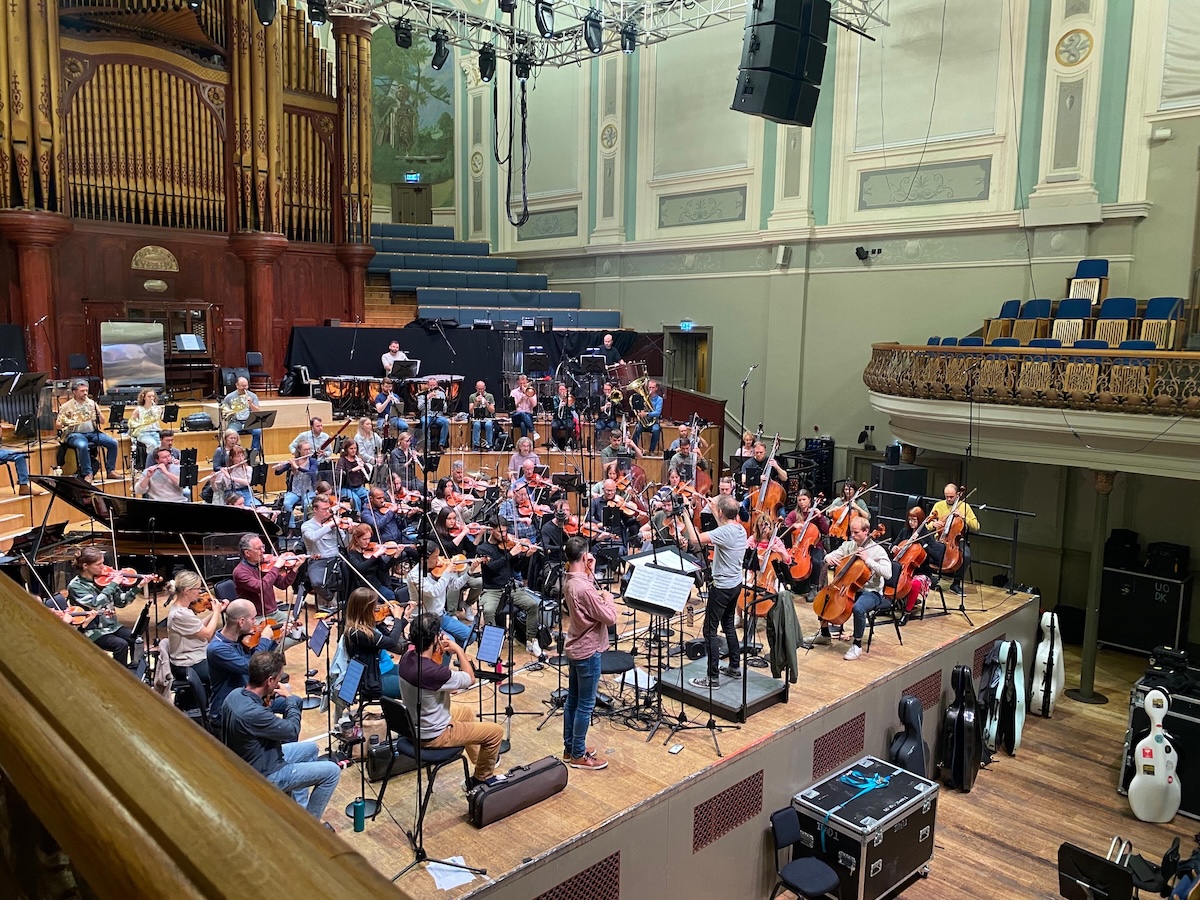
Darragh Morgan, David Brophy and the Ulster Orchestra recording Spin in the Ulster Hall (Photo: Brian Morrison)
Exploratory work
The concluding work on the album is Frank Lyons’ Spin 3, a large-scale, 20-minute work for violin, orchestra and electronics. The piece is the third in a series of Lyons works written for Morgan that reworked and expanded an initial piece for solo violin. It is structured into ten contrasting sections that alternate between those featuring the solo violin and those more focused on the orchestra.
The episodic nature of the piece demands an almost moment-form style of listening rather than a goal-orientated one, and as with most works of this kind, it all depends on the strength of the material at a particular moment. The work is probably the most exploratory on the album and the fragmented structure, with several extended cadenzas for the soloist, gives an overall loose, improvisatory feel.
No matter what the style, one gets the sense that Morgan fully believes in the composer’s conception and it is this impression that makes the album compelling listening. The Ulster Orchestra under David Brophy match this commitment and produce a rich, fulsome sound throughout. This album is not just a major achievement for Morgan himself but an important milestone in documenting Northern Ireland’s contemporary music landscape.
Spin: New Music for Violin and Orchestra from Northern Ireland is released on the Resonus Classics label. Visit www.resonusclassics.com.

‘ The preceding article may include information circulated by third parties ’
‘ Some details of this article were extracted from the following source journalofmusic.com ’