Robert Redford passed away, and unlike some public figures we’ve seen die, the memory of what he brought to the world is nothing but celebrated. He left the movie business better than he found it, delivering indelible classics as well as advocating for independent filmmakers. Throw a dart at his filmography and you’re sure to land on some beloved classic that took advantage of his one-of-a-kind leading man charisma.
However, the movie I thought of when the news hit of Robert Redford’s passing was not one that he starred in. Instead, I immediately wanted to rewatch Quiz Show, the 1994 adaptation of Richard Goodwin’s account and involvement in the 1950s quiz show scandals. Specifically, the fervor surrounding the revelation that popular television game show Twenty-One was completely rigged.
The True Story Of Quiz Show
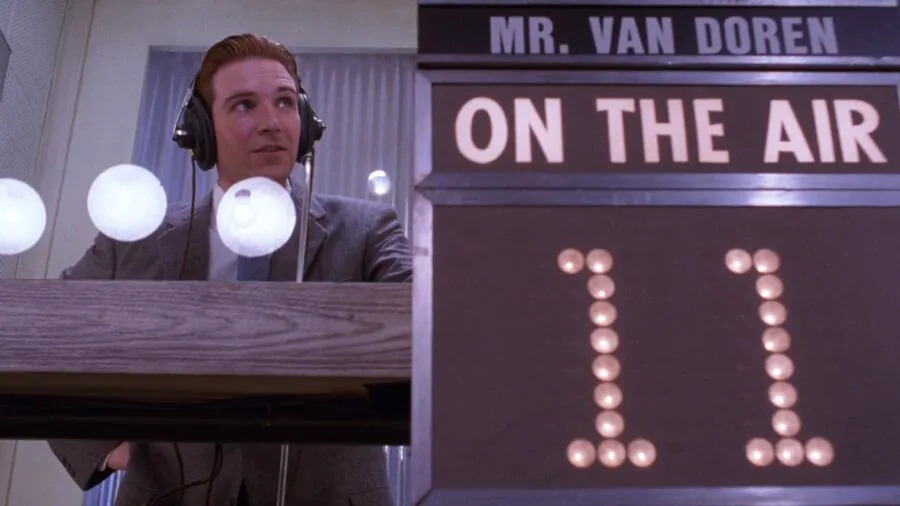
Robert Redford directs the story of Twenty-One and gives focus to three important characters: Charles Van Doren, Herb Stempel, and Richard Goodwin. Van Doren was selected as a contestant for Twenty-One specifically to replace long-time champion, Herb Stempel, who was told to take a dive by the producers. Van Doren realizes that the producers will give him the answers to the questions and decides to go along with the ruse. When young Congressional lawyer Richard Goodwin starts to get suspicious, he begins an investigation into Twenty-One that will reveal the terrifying truths behind the emerging power of television.
There is a lot more about the quiz show scandals that Quiz Show doesn’t cover, but Robert Redford zeroes in on a story that still feels shockingly relevant to the warped world we inhabit today.
“Television is gonna get us.”

Besides an incredible cast — Ralph Fiennes and Jon Turturro fill every second in the spotlight with magnetic energy — and a legitimately riveting story about the early days of television, Robert Redford uses Quiz Show to examine how much America (and the world) is changing due to the devious ways advancements in technologies are being used by corporations. The opening scene has Goodwin contemplating buying a new car, only to remark, “The car drives the man,” and turn on the radio to hear a broadcast about the Soviet satellite Sputnik hovering over Earth. Even then, the car salesman is trying to use these moments to his advantage to sell the car.
The most chilling parts of Quiz Show come in its ending moments, as powerful elites who control the network and their shows parade themselves in front of a panel of similar rich men during a series of inquiries. Big surprise, the ones in power get off with nary a slap on the wrist, while the blame is foisted upon the contestants like Van Doren for playing along. As Goodwin leaves the government hearings in disgust, he says, “I thought we were gonna get television. Truth is… television is gonna get us.” The final moment has one of the Twenty-One producers saying, “It’s show business,” as we fade to black on an image of our capital and an American flag waving in the wind.
Robert Redford made Quiz Show a scathing critique of how entertainment would eventually consume politics until they were indistinguishable from each other. That sure sounds like the world we’re stuck in today, doesn’t it? If for that reason alone, Quiz Show deserves to be rediscovered. It was heralded in its time but has fallen off in conversation and recognition. If the passing of its director is what it takes to get Quiz Show in front of more eyeballs, so be it. It’s one of the best films of the 1990s and has only gotten better with each passing year. Track it down and celebrate a man who wasn’t just a great actor but also a phenomenal director.
‘ The preceding article may include information circulated by third parties ’
‘ Some details of this article were extracted from the following source www.yahoo.com ’