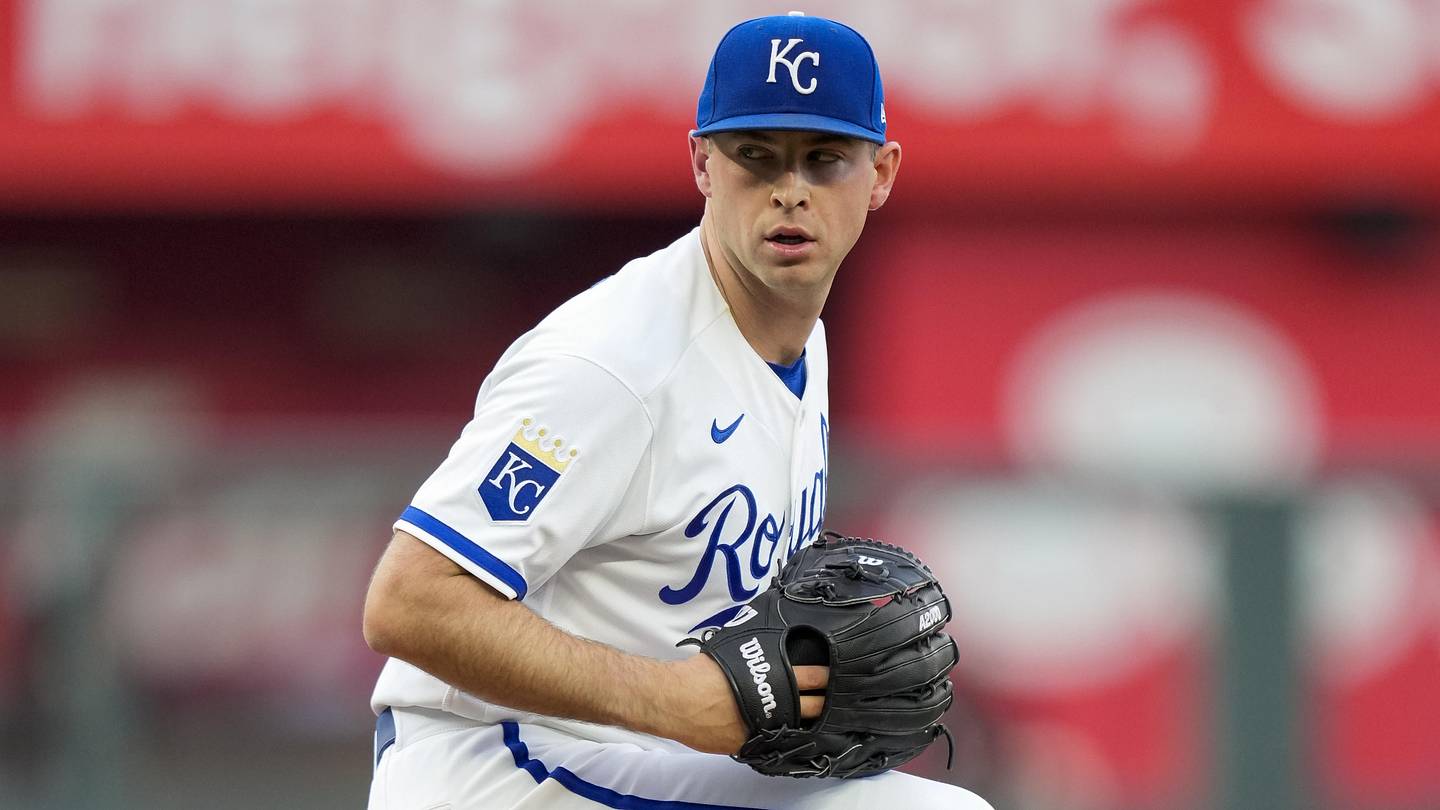
The Kansas City Royals entered 2026 with playoff aspirations and instead find themselves at 27-39, battling the Detroit Tigers for last place in the AL Central and trending unmistakably toward becoming sellers at the trade deadline. One of the most obvious assets to move is left-hander Kris Bubic, a 28-year-old 2025 All-Star in the final year of his contract, and USA Today’s Bob Nightengale has already reported some smoke between the Royals and the Athletics.
While the Royals are reportedly not ready to make trades right now according to Nightengale, that seems like a matter of when rather than if. The complication for Bubic’s trade value is that he is currently on the 15-day IL with left elbow soreness.
Through nine starts before the IL stint, he went 3-1 with a 4.11 ERA, 51 strikeouts, and a 1.23 WHIP. That follows a 2025 season in which he posted a 2.55 ERA across 20 starts and earned his first All-Star selection. Over the past two seasons combined, he carries a 2.58 ERA with a 167-to-65 strikeout-to-walk ratio. When healthy, he is a legitimate mid-rotation starter, and at a $6.15 million salary, he is one of the most cost-effective arms a hopeful contender could add.
Kansas City also holds a leverage card that has nothing to do with Bubic himself. The 2026 deadline is shaping up to be dominated by Tarik Skubal at the top, and below him, the starting-pitcher market is thin. Reports have downplayed the availability of Paul Skenes, Hunter Greene, Freddy Peralta, Joe Ryan, and Pablo López. Every front-line arm that comes off the board pushes more contenders toward the second tier, where Bubic lives. Scarcity inflates price.
The elbow issue is the real thing holding Bubic’s trade value back, especially with an open-ended nature. That reality pushes the realistic return toward a two-prospect package of secondary pieces rather than a single premium name. The Royals need to thread the needle: move Bubic while contenders still believe in the underlying track record, before the testing timeline drags the price down further. But, if the Royals were to make a move with the Athletics, here are three names that should be in the talks.
Royals could bolster infield depth with Joshua Kuroda-Grauer
The Royals’ need at second base has been well-documented, and Joshua Kuroda-Grauer answers it directly. The 23-year-old former Rutgers standout, Big Ten Player of the Year as a junior, hit .296 with 30 doubles and 27 stolen bases across 121 games between High-A and Double-A in 2025, helping Midland reach the Texas League Championship. He has struck out just 83 times in 943 career minor league plate appearances. Saying the New Jersey native puts the ball in play is an understatement.
He has seen a jump in extra-base production this season, already nearly tripling his home run production from 2025. Kuroda-Grauer is on pace for a coveted 20/20 season in the minors, and spending most of the season at Triple-A will only shoot his outlook even higher. Kuroda-Grauer is not a perfect prospect, but his production is notable in 2026.
Joshua Kuroda-Grauer hit two homers over 121 games last year.
He just launched two in one game for the Double-A @RockHounds!
The @Athletics‘ No. 10 prospect has five homers across 16 contests this season. pic.twitter.com/3ESAvuco7q
— MLB Pipeline (@MLBPipeline) April 22, 2026
A’s assistant general manager Billy Owens drew a comparison that should get Kansas City’s attention, saying Kuroda-Grauer has “similar makeup qualities to Marcus Semien.” Owens also acknowledged the depth working against Kuroda-Grauer’s visibility, saying “Our system is stronger than most years, or else [Joshua Kuroda-Grauer] would be getting a lot more prospect love.”
The power grades below average, and the fair ceiling is a solid everyday middle infielder rather than a star. But a 55-grade hit tool with 60-grade speed and the ability to play three infield positions, already at Triple-A in his third professional season, is exactly the profile Kansas City should be targeting. Jacob Wilson is locked in at shortstop, and Leo De Vries is on the way, leaving Kuroda-Grauer blocked in Sacramento. He could be the centerpiece of any Bubic discussion.
Right-hander Zane Taylor could address Royals’ dwindling pitching depth
Right-handed pitcher Zane Taylor is a piece that rounds out a package and addresses a secondary Kansas City need. A fifth-round pick last summer out of UNC Wilmington, Taylor was one of the most polished arms in the 2025 draft class. He led all of NCAA Division I in K/BB ratio (9.6) and WHIP (0.76) as a senior, ranked second in walk rate, and finished fourth in ERA (1.98) while winning Colonial Athletic Association Pitcher of the Year.
His ceiling is a mid-rotation starter, not a front-line arm. His game doesn’t scream a dominant starter, but someone with pitchability who could grow to trust his present stuff a bit more in the zone. This season, Taylor has a solid 2.75 ERA in High-A, by the combination of 44 strikeouts and 21 walks in 52.1 innings is a red flag.
The organization has compared him internally to a young Sonny Gray: undersized, with a drop-and-drive delivery and deceptive extension that makes his pitches difficult to read out of his hand. The five-pitch mix gives him an answer for both lefties and righties without leaning on one dominant offering.
Zane Taylor was awesome, dicing through Great Lakes: 7 2/3 IP, 2 infield singles, 0 runs, 9 K. pic.twitter.com/VCr60ij4vA
— Jesse Goldberg-Strassler (@jgoldstrass) June 5, 2026
Taylor belongs in this conversation precisely because the Athletics’ pitching pipeline is so deep that he is genuinely surplus. Prospects like Gage Jump and Jamie Arnold certainly have higher ceilings and better routes to the majors than Taylor does.
He would be an addition to a Kansas City system that has been thinned by rotation injuries throughout the minors, a misunderstood strike-thrower who profiles as a big-league depth starter, the exact kind of arm that becomes valuable when a team runs through as much pitching as the 2026 Royals have.
Royals should take advantage of how blocked infielder Tommy White is
Infielder Tommy White is blocked in the Athletics’ system about as completely as a prospect can be. Nick Kurtz won the American League Rookie of the Year award at first base last season. Jacob Wilson is the shortstop. Max Muncy holds second. White’s glove is not good enough right now to stick at the hot corner every day. The infield is spoken for from top to bottom, and White, a right-handed power bat with a 55-grade power tool, has nowhere to go in Sacramento. Kansas City should take advantage of that.
The 22-year-old LSU product hit 10 home runs across High-A and Double-A in 2025, then posted a .292/.395/.441 slash in the Arizona Fall League that reinforced the belief the power is real, and the hit tool is developing. He’s at Triple-A Las Vegas in 2026, a placement that signals organizational belief even as his path to Oakland stays sealed off. For a Royals team whose corner production has been inconsistent, a 22-year-old with a 55-grade power tool at Triple-A is a meaningful addition.
Tommy White torpedoes an opposite-field roundtripper for Triple-A @AviatorsLV 💥
The @Athletics‘ 2024 second-rounder has hit safely in 19 of 21 May contests, a span in which he has 19 RBIs: pic.twitter.com/thyIBRs3aS
— MLB Pipeline (@MLBPipeline) May 29, 2026
Royals fans pointing to Vinnie Pasquantino already holding down first base is a valid response. But while Pasquatch is beloved, even he has admitted that his performance this season has not been great. And the late-bloomer does not look like the cornerstone kin to shortstop Bobby Witt Jr. or third baseman Maikel Garcia. White would give the Royals another right-handed bat with notable power at at position without a untouchable player. Even with Pasquantino’s resurgence at the plate, the slow starts are hampering his overall contributions.
The ceiling is a right-handed masher who hits 20-25 home runs annually at his peak. That is just what Kansas City needs to lengthen the lineup and is a useful bat on a team that badly needs more of them in the pipeline. White and Kuroda-Grauer together would represent a strong offensive return for a pitcher Kansas City may not be able to re-sign anyway.
None of these three are Leo De Vries or Jamie Arnold. That is the point. The Royals are trading a rental left-hander with an elbow issue, not a franchise cornerstone, and the return should reflect that honestly. But Kuroda-Grauer, Taylor and White, or some two-of-three combination depending on how Bubic’s testing comes back, would address Kansas City’s middle infield need, add corner-bat projection, and deposit a polished arm into an injury-thinned system. The Athletics get the rotation help they need for a second-half push. The Royals get younger, deeper, and more aligned with the timeline that actually matters.
‘ The preceding article may include information circulated by third parties ’
‘ Some details of this article were extracted from the following source kingsofkauffman.com ’