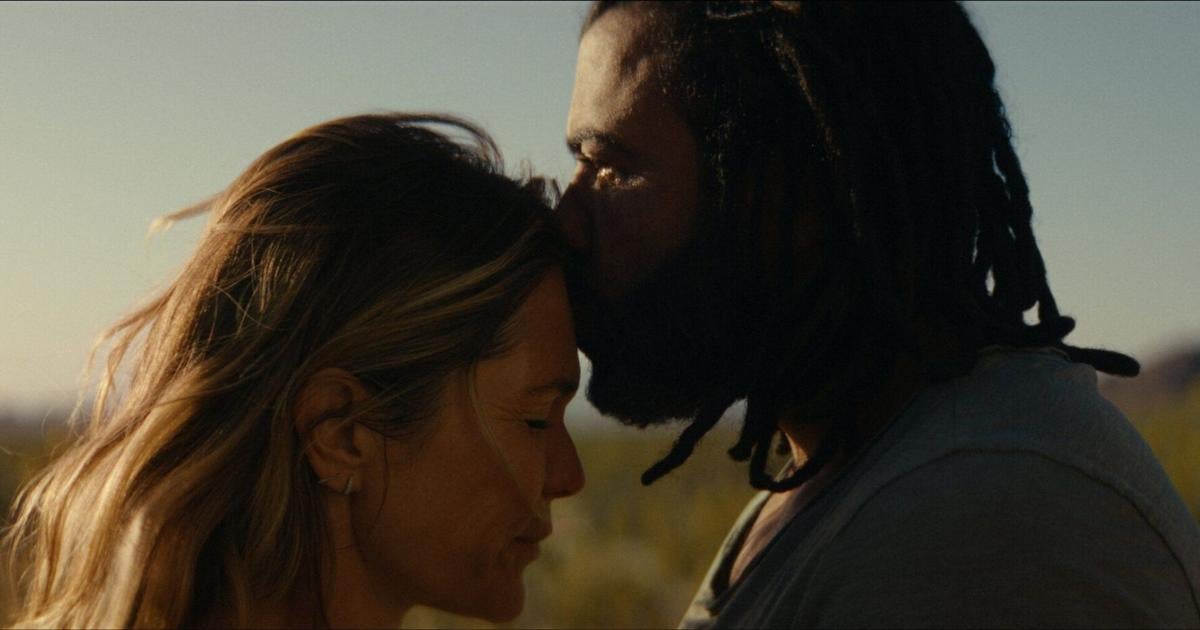
“Magic Hour,” the new romantic drama from director Katie Aselton about a couple who take a little trip out into the desert to work through some big challenges, has many tricks up its sleeves.
In addition to boasting plenty of indie talent, with Aselton (“The Puffy Chair”) starring alongside Daveed Diggs (“Hamilton”) while working from a script she co-wrote with her husband Mark Duplass (“Backrooms”), there’s also a core supernatural element that arises fairly early on. But rather than take us away from the relationship of the couple, it brings us closer to both of them, including in the film’s intimate scenes.
For these, the film turned to S.J. Chiro, the veteran Seattle filmmaker who recently directed the locally filmed “East of the Mountains” and has also begun increasingly working as an intimacy coordinator. This means she’s one of the go-to people helping choreograph intimate scenes on productions like “The Year of the Fox,” “Penelope” and now “Magic Hour.” For Chiro, it’s about making sets a supportive, safe place both for actors and the crew working on them.
“The intimacy coordinator works really hand-in-hand with the director. They’re there to actually make things better and take pressure off of the director,” Chiro said, comparing it to being like a stunt coordinator in how the role serves the film. “The collaboration is so fun, so great.”
Even though the supernatural twist of “Magic Hour” complicated the intimate scenes, Chiro said her work remained the same.
“I don’t want to give anything away, but it was a kind of spiritual visitation. But the truth is, the actors were engaging and touching,” Chiro said. “So we treat it the same way we always do.”
Chiro said she now hopes intimacy coordinators can become a standard role on productions.
“It’s just work that I really believe in,” Chiro said.
Also a believer in this work is Mel Eslyn, president of Duplass Brothers Productions, which produced “Magic Hour.” (She also directed the aforementioned “Penelope” and the recent “Biosphere.”) She said that, after experiencing sets that weren’t safe when it came to intimate scenes, she’s made it so all Duplass Brothers productions now have an intimacy coordinator.
“I saw how (an intimacy coordinator) affected, in a positive way, everybody on set, not just the actors. So since then, I made it a companywide requirement. Even if we can’t have them on set, they’re available remotely, so a safe space is created regardless,” Eslyn said. “It’s like, you can’t shoot a movie without a director or a cinematographer.”
Eslyn said rather than limiting a filmmaker’s overall vision, intimacy coordinators free up the actors to explore more areas of vulnerability, which was a key part of her film “Biosphere.” After working with Heather María Ács, who she said was a “great” intimacy coordinator on that film, Eslyn was determined to never go back to having productions without one. It’s not just about serving the film, but ensuring productions don’t put anyone in unsafe or uncomfortable positions, which Eslyn said she’d experienced personally when working on a local project years ago.
“It was a Seattle production that very much scarred a lot of us,” Eslyn said, recounting how she was asked to serve as a stand-in actor due to budget constraints in what she identified as being “very unsafe” intimate scenes. She now considers intimacy coordinators critical to ensuring bad experiences like she had don’t happen to others. “When all this stuff (the role of intimacy coordinators) started to come up, I was like, ‘Oh, I was put in a very uncomfortable position.’”
For Chiro, no matter the production or budget, she sees the work of an intimacy coordinator as being intertwined with both making sets safe environments and creating the best films possible.
“When people ask me to do this work, they’re doing it for a reason,” Chiro said. “It’s a wild world on set.”
‘ The preceding article may include information circulated by third parties ’
‘ Some details of this article were extracted from the following source www.yakimaherald.com ’