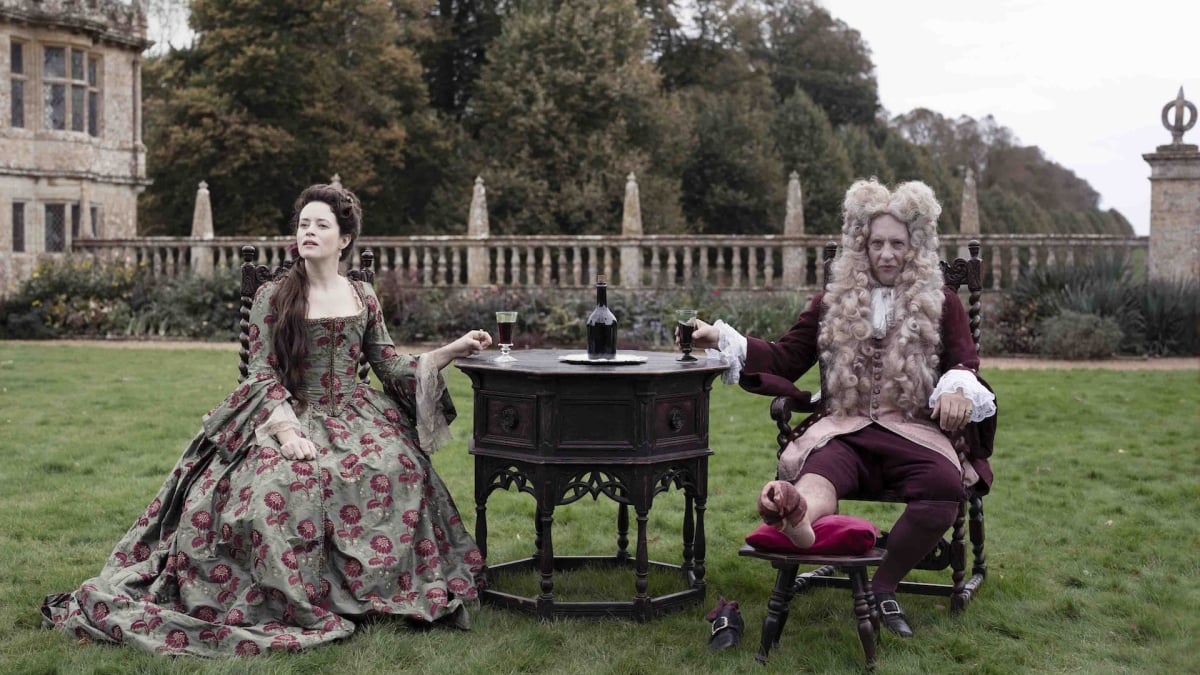
The aristocratic art of hosting a dinner party becomes a bloody, pustulant battleground in Savage House, a riveting dark comedy so rich it’ll make you sick.
An ostentatious political commentary on 18th-century English profligacy written and directed by Peter Glanz (Captain America: Brave New World), Savage House presents two households, both alike in dignity, living within one household. However, this is no fairytale of upstairs/downstairs benevolence like Downtown Abbey or Bridgerton. Instead, it’s a brutal, bombastic tale of class and social climbing, in which extravagance and overindulgence can’t cover the cracks forever.
With majestic performances from a theatrical Richard E. Grant and deadpan Claire Foy, pristine production design that literally and figuratively rots from within, and over-the-top direction from Glanz, Savage House is a hilarious cautionary tale, a testament to status-seeking by any means necessary.
Savage House makes a lavish meal of 18th-century class politics and paranoia.
Political suspicion and health paranoia hang heavy in Britain when we meet the Savages, a near disgraced family of nobility only plagued thus far by reckless spending. Smallpox is decimating the population, while the Jacobite uprising is in full swing, with the exiled House of Stuart attempting to overthrow the ruling House of Hanover in the background. Trust is scarce; pestilence abounds.
With most of the aristocracy’s travel plans abandoned, there’s little opportunity for the histrionic Sir Chauncey Savage (Grant) and pragmatic Lady Savage (Foy) to reach higher on the coveted social ladder. However, in a moment of pure pox-related luck, the still-traveling Duke and Duchess of Devonshire find themselves in need of accommodation — and they want to dine with the Savages.
But this is no casual soirée; this is a production. And they’ve only 10 days to see this “march of folly” done by the evening of the impending solar eclipse.
Pooling every last resource and rallying their skeleton crew of a house staff, the Savages will host the Duke and Duchess, and they will savor the spoils of such a lofty connection. But a dinner such as this could also cost them everything, as debt collectors circle, servants plot, and hired professionals (from tailors to providores) know that having money doesn’t mean you know how to spend it.
Mashable Top Stories
Richard E. Grant and Claire Foy are shining comedy jewels in Savage House.
Opportunists united, the Savages feel simply made for each other. As the heads of this noble family, Grant and Foy’s unique chemistry renders their long relationship one of utter frankness and admiration. Marriage being “hard work” lies at the core of many a film, and here, it reaches more match points than a Wimbledon final. But nothing, not even inflammatory arthritis or in-house adultery, seems to be able to rattle these two, both adorned in Alex Bovaird’s exquisite period costumes.
As the magniloquent, simply pestilential Sir Chauncey, Grant is an outsider in the ruling class, more terrified of returning to his working class roots than losing a limb. In his cavalier “everything’s fine” manner and an increasingly large powdered wig, he scorns the Jacobites as “seditious imbeciles masquerading as revolutionaries” while performing his own ruse as an aristocrat, rehearsing speeches of feigned hospitality. A maniacal smile plastered on his starchily decorated face, Grant’s Chauncey crawls to the end of Savage House, a gangrenous, gout-ridden husk of a networker who refuses to say “when” — especially if you’re pouring him another drink. “Like an undercooked soufflé,” the film’s narrator tells us, “he was collapsing into himself.”
Meanwhile, as Lady Savage, Foy is a formidably bemused force who flourishes in a rare comedic role for The Crown star. Having actually come from wealth, the lady of the house married for love rather than social ambition, her rogue romantic choice rewarded with an undeniably compelling but unfortunately spendthrift husband. Knowing the fiscal reality of the duke and duchess’ visit and their lack of means to deliver such a production, Lady Savage salvages every last glimmer of possibility, with Foy’s fierce performance one of determinedly keeping up appearances while secretly relishing in the madness of it all.
Neither have much time for their sweet, astronomy-loving daughter Fanny (Kíla Lord Cassidy), whose obsession with the incoming lunar eclipse and her mouse mansion makes for a fitting parallel with the main storyline. However, they should really keep a closer eye on the marvelous Bel Powley and Jack Farthing as their long-suffering servants, maid Dorothy Neville and valet Reginald Halifax.
These are the imperturbable working class people who empty the Savages’ stinking bedpans and catch their hungover projectile vomit while lavishing praise upon them and fantasising about their demise. Notably, they’re also their employers’ confidantes, assisting them in various scams. A thieving brigand borne of gambling addiction, Sir Chauncey requires Reginald’s help in his casual chicanery to keep his purse full, with no respect awarded in turn. “I care for you like a son…or an affectionate dog,” Sir Chauncey tells his valet. When Dorothy feeds Fanny’s mice and hungrily feasts on their crumbs, it’s clear these rodents live better than the servants. The Savages might regret that.
Savage House‘s production design is so opulent it’ll make you sick.
Visually, Savage House is at once magnificent and horrific, a triumph of meticulous period detail and visceral juiciness that makes you feel like you can actually smell the film. Production designer Gary Williamson deploys overt visual metaphors of rotting fruit around the mansion, routinely rotated by servants to hide the decay.
A pendulum of lush, symmetrical wide shots and unwelcome close-ups of beheaded fowl and chewing mouths by director of photography Adriano Goldman, the film brilliantly balances abundance with disgust. Glanz, who also edited the film, delivers furious montages and quick cuts to up the drama over seven parts. As the Savage purse empties and the opulence of the estate increases, the film’s set decoration follows suit. Elaborate rehearsal dinner spreads, ludicrous family portraits, a stream of auditioning entertainers, and customised fashions appear edited alongside shots of bloody pheasant bodies, trodden piles of ambiguous shit, festering sores, and grisly 18th-century medical treatments.
It’s a gruesome portrait of maintaining hierarchy and influence. And it’s this constant contrast between pain and pleasure, effort and guise, that makes Savage House such a compelling depiction of class politics, with the film decrying “perception is everything, especially among the ruling class.”
Savage House will inevitably find itself compared to Yorgos Lanthimos’ The Favourite, as two 18th-century dark comedies featuring gout-ridden aristocrats and underlings jostling for a sliver of power. However, Glanz’s film finds its own inflamed, leech-dotted footing, as a rambunctious cautionary tale of the cost and moral quandaries of “rattling the social ladder.”
Savage House was reviewed out of SXSW London and is now showing in UK cinemas and U.S. theaters.
‘ The preceding article may include information circulated by third parties ’
‘ Some details of this article were extracted from the following source mashable.com ’