IN MALCOLM M. ROBERTS’ 1941 PAINTING “Lunar Landscape,” surrealism washes up on an imagined Pacific Northwestern shore.
The title of the work implies that this dreamy scene takes place on the moon, but the mountains in the background look eerily like the Olympics during a stormy sunset. Pieces of driftwood are stuck upright into a shoreline, wrapped in rags, as purple-black clouds roil above. To Seattleites, the landscape may appear both oddly familiar and totally foreign, as if conjured from a dream that collided into a memory. Roberts — who lived in Seattle all his life — was deeply inspired by surrealists like Salvador Dalí, translating their taste for the uncanny onto Pacific Northwest vistas, beating David Lynch to the punch by a good half-century.
“Lunar Landscape” and over 150 other artworks are on view in Seattle Art Museum’s latest show, “Beyond Mysticism: The Modern Northwest,” which closes Aug. 2. Taking its name from the “Northwest Mystics” — the infamous term bequeathed upon painters Guy Anderson, Kenneth Callahan, Morris Graves and Mark Tobey in 1953 — the exhibition bucks the idea that artists working in midcentury Seattle were solely working in the “mystic” tradition as current scholarship typically holds.
Instead, “Beyond Mysticism” offers a glimpse at a wide breadth of abstract, social realist and surreal artwork made in Washington state by artists who worked in the same time period as the “Big Four.” In addition to showcasing work by the Northwest Mystics and their lesser-known contemporaries, the exhibition also mixes in pieces by celebrated artists who were working outside the Pacific Northwest at the time, including Georgia O’Keefe, Max Ernst and Dalí, to further contextualize the ideas that were circulating in the Pacific Northwest. Most of the pieces in the show come from SAM’s collection.
On the whole, “Beyond Mysticism” asserts that midcentury Seattle was not some mysterious, spiritually impenetrable outpost in the left corner of the contiguous United States, but a home to a diverse array of artists riffing on modernism in a way that revealed more about the Emerald City than it obscured.
Getting beyond the Big Four
Theresa Papanikolas, SAM’s curator of American art, first got the idea for the exhibition while combing through the museum’s collection ahead of the American galleries reinstallation back in 2022. She found dozens of artworks by local artists from the mid-20th century that SAM hadn’t shown much. The Big Four always got their shine, but considering their work alongside that of other artists from the same period revealed something deeper: a regional perspective rooted in nature and shaped by the social, economic and cultural conditions of the time.
“Any kind of scholarship on modernism in the Pacific Northwest really focuses on four artists,” Papanikolas says. “This was not aligned with what I was finding in the collection, which was all these other artists and artworks. A lot of it wasn’t mystical or even abstract. I wanted to develop a project where I could tell the real story of what happened in the Pacific Northwest from the 1930s up through, and a little bit after, World War II.”
For the uninitiated, the oft-told history of the Northwest Mystics goes something like this: On Sept. 28, 1953, Life magazine published an article titled “Mystic Painters of the Northwest,” launching Anderson, Callahan, Graves and Tobey into the national sphere.
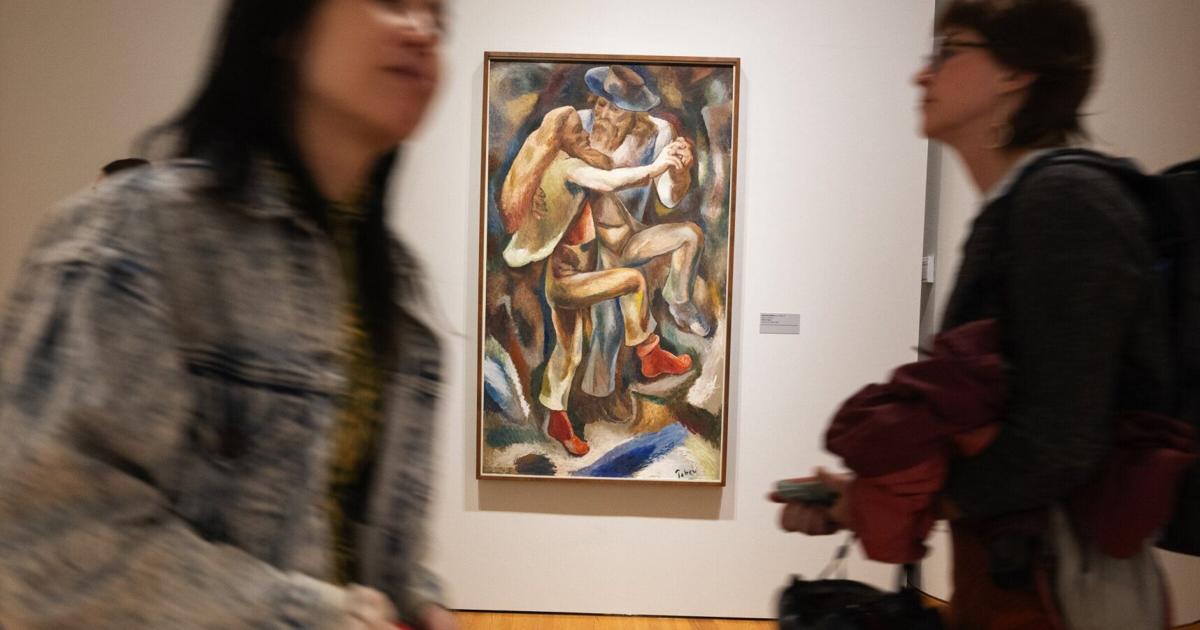
The article noted the “Big Four” of the Northwest School for the air of so-called mysticism of their work, a label that exoticized the inspiration they derived from the Pacific Northwest’s Native and Asian communities as well as its natural world. Specifically, Anderson was known for his monumental, earth-toned works and nude figures; Callahan for his paintings of laborers and nature as well as his later dalliance in abstraction; Graves for his use of color, light and depictions of birds; and Tobey for his calligraphic abstract paintings.
Furthering the intrigue around these four men was the fact that all of them knew and greatly influenced one another. (Callahan and his first wife, Margaret, routinely hosted salons at their house; Graves and Anderson were even lovers at one point). Their tangled web of connections only fueled the “mystic” narrative.
“[The Life article] made them seem super wacky and mystical and interested in life forces beyond what was visible,” Papanikolas says. “There’s a lot of great scholarship on this period, but it always tends to take at face value that these artists were mystical in the sense that they’re pulling from some unseen force within the Pacific Northwest.”
Rooted in time and place
Because the exhibition’s thesis is so wide, its berth of included artists feels like who’s who of the midcentury in Seattle, regardless of medium.
There is sculptor James W. Washington Jr.’s egg-like granite carving of a noble woodchuck; photos from smoky jazz clubs along Jackson Street taken by prolific photographer Al Smith; the dusty, industrial desertscapes depicting the construction of Grand Coulee Dam and serene blue green pools of Kettle Falls by Eastern Washington’s Z. Vanessa Helder; painter and sculptor George Tsutakawa’s impeccably balanced abstract wooden sculptures.
In some pieces, bits of Seattle are distinctly recognizable — like in the impressive 1942 watercolor of the crowded ship docks on Lake Union by Fay Chong, who studied art alongside Graves and Tsutakawa at Seattle’s Broadway High School. Anyone who has huffed up Yesler Avenue from Pioneer Square will immediately clock the setting of Kenjiro Nomura’s “Street” which renders the avenue in a serene wash of blues and grays. (“Beyond Mysticism” includes an interactive game where visitors guess the locations depicted in each painting.)
In other works, painters like Callahan and William Cumming depicted the factory and lumber laborers who fueled the region’s economy. Through their work, these artists fastidiously mapped the city and people who built it, reflecting the ways the various industries impacted the region.
Collectively, Pacific Northwestern artists had their own unique take on abstraction, one deeply informed by Asian and northwest Native art traditions. Tobey, in particular, was noted for his study of Asian and Arabic calligraphy, which inspired his “white writing” technique that featured an ecstatic network of white lines over a Pollock-esque abstract painting. Anderson almost wholesale ripped Salish motifs in works like “Primitive Forms II,” which feature vaguely recognizable renderings of eyes.
The works made by the Big Four stand in contrast to artworks made by Asian, Asian American and Native artists of the time who blended their own cultural heritage with their understanding of modernist art. During their lifetimes, their unique perspectives as minority artists were often sidelined as traditional examples of Asian or Native art and overlooked by the mainstream rather than being taken seriously in their own right.
Take, for instance Julius “Land Elk” Twohy’s lithograph “Tom Toms and Drum” (1939). Twohy, a member of the Ute tribe, transformed patterned drum skins into several ornamented Kandinsky-like orbs that thrum with their own rhythm and energy. Paul Horiuchi, a Japanese immigrant to Seattle, riffed on abstract expressionist forms by collaging hand-dyed rice paper into angular forms, inspired by the old, peeling layers of paper advertisements posted on buildings around the Chinatown International District.
One of the most powerful moments in the show is in a gallery where Horiuchi’s “Monolithic Impasse” (1964) hangs across from works by two of the biggest artists in abstract expressionism — “Cross Section” (1956) by Franz Kline and “Crimson Spinning #2” (1959) by Adolph Gottlieb. Though Horiuchi worked in collage rather than oil paint like Kline and Gottlieb, their forms are similar — angular, dark, and energetic. Together, they ask the viewer to consider who gets recognized in conversations about modernism and abstract expressionism.
In overlapping all these perspectives and experiences, “Beyond Mysticism” brings a depth to the understanding of the artistic goings on of Seattle during a period where the city was rapidly growing and industrializing. The scene was always more than four painters simply divining work from within themselves, producing paintings that were the result of otherworldly forces. Rather, they were artists painting within a community of artists who were, in turn, inspired by their own histories, heritages and environments that then broke through in their art.
Ongoing influence
Despite the brouhaha over the Northwest Mystics, their direct influence on subsequent generations of Seattle artists is comparatively light. Ironically, by the time Life’s article came out declaring the existence of a Northwest School, the Big Four had stopped talking to one another and many rejected the “mystic” title outright.
But many of the core defining characteristics about Seattle remain basically unchanged. The city is still on an isthmus surrounded by cold bodies of water and snowcapped mountains in every direction. Pike Place Market still bustles with activity. The ebb and flow of industry still profoundly shape the city. And Seattle is still home to diverse cultural communities making an outsized impact on artists living and working here today.
John Braseth, owner of Woodside/Braseth Gallery, frequently exhibits work by the Big Four. “Consciously or subconsciously, artists paint their environment,” he says of the throughline that connects Seattle artists across generations. Just as artists trafficked in related influences and inspiration in midcentury Seattle, today the city’s contemporary artists make work shaped by a similar sense of place. And while equity still isn’t a given, many artists of color are actually getting their due now.
One artist gobbling up the city and spitting it back into her art is Stevie Shao, a Seattle-born and raised muralist and painter. She got her start painting boarded up windows of businesses during the early part of COVID. Inspired by her Chinese heritage and the flatness of Americana tattoo flash sheets, Shao’s work is taxonomical. Flora and fauna from the Pacific Northwest and Chinese folk tales — orcas, dragons, hares, trees, cranes, seals, starfish and seaweed — often pepper her vibrant murals as well as her studio paintings.
Unlike many of the artists featured in “Beyond Mysticism,” much of Shao’s work is literally located in the city’s landscape. A giant mural of hers wraps around the Crossroads Trading building in the University District, pulsating vermilion red with blue and orange animals dancing across it. Color is a vital tool in Shao’s work, one that gives her pieces their reflective edge of the communities in the city.
“It’s like how grunge is from here,” Shao says. “[Artmaking] is the same sort of thing — there’s a sort of introspection.”
Color is a huge part of Cristina Martinez’s practice. Raised in Tacoma but now based in Seattle, the painter of Black and Mexican descent composes portraits of young women of color in intimate spaces — their homes, their beds, their dreams. Martinez says growing up in the Pacific Northwest had a huge impact on her vibrant pieces, particularly, going on hikes with her mom.
“I would go and stop every two seconds trying to see every tree, every leaf, every color,” Martinez says. “I liked the story of nature, going through seasons — periods of wilting and periods of blooming.”
Painter Gillian Theobald’s paintings border on abstraction — the verdant plants and flowers she depicts only just take a recognizable form. Looking at her lush, flat paintings is kind of like looking at a landscape through pressed eyelids; the colors feel hot and forms stripped down to their essential shapes. As a grad student at San Diego State University in the ’70s, she learned how to paint from abstract expressionist teachers which she says helped break down elements to their most essential.
Theobald grew up in southern California in the midcentury, the daughter of a British father — a philosophy professor — and an American mother. Growing up, her parents were into spiritual mysticism, traversing the mystic outposts of Christianity, Hinduism and Buddhism with spiritual leaders often coming to her house for tea (including Walter Evans-Wentz, a spiritualist who was known for compiling English translations by others into “The Tibetan Book of the Dead” and other works). Though Theobald didn’t think much of it at the time, her parents’ mystic intrigue made its way into her work.
“Spiritual things have always been significant to me,” she said. “And for some reason, the landscape has been a voice for that.”
Her paintings don’t depict a concrete or real space, rather, are fictive landscapes composed of whatever Theobald meditates on that day. Bits of Horiuchi could be traced to Theobald’s collages, which she began making in the ’80s, shaping collected bits of billboard paper into flat sculptures. Today, she continues that collage practice but with pieces of painted cardboard boxes or other discards, transforming them into unique structures — her environment literally becoming art. However she says much of her work isn’t directly inspired by Washington’s nature, but is moved by the way light and color interact in the Pacific Northwest.
“If you live in this dark cloudy place, you kind of crave color,” she says.
Landmarks and imagined peaks are front and center in Seattle-based artist Ryan Molenkamp’s acrylic paintings, which depict familiar settings like the meadows surrounding Mount Rainier and the cool waters of Lake Chelan in thick brush strokes pieced together like strips of paper. Molenkamp has spent his entire life in the Pacific Northwest, and it shows in his renderings of regional sights like volcanoes, earthquakes and deforestation.
“Beyond Mysticism” contains the DNA of these contemporary artists. In Callahan’s sweeping mountain vistas are threads to Molenkamp’s thick landscapes; in Al Smith’s photos of jazz clubs are threads to Martinez’s emotive portraits; in Graves’s renderings of birds are threads to Shao’s vibrant murals. The sense of place runs through them all.
While the exhibition expands the understanding of what exactly was going on in Seattle’s midcentury arts scene, it doesn’t undercut the very real talent exhibited by the Big Four of the Northwest School. “Beyond Mysticism” rightfully recognizes their artistic greatness while also appreciating that they arrived at greatness within the context of something much bigger and much more inclusive.
‘ The preceding article may include information circulated by third parties ’
‘ Some details of this article were extracted from the following source www.yakimaherald.com ’



![[L-R] Professor Tshidi Mohapeloa, Dean of Commerce; Professor Michelle Karels, Registrar; Dr Kwezi Mzilikazi, Deputy Vice Chancellor: Research, Innovation and Strategic Partnerships; Professor 'Mabokang Monnapula-Mapesela, Deputy Vice Chancellor: Academic and Student Affairs; Professor Siphokazi Magadla, Dean of Humanities; and Professor Boudina McConnachie, Head of Music and Musicology. [PIC: Micky Oscar]](https://celebrity.land/en/wp-content/uploads/2026/07/Latest-News-Where-language-ends-music-speaks-Professor-Catherine-120x86.png)