Compared with opera or orchestral music, chamber music has always had one practical advantage: It travels light. This summer, the Seattle Chamber Music Society is putting that mobility to work.
Benaroya Hall renovations have temporarily disrupted the usual home base for SCMS’ flagship Summer Festival, billed by the organization as “the world’s largest chamber music party.” This year’s edition runs June 18-July 26 and will no longer be centered at Benaroya, though a handful of concerts will still take place there. The rest of the mainstage events will migrate outward, to Town Hall Seattle, Meydenbauer Center in Bellevue and venues on Vashon and Bainbridge islands.
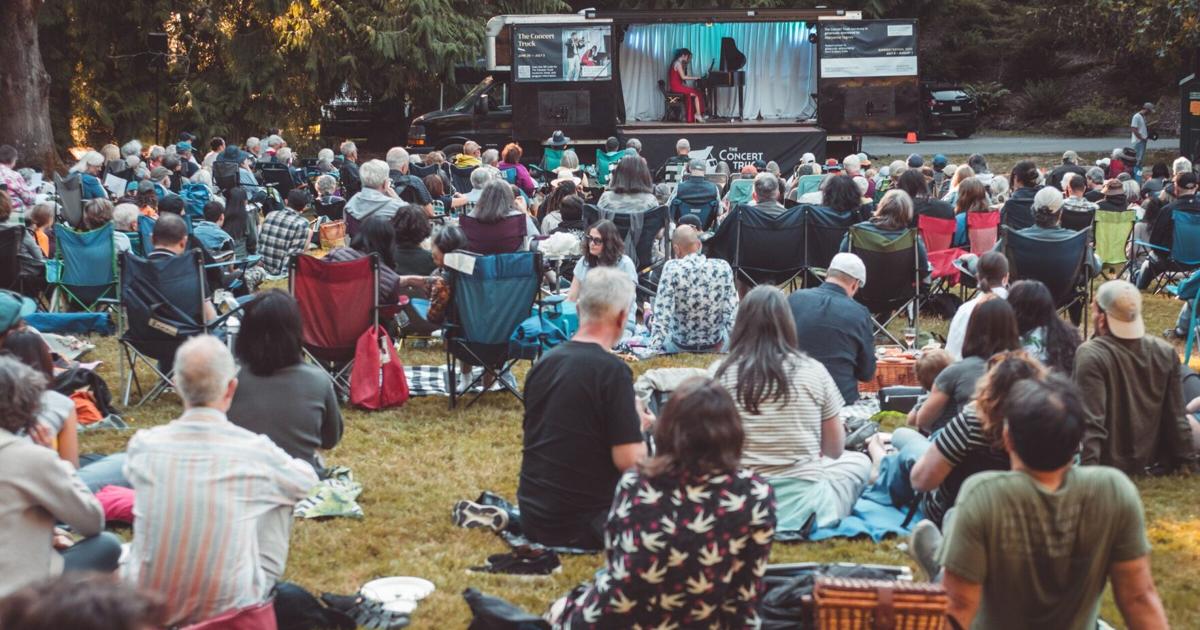
Free events will also bring the festival into less formal spaces, including a Chamber Music in the Park concert and community play-along at Volunteer Park on July 18, and more than 20 Concert Truck performances in neighborhoods, parks and other everyday settings across the region.
The programming itself marks America’s 250th anniversary, with every program including a work connected to the United States, from pieces by Aaron Copland, Samuel Barber, Amy Beach and George Walker to new SCMS commissions by Juhi Bansal and Kian Ravaei.
The itinerant season arrives as SCMS is making other moves as well: expanding programming beyond the summer festival, introducing its first-ever resident string quartet and launching an in-house record label.
The resident-quartet experiment centers on the Balourdet Quartet, which spent the 2025-26 season based at Skyline, a downtown Seattle retirement community, while playing in schools, museums and programs connected to the University of Washington’s Memory Hub. Skyline residents were invited to sit in on rehearsals and could get to know the players over the course of the season. The quartet will return in September for a second residency season with more community partnerships.
For violinist James Ehnes, SCMS’ artistic director since 2012, the organization’s widening reach over the past several seasons is not about growth for its own sake.
“There can be a danger of thinking that the only logical step when one is enjoying success is to simply do more,” he said. “That’s not something that any of us have ever believed in.” He described SCMS’ recent changes instead as “a logical extension of the fundamental mission of making this music in its best possible form — and then bringing it to as many people as we can.”
That idea will get a practical test this summer, as the Benaroya Hall renovations force SCMS to adapt to a more dispersed festival map. For Eastside listeners long used to trekking into downtown Seattle, the two Meydenbauer Center programs reverse the usual journey. “We have many fans who make the trip to us year after year,” said SCMS board member Kate Battuello. “Why not make the trip to them?”
Meanwhile, the events on Vashon and Bainbridge give SCMS a chance to begin building audience relationships where the festival has not had that kind of mainstage presence before. But the more scattered map creates obvious practical risks: Audiences used to the Benaroya routine now have to navigate new parking, transit, acoustics and travel times. Battuello said SCMS is treating the summer as a learning process, with staff and board members listening for where patrons need help.
For John Holloway, SCMS’ executive director since 2021, who was recently named its first CEO, that learning process is part of the point. The dispersed festival isn’t just a logistical challenge but a chance to test one of his core ideas: that new listeners are most likely to connect with chamber music when they encounter it at the highest level, in places that feel accessible.
The close partnership between Holloway and Ehnes rests on a shared outlook: SCMS can keep widening its reach only if musical standards remain consistent, whether the performance is in a recital hall, a park or online. Holloway brought The Concert Truck — a 16-foot box truck that opens to become a mobile concert hall — to SCMS, giving that idea a literal vehicle. He said both he and Ehnes are wary of the split that can happen at arts organizations when the biggest names appear on the mainstage while community programs get treated as something lesser.
“If it’s the first time someone’s experiencing something,” Holloway said, “it’s so important that they get your very best work.”
For SCMS, that “best work” is closely tied to Ehnes and the musicians he attracts to Seattle. As a soloist in demand with major orchestras around the world, he gives the organization a level of artistic credibility that helps its expanded work feel connected rather than scattered.
The new record label pushes that same idea into recorded sound: If SCMS is trying to send its best work farther, it also wants to preserve more of it. SCMS Records, announced this spring, is expected to launch this month with three CDs and four vinyl releases, including all the Brahms violin sonatas with Ehnes and pianist Andrew Armstrong and Dvořák string quintets recorded at Nordstrom Recital Hall.
The label also reflects Ehnes’ concern with curation in an era when recordings are everywhere. “There are concerts and recordings everywhere all the time by everybody, which is great, but it does make it very difficult to know where to start,” he said. “I think a certain curation of things is valuable — and that is about establishing trust in your identity.” He added that he likes the idea of SCMS becoming known as a brand listeners can trust to release recordings made with “tremendous care, tremendous love and tremendous skill from the best musicians I know.”
Holloway framed the label as a matter of timing, not revenue. In an SCMS blog post, he acknowledged that labels are expensive and rarely make money, but wrote that the performances taking place under Ehnes’s stewardship are “too special not to share and preserve.”
SCMS has already been reaching beyond the live, in-the-room concert experience through its Virtual Concert Hall, which began as a survival strategy during the pandemic and has since given the organization an online footprint far beyond the Pacific Northwest. SCMS says the platform now reaches viewers in 12 countries and 40 states and represents 40% of total revenue. This summer, it also gives local audiences another way to stay connected if the festival’s more scattered geography proves hard to navigate.
For longtime SCMS supporter David Fulton, the Virtual Concert Hall is not just a consolation prize. He said that with its “outstanding” audio and video quality, the stream can even be “more pleasant than being there live,” especially when cameras show details he might miss from the back of a concert hall.
Fulton and his wife, Amy, often stream concerts from remote anchorages on their boat in British Columbia or Alaska. “Here we are, sitting in a bay, 50 miles away from anybody in Alaska, watching the sea otters cavort and listening to Bach’s Brandenburg Concertos,” Fulton said. “The world has changed.”
‘ The preceding article may include information circulated by third parties ’
‘ Some details of this article were extracted from the following source www.yakimaherald.com ’