A few years ago, Seattle-based documentarian Rustin Thompson was all set to make, by his own description, a rather depressing film about the disappearance of the moviegoing experience in small communities. “No one sees my movies anyway,” he remembered thinking, half-joking, so why not make an artistic, somewhat experimental film “and show all these bleak, lost places of history.” And then he met Tiny.
For his newest documentary, “The Last Picture Shows,” which has screenings in Western Washington throughout July and August, Thompson toured the American West in search of what remained of small-town moviehouses, expecting to find a sad parade of shuttered theaters and deserted storefronts left behind in the wake of streaming.
His first stop was Burns, Ore., with a population of less than 3,000 — and a movie theater called the Desert, opened in 1948 and still in business. Though Thompson wasn’t initially planning to do any interviews for the film, jovial owner/operator Tiny Pedersen wanted to talk on camera. “It turned out that he was so great,” Thompson said, “I turned to my wife, and I said, ‘You know what, I think I’ve got to make this movie a little more hopeful.’”
Pedersen, who runs the theater with his wife, says in the film that he still has a full-time day job; you can’t make much of a living running a small-town cinema. (A recent turnout of 19 people, he said, was “a good Friday night in Burns, Ore.”) But he was cheerfully matter-of-fact when asked why they keep going: “Because we enjoy doing it and the community needs it.”
What Thompson first envisioned as a story of something lost turned into something found: community — people working hard, for little money, to carry on a long tradition for their neighbors to enjoy. There’s plenty of wistfulness in “The Last Picture Shows,” which is filled with haunting photographs of theaters with boarded-up windows, incongruous “Now Playing” signs and empty spaces where cinema lights once sparkled. Of the 123 small-town theaters Thompson visited, roughly half of them were closed, demolished or transformed into something else. (The former Chief Theater in Tonasket, Okanogan County, for example, is now a Subway sandwich shop; you can still see the empty frames that once held colorful movie posters.)
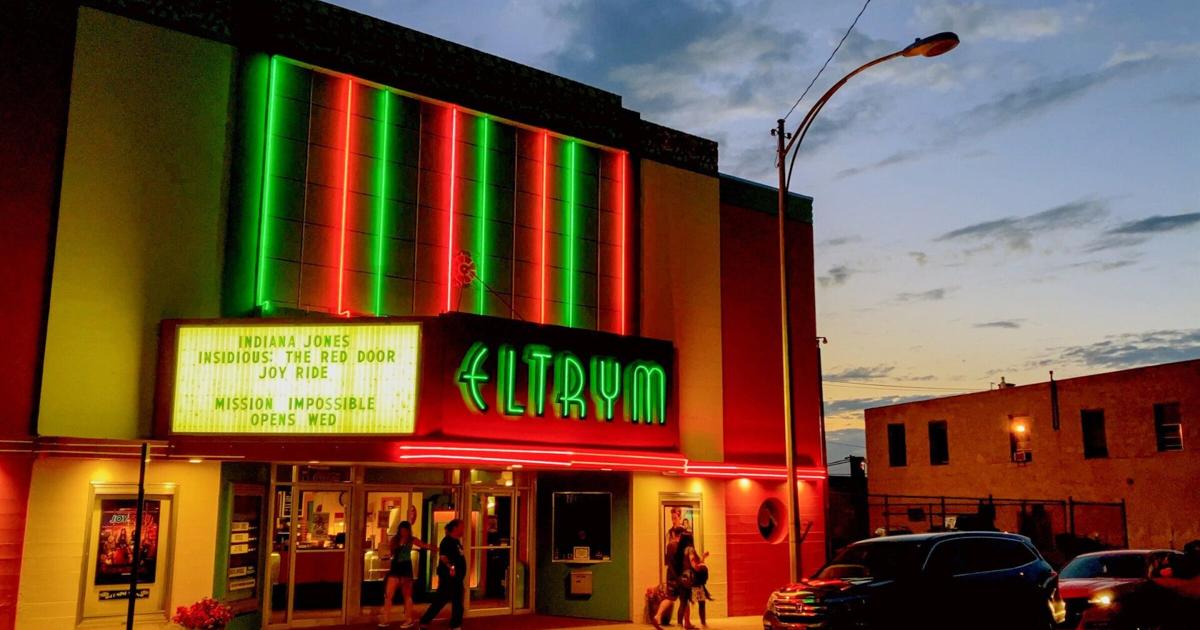
But he also found hope, in places like Winthrop, Okanogan County, where an optimistic young couple 10 years ago opened the small town’s first cinema in 60 years, The Barnyard Cinema, and continue to run it today. He found it in Chelan, where the Ruby Theatre continues to welcome patrons after more than 100 years. He found it in the beautiful Washoe Theatre in Anaconda, Mont. — a 1930s art deco palace that’s being slowly and lovingly restored. He found it in the Eltrym Theater in Baker City, Ore., whose name is its original owner’s first name spelled backward, its elegant neon bright since 1940. And he found it in the Auto Vue Drive-in in Colville, Stevens County — still family-run after several generations and more than 60 seasons. (It has since found new ownership but is still in business.)
Thompson, an Emmy Award winner whose previous work includes the WTO documentary “30 Frames a Second,” is a University of Washington graduate who grew up in Puyallup and, since childhood, adored movie theaters. Before beginning work on “The Last Picture Shows,” he had long been concerned about the loss of that experience he loved. “I was really getting depressed over all the great theaters in Seattle disappearing: Seven Gables, Harvard Exit, Guild 45th … That was so distressing to me.”
After The Beacon, one of Seattle’s few neighborhood movie theaters, opened several years ago, Thompson programmed a series there of 1970s cinema, which included Peter Bogdanovich’s “The Last Picture Show” and its poignant depiction of a movie theater in a tired small town. Wondering then about what his next film project might be, he said, “I thought, there’s something here. The times I’ve driven through small towns in the American West, you see movie theaters, most of them are closed, or they look closed. How did that happen in America? I knew it had a lot to do with streaming and Netflix and consolidation and multiplexes and everything, so that’s what I originally set out to do: to go off and film these places.” (Scenes from “The Last Picture Show” appear in Thompson’s movie, along with “Cinema Paradiso” and other classic film clips.)
Thompson shot the film over two long road trips in the summers of 2023 and 2024. The website cinematreasures.org, whose co-founder Ross Melnick appears in the film to provide thoughtful historical context, helped him put together a list of small-town theaters (Thompson loosely defined small towns as having a population of fewer than 10,000). “In some cases, I reached out to the owners before I got to the towns,” he said, “but a lot of times it was hard to get in touch, so I would just show up. I would walk in, and usually the owner was there serving concessions, and I just started talking to them and said, ‘Hey, do you want to be in this film I’m making?’ And right on the spot, they would say yes, and I’d do an interview, no hassles with corporations or PR people.”
The film Thompson thought nobody would see has taken on a life of its own: It’s played at more than a dozen film festivals around the country (winning a special jury award at the Arizona International Film Festival) and, thanks to the determined work of executive producer Rachel Price, it has multiple theatrical runs booked, including in New York and Los Angeles in August. Thompson will appear at several local screenings this summer, including the Firehouse Theatre in Kingston, Kitsap County (July 12), the Grand Cinema in Tacoma (July 14), the Tasveer Film Center in Seattle (July 15) and others.
And, for theaters that are trying to raise money, he’s offering screenings of his film for free, with no rental charge. Several benefit screenings have already taken place, with more to come. “That’s part of my mission here,” he said. “I didn’t set out with a mission, but I want to help these theaters stay in business. If they’re having fundraisers, they’re probably transitioning (to nonprofit) or already nonprofit, and if my film can help, I’ll do that.”
There’s definitely a poignant sadness in “The Last Picture Shows,” for the magical places now gone. But hope beams throughout the film, like the light from a projector, and you leave it happy to have met the caretakers of these places that have provided wonder for so long. “It’s a building that’s supposed to be used, like all buildings,” says Jerry Lussy in the film; he’s been running the Washoe Theatre for 36 years. “They have a purpose: to take care of people.”
‘ The preceding article may include information circulated by third parties ’
‘ Some details of this article were extracted from the following source www.yakimaherald.com ’