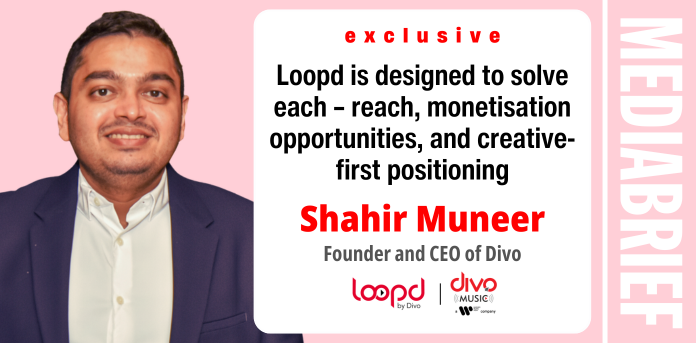
In a MediaBrief exclusive, Shahir Muneer, Founder and CEO of Divo, shares the vision behind Loopd, Warner Music’s latest venture into India’s independent music ecosystem. Muneer outlines how the structural challenges facing indie musicians today, the role of regional languages in shaping cultural experimentation, and short-form platforms are reshaping discovery without guaranteeing longevity. The conversation also touches on revenue splits, data-driven insights versus human intuition, and what true success means for independent voices seeking global recognition.
In an era where independent artists often struggle to balance authentic creativity with wide reach, Muneer explains why he decided to create a new platform that addresses this challenge. “Most indie collectives focus on either curation or small-scale releases but lack the infrastructure of a major label,” he says.
“With Loopd, we bring the best of both worlds – the indie spirit of fearless originality and the global network of Warner Music,” Muneer adds. He explains that the gap Loopd fills is simple: giving artists creative freedom while ensuring their music reaches audiences in India without compromising on quality, transparency, or scale.

Defining authenticity in an algorithm-driven world
“Authenticity, to me, is about creating music that comes from a place of creativity, not just what fits into a playlist or a trending reel,” Muneer says. He adds that while algorithms may reward short-term hooks, audiences ultimately connect with music that has depth and cultural resonance.
“At Loopd, authenticity means giving artists the confidence to stay true to their sound while we build the ecosystem around them – distribution, marketing, and partnerships – so they don’t feel pressured to dilute their art for virality,” he explains.
Addressing the challenges independent artists face
Independent artists in India, Muneer says, face three structural hurdles: access, monetisation, and creative freedom. “Breaking through noise without the marketing budgets of film or label-backed tracks is tough,” he explains.
He continues, “Streaming royalties alone are insufficient to sustain careers. And artists are often forced to compromise originality to secure visibility.” He adds, “Loopd is designed to solve each – reach, monetisation opportunities, and creative-first positioning.”
Balancing commercial viability and experimentation
Muneer asserts that experimentation is an investment. “Every breakthrough sound starts as a risk,” he says. “Our approach is to support artists with resources, smart marketing, and analytics so even experimental tracks find their niche and scale.” He adds that commercial viability comes when an ecosystem respects originality, and Loopd is committed to that.
Evolving through Warner Music’s global network
“Being part of Warner Music changes everything – from how we structured our team to how we think about distribution,” Muneer says.
He explains that Loopd now benefits from access to global best practices, collaborations, and premium DSP positioning. “Loopd artists gain from Warner’s infrastructure while retaining the indie freedom that defines the label,” he adds.
Spotlighting India’s regional voices
“India’s diversity is Loopd’s canvas,” Muneer says. “We want to spotlight vernacular and regional languages and genres that have been underrepresented in mainstream indie circuits – Malayalam, Tamil, Telugu, Bengali, Marathi.” He notes that authentic regional voices are often where the most exciting experimentation happens.

Building transparency in artist compensation
“At Divo our company’s legacy since origination in 2014 has been stemmed from the fact that media and music industry has a lot of lack of transparency,” Muneer says. “One of the major reasons for our growth – from a bedroom in Kodambakkam, Chennai, to now having mutli city offices has been purely because of our transparency across contracts, roles and responsibilities, reporting, payments and so forth.”
“In the same spirit, Loopd operates with clear contracts,” he adds. “Where artists want to sell their rights, they are compensated for their creativity. Where they want to retain rights and have revenue splits, revenue is transparently reported through digital dashboards integrated with major DSPs.”
He explains that this includes revenue from streaming, publishing, sync, and all monetisable channels. “Our pitch is simple: no hidden agenda and no leakage. Artists know what they’re earning, and when.”
Navigating the sustainability of streaming models
“The current streaming model is challenging – especially for indie artists, where per-stream payouts are minimal,” Muneer says.
He adds that while streaming won’t be the sole revenue pillar, it remains essential for discovery. “Sustainability will come from blended models – streaming, live performances, sync, and brand collaborations,” he asserts.
Beyond music production – building long-term artist partnerships
“Loopd isn’t just about releasing tracks,” Muneer says. “We provide marketing strategy, sync licensing opportunities, content partnerships, and live activations.” He explains that the goal is to make artists feel they have a long-term partner, not just a label. “This mirrors Warner Music’s objective of making it a hub for artists,” he adds.
Virality versus longevity in artist development
“Reels and Shorts drive discovery – and we encourage artists to use these platforms,” Muneer says. “But virality is a spark, not a career.” He adds, “Loopd’s role is to ensure those sparks turn into lasting flames by building consistent catalogues, brand partnerships, and sustained audience engagement.”
The role of AI and human instinct in artist discovery
“AI and data analytics are invaluable for audience insights and identifying trends,” Muneer says. “But discovery of artistry is still human-led.” He adds, “Data can tell you what’s working, but gut instinct and cultural intuition are irreplaceable when it comes to finding the next breakthrough voice.”

Defining success for Loopd
“For Loopd, success will be measured in artist breakouts and cultural influence – not just market share,” Muneer says.
He concludes, “If we can look back and say we helped bring independent voices from India into global conversations, empowered them financially, and built a sustainable indie ecosystem – that’s true success.”


‘ The preceding article may include information circulated by third parties ’
‘ Some details of this article were extracted from the following source mediabrief.com ’