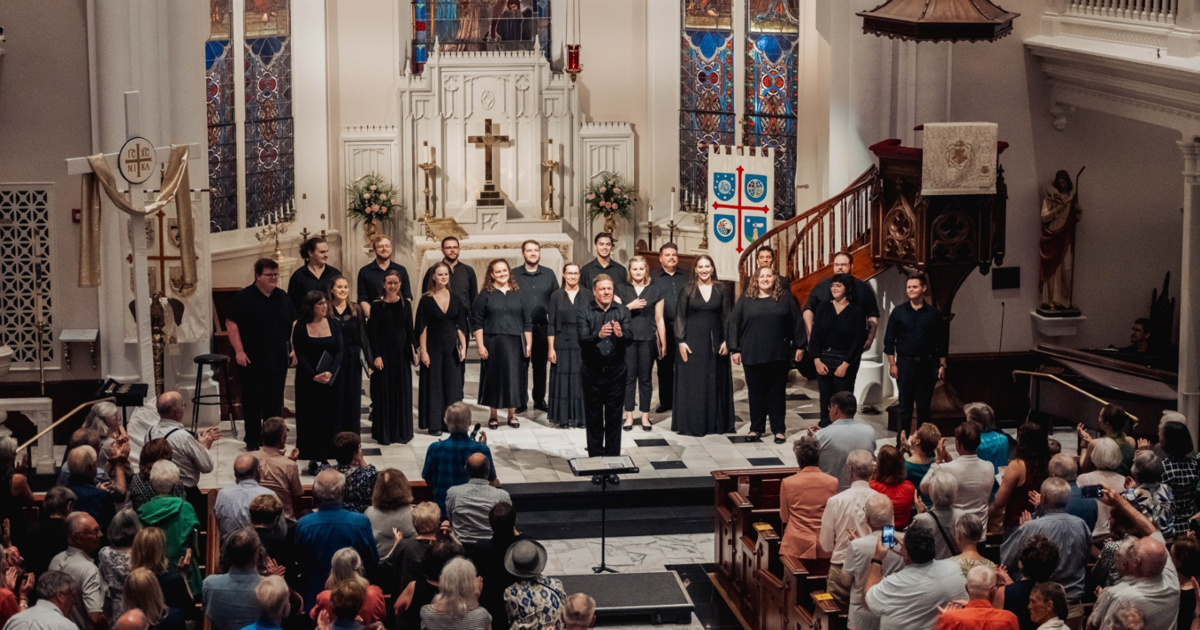
This is Dr. Amanda Quist’s first year as the music director for the 50-voice-strong Spoleto Festival Chorus, and if the program she has created is any indication, she’s definitely diving in with both feet.
The shows on June 5 and 6 — both of which are at St. Matthew’s Lutheran Church, 405 King St. — will feature a unique format for America’s 250th birthday, with Quist conducting a program called “Storytelling Through American Composers.”
A folk feel to it
“We have a mix of very new and somewhat challenging music that’s also very beautiful,” Quist told The Post and Courier. “But also music that is … sort of folk song-like. So there’s a wide range of styles and even time periods, and that’s especially interesting to me.”
Featured in the performance are Vittoria Aleotti’s “Surge Propera Amica Mea,” a lush Renaissance piece with flowing lines that overlap and intertwine for fresh harmonic surprises, as well as the moving Muscogee Creek hymn “Heleluyan,” which is more spare, leaning on a chanting melodic line and joyful choral singing that feels almost communal.
“Vittoria Aleotti was the first woman to have her sacred music published,” Quist said of the opening composition. “This particular piece has a little Renaissance and a little baroque, and it’s very sonically strong and uplifting. And ‘Heleluyan’ is a Native American piece. … It’s a very simple but very beautiful melody sung in a canon.”
War & Revolution
The second section of the program, “War & Revolution,” continues the theme of American history, threading “Chester,” by William Billings, “When David Heard” by Thomas Weelkes and “The Dying Soldier,” arranged by Nigel Short.
These songs all deal with the horrors and momentary glories of war, Billings’ piece based in the American Revolution.
“It’s a five-verse hymn that was written to be sung to rally the troops, so to speak,” shared Quist. “But then thinking about the cost of war, the human suffering side, I wanted to pair it with a ‘What David Heard,’ which is the story of David hearing that his son Absalom was killed in battle. And the music is so colorful in the way that it symbolizes the discovery and the pain that his father goes through.”

Amanda Quist is the new music director of the Spoleto Festival USA Chorus.
The program then shifts to more modern times with “The Dying Soldier.”
“It really reminds us of the human cost behind every conflict,” Quist said.
Dream sequence
The next section of the program, “Dreams Deferred,” is the lynchpin of the show.
“It’s about people reflecting on the past and responding to it,” said Quist. “There’s a theme of people looking back into history and thinking, ‘I wonder if that’s the whole story.’”
Joel Thompson’s “Hold Fast To Dreams” moves into Ayanna Woods’ “No. 2 Shift,” Caroline Shaw’s “To Her Hands” and Moses Hogan’s arrangement of “Elijah Rock,” a traditional African American spiritual typically sung by enslaved people in the United States.
“Hold Fast to Dreams” is actually built on the Langston Hughes poem of the same name, and the writing moves in layered harmonies that make the chords feel like they bloom and settle rather than shift sharply. Woods’ piece expands on some of the questions raised in the opening song, offered Quist, while Shaw’s piece then refers to a poem at the base of the Statue of Liberty.
Reaching for something
Then the set closes with something Quist describes as “familiar but also visceral.”
“It’s the sound of people reaching for something,” she offered of “Love and Transcendence,” which features “Both Sides Now” by Joni Mitchell and a buoyant arrangement of the traditional hymn “Shall We Gather At The River.”
Ultimately, Quist said that this program represents not just the fabric of America, but her own vision for the Spoleto Festival Chorus.
“I love the blend of old and new,” she said.
That’s what reflecting on America’s 250th is all about.
‘ The preceding article may include information circulated by third parties ’
‘ Some details of this article were extracted from the following source www.postandcourier.com ’