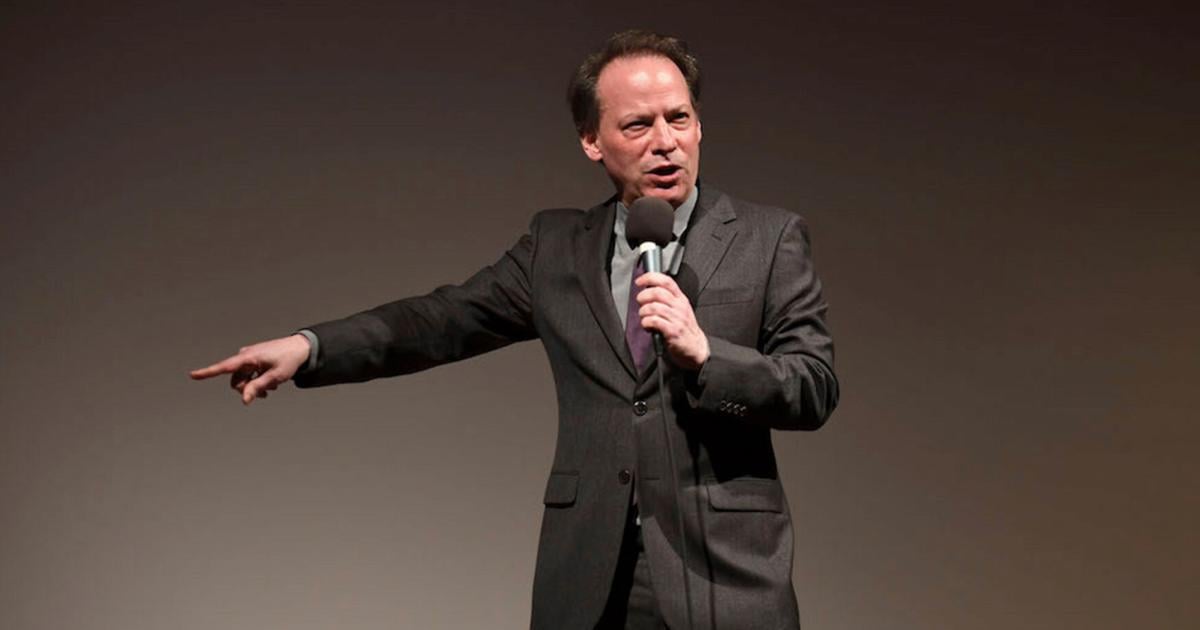
Adam Gopnik is a longtime writer for The New Yorker. Encouraged by his friend, famed comedian Steve Martin, he developed a one-man show called “Talk Therapy: An Evening with Adam Gopnik You Didn’t Know You Needed.” Gopnik will perform at Paepcke Auditorium starting at 6:30 p.m. Saturday.
Adam Gopnik has been a contributor for The New Yorker magazine since 1986. The intellectual polyglot has written nonfiction, fiction, criticism, book reviews, first-person essays, foreign correspondence and work that has defied genre.
But there is one genre that reigns supreme.
“Humor has always been my default mode,” Gopnik said in an interview with the Aspen Daily News. “My writing is not always funny but for me, the urge to delight is much more powerful than any other urge I feel in writing.”
In 2022, Gopnik and his friend, famed comedian Steve Martin, were recording an audiobook when Martin suggested Gopnik should do a one-man show. Gopnik had done plenty of public speaking over the years.
But Martin had something else in mind. “You should do a show, not a reading or a lecture, one where you talk the way you talk over breakfast where you jump from one subject to another, the way you write in the magazine. That’s the show you should do,” Gopnik recalled Martin as saying.
Gopnik has spent the last three years metaphorically warming his biscuits and fluffing his eggs. Saturday breakfast will be on the dinner menu at Paepcke Auditorium when Gopnik presents his show, “Talk Therapy: An Evening with Adam Gopnik You Didn’t Know You Needed” at 6:30 p.m. Martin is one of the producers of the show.
After Martin’s suggestion, Gopnik, with the help of his wife — who after all, knew his best material — began coming up with possible riffs for the show: 30 to 40 stories that people would enjoy. He tried them in his living room in front of friends and family. Emmy-winning actor (and Theatre Aspen alumnus) Raul Esparza helped him mold the pieces from the page to the stage.
“We took it back to Steve and he said, ‘I think this is going to work.’ We decided it needed a little more stagecraft with imagery to evoke the places, and we added some beautiful slides that were done by an artist in the spirit of 1950s New Yorker covers.”
Gopnik tested the show at Lincoln Center, then performed at the Roundabout Theatre in New York, and is now taking it on the road. Other shows besides Aspen include Los Angeles, Berkeley and Montreal.
Montreal is a homecoming show for Gopnik as he grew up there. He was born in Philadelphia, but his parents, who were pursuing doctorates at the University of Pennsylvania — his mother in linguistics, his father in 18th-century English literature — moved the family to Montreal to continue their academic pursuits at McGill University.
“My childhood was filled with books and the habit of reading, and reading openly, and feeling that you could read this book, and then the book right next to it, and the book beside it,” Gopnik said. “Literature was always available; learning was available. The bottom line is that when you read you learn a lot of things, and that’s always what I’m trying to do when I’m writing is tell a coherent story and figure out what’s important and try to make it a pleasure to read. And that’s where the show connects to my essay writing.”
His trademark is taking complex ideas and synthesizing them into concepts that people not only can understand, but discover the absurdity and humor within them. He calls this process “horizontal thinking — the idea that there is no subject too trivial to be worth thinking about hard.”
Some of the subjects Gopnik paints with words in “Talk Therapy” include “the single most begotten psychoanalysis in the history of European-trained analysts with strong German accents dealing with New York neurotics,” he said.
Branching off that idea are musings on the history of snowflakes and their first photographer, the politics behind the making of Central Park, a teenage encounter with philosopher Karl Popper, the peculiarities of arriving at The New Yorker in its earlier incarnation, fatherhood, Marcel Proust’s fascination with erotic rats and a near-disastrous keynote-speech mistake discovered the night before it was to be delivered.
Gopnik said the structure of “Talk Therapy” remains constant but each night is its own unique performance.
“The basic beats are the same night to night but I don’t have a script; I’m not reciting it, I’m articulating it. For Aspen, I have a whole new ending that involves aspens and the history of the aspen tree that I’m putting in, just for this occasion.”
At the heart of “Talk Therapy” is a concept Gopnik picked up from Joseph Mitchell, who wrote for The New Yorker for close to 60 years. Gopnik asked him what united the writers of the golden age of magazines.
“Joseph said to me, ‘Each one had a wild exactitude of their own,’ the ability to pay your duty to precision, to the facts, to the world as it is, and still imbue it with peculiar personal passion,” he said. “That, for me, is not just what writing is about, it’s what life is about. So, if people come away with that phrase ringing in their heads, ‘a wild exactitude,’ I’ll be very happy.”
For more information or tickets, visit theatreaspen.org.
‘ The preceding article may include information circulated by third parties ’
‘ Some details of this article were extracted from the following source www.aspendailynews.com ’