The 1980s was the decade of big hair, huge shoulder pads and seismic musical controversies. From onstage bust-ups to scandalous videos and genuine tragedy, it was a time when the next epoch-changing bombshell was always just around the corner.
The era is explored and celebrated in a new BBC documentary, Banned in the 80s: Moments That Shook Music, which promises to reveal “the untold stories behind the most controversial music of the 1980s”. Ahead of its broadcast, here is our own list of the scandals, tragedies and storms in a newfangled CD slipcase that set the decade alight.
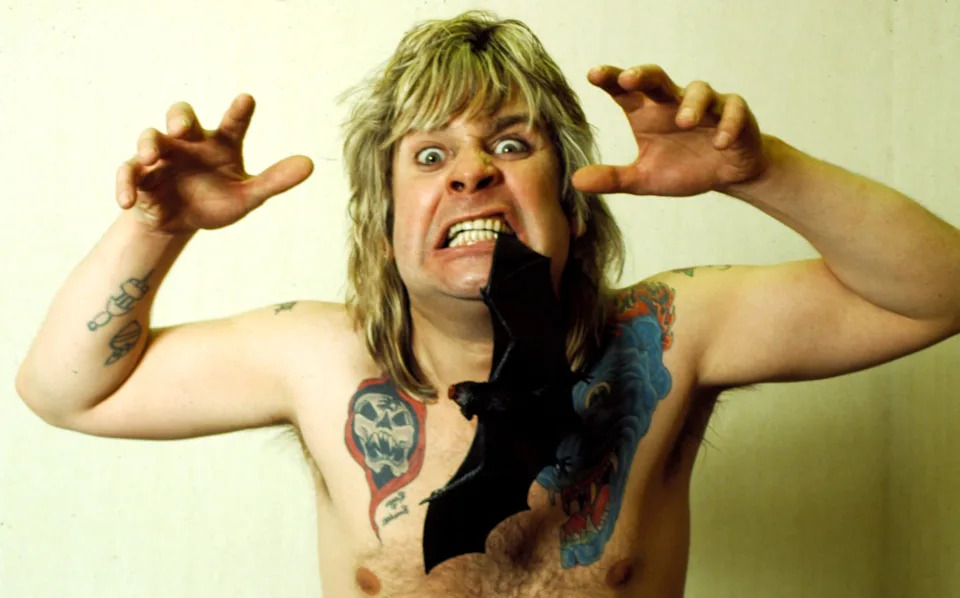
1. Ozzy Osbourne bites the head off a bat, 1982
The bat incident became shorthand for a life lived in the fast lane – Alamy
When Osbourne died this July, one of the oft-repeated war stories about his glory days as a bad-boy rocker involved a concert in Des Moines, Iowa, where a fan threw a bat on stage. Believing it to be a rubber toy, Osbourne snapped the head off with his teeth. He was later relieved to discover the bat had been dead for days and that the rabies shots he received straight after the show had been unnecessary.
Nonetheless, the incident became a shorthand for a life lived in the fast lane. Talking about it in later life, he reportedly said, “I got rabies shots for biting the head off a bat – but that’s okay. The bat had to get Ozzy shots.”
2. Frankie Goes To Hollywood banned by the BBC, 1984
In your face and laden with innuendo, Frankie’s debut single, Relax, was controversial by design. But initially, it drew little attention – to the disappointment of Frankie’s record label, ZTT, a high-concept alliance between producer Trevor Horn and journalist Paul Morley. Despite several ads that spotlighted the flamboyant homosexuality of Frankie’s members Holly Johnson and Paul Rutherford, the tune failed to catch on – until, in January 1984, Radio One DJ Mike Read expressed his distaste for the suggestive lyrics.
Two days later, Relax was officially banned by the BBC – along with its S&M themed video. As the moral panic took hold, the track shot up the charts, though the band initially denied the song had a sexual undertone. They would eventually relent. “It was about shagging”, admitted bassist Mark O’Toole in the liner notes to their 1985 album, Welcome to the Pleasure Dome.
3. MTV blacklists Queen’s I Want to Break Free video, 1984
Never the most macho of bands, by the 1980s Queen, and singer Freddie Mercury, were leaning with gusto into their camp side. The group went full panto queen by appearing in drag in the video for I Want to Break Free, where Mercury played a busty housewife, guitarist Brian May donned curlers and a nightdress, bassist John Deacon appeared as a stern-faced grandmother and drummer Roger Taylor vamped it up as a “naughty” schoolgirl. Nobody blinked in the UK – if anything, they were impressed at Mercury’s vacuuming skills.
But in the US, the response was shock and fury over the sight of men in tights – and MTV refused to play it. “I remember being on the promo tour [for album The Works] in the Midwest of America and people’s faces turning ashen,” May recalled in 2010. “And they would say, no, we can’t play this. We can’t possibly play this. You know, it looks homosexual… I know that it really damaged our whole relationship with radio in [the US] and probably the public as well.”
4. Matt Bianco are insulted on Saturday Superstore, 1984

Matt Bianco on BBC kids’ show Saturday Superstore in December 1984
All seemed well in the world of cod-soul chart-toppers Matt Bianco when they appeared on the BBC kids’ show Saturday Superstore in December 1984. They’d just released a smash debut album and were the toast of Smash Hits.
However, none of that cut much ice with a phone-in caller named Simon Roberts, who labelled the band (none of whom were actually named Matt) a “bunch of w—-ers”. They look appropriately miffed – as were sibling R’n’B quintet Five Star, when schoolboy Eliot Fletcher called into their appearance on the BBC’s Going Live in 1989 to ask, “why are you so f—–g crap?” – though, he would apologise to the band’s Doris Pearson on social media 30 years later.
5. Judas Priest are caught up in the Satanic Panic, 1985

Pictured l-r: Guitarist KK Downing, guitarist Glenn Tipton and singer Rob Halford of Judas Priest
By the mid-1980s, much of Bible Belt America was convinced Satan worshippers were taking over the US. Dungeons & Dragons players were accused of being in league with the Devil, as were heavy metal bands such as Judas Priest.
In the case of the Birmingham headbangers, the inciting incident was the double suicide in 1985 of Raymond Belknap, 18, and James Vance, 20, who took a shotgun to themselves after allegedly listening to Priest’s Stained Class album. Vance’s parents brought a $6.2 million lawsuit against the group and their label, claiming that their cover of Spooky Tooth’s Better by You, Better than Me had subliminal messages like, “try suicide,” “do it”, and “let’s be dead”. At the trial, singer Rob Halford explained that the “backwards sounds” were the result of him exhaling while singing, and the case was ultimately thrown out of court.
6. The Beastie Boys’ Licensed to Ill Tour hits the UK, 1987

Mike D, MCA and Ad-Rock of the Beastie Boys – Corbis Historical
Three middle-class kids from New York’s Upper West Side and Brooklyn, the Beastie Boys had so much fun playing rock ’n’ roll bad-boys in the aftermath of their debut album, Licence to Ill, that they began to confuse fantasy and reality. Instantly notorious, the Licence to Ill Tour featured giant inflatable genitalia while the group went out of their way to provoke fans.
It all came to a head in Liverpool in 1987, when band member Adam Horovitz got into a scuffle with audience members at the Royal Court Theatre. Police were called as bottles and other objects were hurled at the stage, and Horovitz lashed out. As the group hastily retreated, the crowd chanted, “We tamed the Beasties”.
7. George Michael’s I Want Your Sex video banned by the BBC, 1987
The 1980s was a high point for pop videos – and also for broadcasters banning pop videos. One of the more notorious cases was that of George Michael, whose determination to shed the teen heartthrob image cultivated with Wham! led him to record the steamy I Want Your Sex.
It also led him to make a promo in which the closeted singer cuddled with his then-girlfriend, Kathy Jeung. “It was genuine. Kathy was in love with me, but she knew that I was in love with a guy at that point in time. I was still saying I was bisexual,” he would later state. “She was the only female that I ever brought into my professional life. I put her in a video. Of course, she looked like a beard. It was all such a mess.”
8. NWA release F— Tha Police, 1988

Rappers MC Ren, DJ Yella, Eazy-E and Dr. Dre (L-R) of the rap group NWA in 1991 – Michael Ochs Archives
The moral panic against rap music was already underway by the time Compton “gangsta” quintet NWA released their seminal invective against police brutality. It sparked a furore: the FBI wrote to the band’s record label expressing their misgivings, and it was banned from radio stations across America. The pressure would cause NWA to implode, with rapper Ice Cube leaving the following year – by which point F— Tha Police had already guaranteed their lasting infamy.
9. Milli Vanilli Exposed as fakes, 1989

Rob Pilatus and Fab Morvan of Milli Vanilli – Gamma-Rapho
It seemed like a sweet deal for male models and dancers Rob Pilatus and Fab Morvan. Mime along to the songs of camera-shy Munich music producer Frank Farian (also the mysterious figure behind Boney M) and wait for the cheques to arrive.
However, a mid-show technical failure in Connecticut made it clear that Milli Vanilli were pretending to sing, and it all came crashing down. Forced to hand back their Best New Artist Grammy, their career ended almost as soon as it had begun. “I knew right then and there, it was the beginning of the end for Milli Vanilli,” Pilatus would confess.
10. Madonna dances with a black saint in the Like A Prayer video, 1989
As the 1980s came to an end, Madonna was already a figure of considerable controversy. There had been an outcry in America when she performed Like A Virgin in a wedding dress at the 1984 MTV Video Music Awards and ended up rolling on the floor. Meanwhile, her 1986 single Papa Don’t Preach scandalised both sides of the political aisle: those on the Right believed it promoted promiscuity, while Planned Parenthood feared it could lead to a spike in teen pregnancy.
Still, that was all merely an appetite-whetter for Like A Prayer – and a video in which she sings in front of the burning crosses associated with the Ku Klux Klan and grooves with Saint Martin de Porres, a figure widely mistaken for Jesus at the time. There was an outcry – and not just among American conservatives. The Pope criticised the video for showing Madonna and Saint Martin getting loved up in a church; facing calls for a boycott, Pepsi cancelled its $5 million endorsement deal with Madonna.
The singer’s defence was that the video and song represented her working through her complex emotions about Catholicism. “Once you’re a Catholic, you’re always a Catholic,” she said. “Sometimes I’m wracked with guilt when I needn’t be, and that, to me, is left over from my Catholic upbringing. Because in Catholicism you are born a sinner and you are a sinner all of your life. No matter how you try to get away from it, the sin is within you all the time”. While her feelings were not unique, only Madonna would seek to exorcise them with a pop promo that left jaws agape, and both Popes and paupers foaming at the mouth.
Banned in the 80s: Moments That Shook Music is on BBC 2 on Saturday 27 September at 9.25pm
‘ The preceding article may include information circulated by third parties ’
‘ Some details of this article were extracted from the following source www.yahoo.com ’


![‘Beyond the Gates’ Creator and Stars Say Farewells After [Spoiler]’s Fiery Death](https://celebrity.land/en/wp-content/uploads/2025/09/‘Beyond-the-Gates-Creator-and-Stars-Say-Farewells-After-Spoilers-75x75.png)