Summer in Hyde Park means that Sunday afternoons are filled with the sound of bells. Carillonneurs from around the world visit our neighborhood and perform on the Laura Spelman Rockefeller Memorial Carillon in Rockefeller Chapel, 5850 S. Woodlawn Ave., on Sundays at 5 p.m., offering free concerts that can be heard from a considerable distance around the chapel.
This year’s “The Bells of Summer” series runs from June 28 to Aug. 16. I caught last Sunday’s concert, which featured Mitchell Stecker, the carillonneur of Westminster College in New Wilmington, Pennsylvania. He presented a concert of 17 works divided into six sections.
It opened with Chorale Partita I for Carillon: “Ach, wie flüchtig, ach, wie nichtig” (Ah, how fleeting, ah, how transitory) by John Knox. It is based on Bach’s cantata of the same name (BWV 26). I was immediately struck by the clear dynamics Stecker was able to achieve, with soft and loud sections providing an attractive contrast. The section that relied primarily on the higher-tuned bells was engaging and there was a pleasing part of the work that offered a sort of call-and-response, so that the bells seemed to be conversing with each other.
Next was an arrangement by Stecker of “Valse Jubilaire” by Edouard Denyn. It had a celebratory feel, commencing with a carefree melody and interesting dissonances. The rapid section had a special texture that was particularly attractive.
“Veni Creator Spiritus” from the Carillon Book of de Sany featured strong, low-tuned bells. This was followed by “Copernicus” by Jerzy Bojanowski. I wondered just what the composer hoped to convey with this piece, but as there were no program notes, I was left wondering until I got home and sat at the computer. Bojanowski (1893–1983) was an interesting man, a conductor from Poland who came to Chicago for the World’s Fair (the Century of Progress International Exposition) in 1933 and remained in the U.S. for the rest of his life. He conducted the CSO as well as orchestras in Milwaukee, Minneapolis, Denver, Tulsa and Omaha. He composed several pieces for carillon, including one employing variations of the Marquette University anthem when the school had a carillon installed in 1967. He set the poetry of Pope John Paul II to music and was the first composer to create a work for carillon and voice. “Copernicus” was written to commemorate the 500th anniversary of the birth of the famous Polish astronomer, but I could learn no more about the piece. The work had energy, power and perhaps just a smidge of stubbornness.
There was a section that highlighted each of the seasons. For “Falling Leaves” by Joseph Kosma, Stecker created a fluid falling effect with a wonderfully light touch. I think it is probably hard to create a soft, airy effect with bells, yet Stecker succeeded. “Skating” by Vince Guaraldi was flowing and enjoyable. Cole Porter’s “I Love You (Says the April Breeze)” was less successful, missing the smoothness and sheen of that composer. Gershwin’s “Summertime” was fascinating in that Stecker improvised it in an unusual fashion, rather like Gershwin on LSD. This famous lullaby had the calm of a night song but was elaborated with loud interjections as disconcerting as a train whistle.
Another section was entitled “Night Songs,” and “All the Pretty Little Horses” was the most attractive piece here, even if the low bells occasionally smothered the higher ones carrying the melody.
“Time Capsule” was the name of the section offering works by some of classical music’s most famous composers. Handel’s Little Fugue in F was performed with remarkable clarity, particularly considering how many bells were sounding at once. It was also paced very well, moving along nicely but never rushed.
J.S. Bach’s “Sheep May Safely Graze” (extracted from his Hunting Cantata) retained its delicacy and calm when translated into bells. This aria, commonly performed at weddings, would be a lovely addition in carillon form to a wedding held at a venue with a carillon.
Suite Archaique by Géo Clément was a marvelous three-movement piece that closed with a minuet that seemed to invite graceful dancing.
The concert closed with “Once Upon a Time.” This work by Liesbeth Janssens seemed to be a fairy tale in the abstract, music onto which listeners might project their own stories or use to guide their creative thinking.
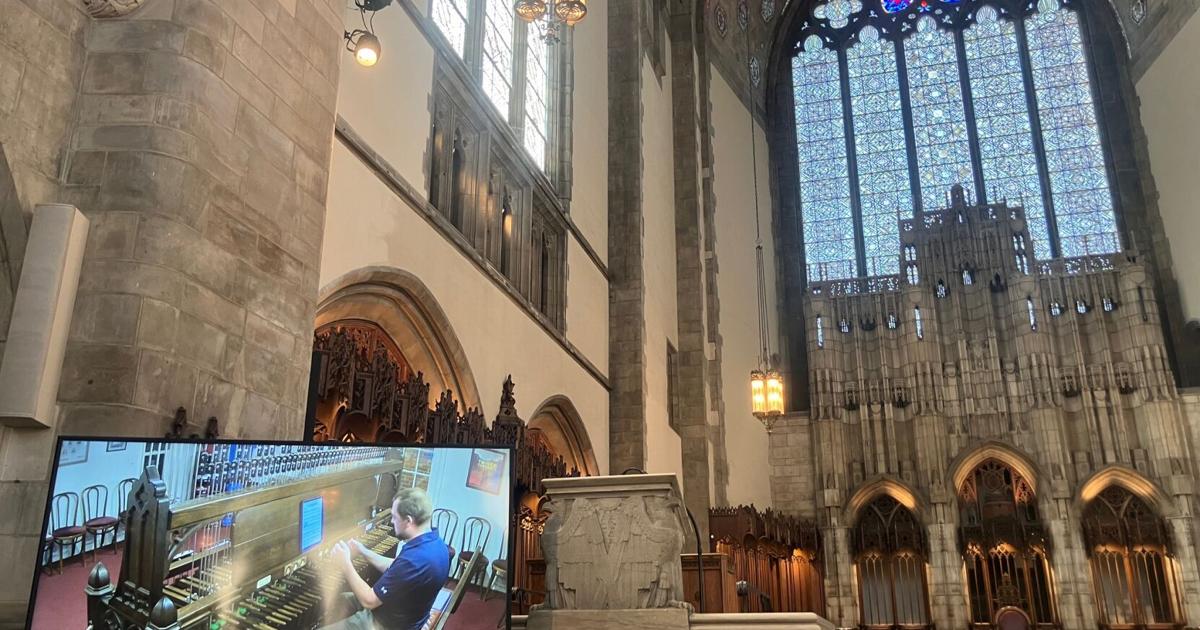
You can listen to the bells on the lush green lawn of Rockefeller Chapel, as most people do. Some bring blankets, others chairs. All ages were represented in the audience, including a goodly number of little girls running around the open spaces and having a jolly good time. The atmosphere is relaxed and friendly. You can also listen to the bells while seated in the pews inside Rockefeller. I did this for part of the concert because even though it is hot inside, there is a large screen showing a live stream of the carillonneur performing in the tower. Those unfamiliar with the carillon can see that, like a piano or organ, it has a keyboard, though performers typically use their fists to depress the keys. With Stecker, I enjoyed watching him switch to just an index finger when he wanted a soft touch.
Upcoming performers in this year’s series include Michael Dixon (July 19, including music by Bach and Debussy) and Carlo van Ulft (July 26, including music by Géo Clément, Isaac Albéniz and Gioacchino Rossini). The final two concerts of the season each feature a pair of performers. The Treblemakers (Janet Tebbel and Lisa Lonie) perform Aug. 9 and University of Chicago carillonist Alex Johnson is joined in the tower by Kayla Gunderson. (UChicago players of this instrument prefer the gender-neutral term carillonist over carillonneur, although I have observed in recent years that many if not most of the guest performers in this series employ the older term.) Visit Rockefeller.UChicago.edu.
‘ The preceding article may include information circulated by third parties ’
‘ Some details of this article were extracted from the following source www.hpherald.com ’