I love watching bad movies. Not as a guilty pleasure, but because the best worst movies are far more sincere, memorable, and iconic than an average movie that’s considered “good” by standard metrics. If I had to pinpoint one specific reason why the best worst movies resonate with me so much, it’s the DIY work ethic that drips from every frame.
A do-it-yourself musician myself, I don’t work with producers, engineers, or even other musicians half the time. More often than not, I crank out unlistenable garbage. Every once in a while, though, magic happens, even if it’s rough around the edges.
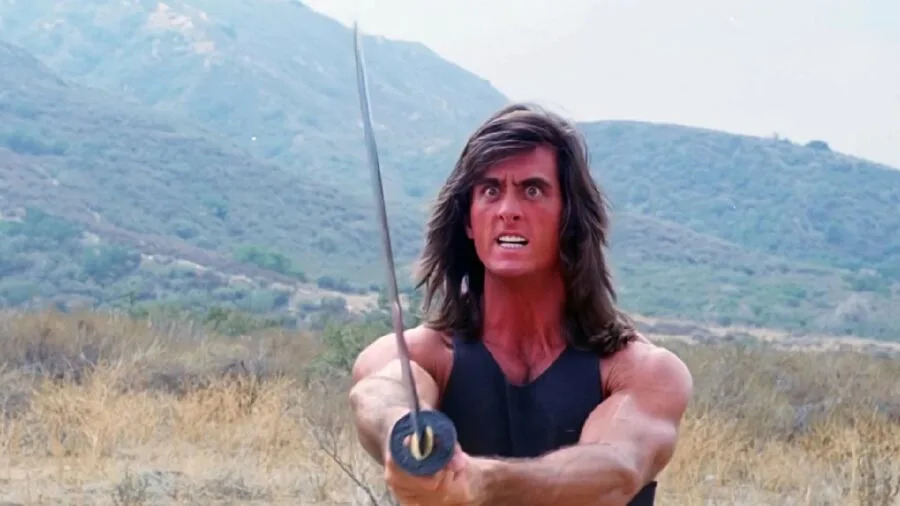
Matthew Karedas in Samurai Cop (1991)
The same can be said about the best worst movies. Filmmakers with little to no experience, industry connections, or financial backing have visions they need to see fully realized because there’s a story inside them they feel compelled to tell. They don’t care what audiences think of their vanity-driven passion projects. They just want to unleash their creations on the world for the sake of doing it.
The minds behind some of the best worst movies are passionate, unhinged, and willing to take creative risks, often at the expense of their reputation, mental health, and personal finances, all for the love of the game. There’s nothing I admire more.
The Big Three Are More Memorable Marvel’s Recent Slop

At the end of the day, most moviegoers just want to watch something entertaining and memorable. You can throw down your hard-earned cash for the next Marvel flick if you want, but personally, I’m not a fan of movies churned through a billion-dollar content machine that lack a personal touch.
You know what’s not written by committee? The best worst movies.
If you’re wondering where to start on your best worst movie journey, I’d suggest beginning with the holy trinity: Tommy Wiseau, Neil Breen, and James Nguyen. All three filmmakers have one very distinct thing in common, and that’s their unwillingness to compromise their own creative visions, no matter how many people tell them how profoundly idiotic those visions might be.
Tommy Wiseau

Tommy Wiseau in The Room (2003)
Wiseau’s best worst movie, 2003’s The Room, has been called the Citizen Kane of bad movies, and for good reason. Spending $6 million of his own money on his romantic drama, he was laughed out of his own premiere after throwing even more money into a two-week theater run.
He sincerely thought he had an Oscar contender on his hands, so he played the game and released The Room under the rules that allowed award consideration. Packed with melodramatic dialogue and expensive soundstages and green screens when filming on location would’ve been infinitely cheaper, Wiseau chased his Hollywood dream one misguided decision at a time. The result is a movie that became a fan favorite through midnight screenings.
Neil Breen

Neil Breen in Cade: The Tortured Crossing
Neil Breen is cut from the same cloth, and his best worst movies are a testament to the craft. Starting with 2005’s Double Down and escalating through five subsequent disasterpieces, Breen self-finances his films because nobody in their right mind would ever write him a check and give him unrestricted creative freedom.
His movies often center on fictionalized versions of himself, Godlike yet tragic. He steals shots, relies on stock footage, voiceover exposition dumps, and talent he finds on Craigslist. His later films, including Twisted Pair and its sequel Cade: The Tortured Crossing, showcase his abilities as a self-proclaimed “Master of the Green Screen.”
As poorly produced as his films are, they’re an absolute treat of hamfisted storytelling, stifled dialogue, and laughably terrible special effects. They’re chaotic and misguided, sloppy yet sincere, and the best of the worst. I still don’t know if he’s in on the joke or just satisfied being the butt of it.
James Nguyen

A scene from Birdemic: Shock and Terror
Armed with $10,000 and what he thought was the cautionary environmental saga of our generation, James Nguyen blessed us with Birdemic: Shock and Terror and its two sequels, The Resurrection and Sea Eagle. Famously known to butt heads with his cast over shooting without permits, Nguyen’s films are one of a kind because of his unwavering commitment to storytelling and his environmental message (global warming causes ravenous bird attacks, or something).
Building a legacy out of his best worst movies, Nguyen belongs in the big three because the first Birdemic made him a laughingstock, and he doubled down on the premise, twice.
Outside Of The Big Three

Yor, the Hunter from the Future
You can find countless cinematic failures that fit the best worst movie category for different reasons. Samurai Cop, Miami Connection, Cool as Ice, and Yor, the Hunter from the Future all fit the mold, and they’re endlessly entertaining. Big-budget flops like 1995’s Cutthroat Island are spectacles in their own right because their producers thought they had a genuinely brilliant adventure film on their hands. They didn’t, but the sincerity plays out all the same.
On the other side of the coin, you have ill-fated horror flicks turned cult classics like 1981’s The Evil Dead, Sam Raimi’s second feature. A sloppy, DIY zombie flick with a grueling and problematic production, the film has endured not as a best worst movie but as an iconic horror entry that spawned a franchise still thriving today. His commitment to his vision shows, even if it began as bootstrapped schlock. Once considered low-budget trash, The Evil Dead now holds an 86 percent critical score on Rotten Tomatoes after audiences caught up with its charm.
There Are Only Three Things That Matter, And They’re All The Same

An actual scene from Miami Connection
Serious songwriters often say, “There are only three things that matter, and all three of them are the song.” The idea is simple: if the vision is pure and the execution sincere, then there’s value. The budget doesn’t matter. Big names don’t matter. Reviews don’t matter. The product is the song, and it should stand on its own. The same goes for the best worst movies, except the only three things that matter are entertainment value, entertainment value, and entertainment value.
The best worst filmmakers are fighting the good fight. They ignore convention and criticism with one thing in mind: make the damn movie, no matter the cost. I’ve seen Morbius. I wasn’t impressed. You know what impressed me beyond belief, though? Coherence, a film shot in five days with no crew, no script, and no known actors. The same DIY approach that defines the best worst movies can also create critical darlings like this one.
It’s not always the best worst filmmakers who make something truly memorable. It’s the relentless approach to the artform, and refusal to compromise that bigger studios should embrace more. The creative freedom and DIY spirit that drive questionable, and sometimes great, art are what keep filmmaking interesting.
‘ The preceding article may include information circulated by third parties ’
‘ Some details of this article were extracted from the following source www.yahoo.com ’