You can get the gist of “The Brief Wondrous Life of Oscar Wao” at the Goodman Owen Theatre without knowing Spanish or anything about Dominican history or culture, but you’re likely to miss many of the fine points and much of the story’s significance.
Directed by Teatro Vista’s producing artistic director Wendy Mateo, this world premiere of Marco Antonio Rodriguez’s English-language adaptation of Junot Díaz’s 2007 Pulitzer Prize-winning novel follows the 2019 Spanish-language stage production, “La Breve y Maravillosa Vida de Oscar Wao,” at Repertorio Español in New York, where it still appears on select dates.
I haven’t read the novel, but judging by the Wikipedia synopsis, the storytelling and narrative structure are so complicated that it’s a wonder anyone would undertake a theatrical version. Rodriguez’s adaptation, which clocks in at close to three hours (and could use some trimming), basically is a coming-of-age tale about Oscar (Lenin Izquierdo), an overweight Dominican American teenager from Paterson, New Jersey. He’s an ultra-nerd who speaks in a stilted formal style and is obsessed with comic books, science fiction, fantasy, Nintendo and pop culture icons, not to mention art history and western literature including Oscar Wilde, whose last name is corrupted to “Wao” by some who know him.
Oscar also is obsessed with the possibility of being the only Dominican American to die a virgin, and the first act focuses on his efforts to avoid that fate as a freshman at Rutgers University. Some tensions initially arise with his roommate Yunior (Kelvin Grullon), who understandably thinks he’s weird but comes around and gives him lessons in macho flirting. Captivated in part by Oscar’s fierce sister Lola (Julissa Calderon), Yunior becomes his lifelong friend and her boyfriend.
While Yunior’s attempts to teach Oscar fail — even though they discover common interests — our anti-hero does fall head-over-heels for Jenni (Jalbelly Guzman), a goth girl who finds him amusing but doesn’t return his affections. This leads to disaster, and we also learn that Oscar’s open-hearted penchant for unconditional love has had similar consequences before.
Oscar is convinced that his misfortunes are the result of a fukú, a curse on his family that dates back generations to their days in Africa. It can be mitigated by zafa, but in order to try to lift the curse entirely, Oscar heads to the Dominican Republic in the second act, convincing Yunior and Lola to go with him.
A warm reception from La Inca (Rossmery Almonte), his grandmother who is also a seer and insists on spraying everyone with holy water, gets the visit off to a good start, but soon all the heavy themes come crashing down. These include the injustices of colorism, the evils of colonialism, intergenerational trauma and the brutality of life under dictator Rafael Leónidas Trujillo Molina, who ruled from 1930 until his assassination in 1961.
Crucially, Oscar also learns a deep dark secret of his mother, Beli (Yohanna Florentino), which explains why she hates the island and didn’t want Oscar and Lola to go there. It does not explain, however, why she is so mean and insulting to her children throughout the play, even though they love her dearly and she is dying of cancer.
Meanwhile, Oscar is at risk of repeating his own — and his mother’s — history when he falls in love with Ybon (Guzman), a prostitute who is La Inca’s neighbor. Catastrophe ensues again but, as the tone slides further into magical realism, we’re supposed to believe (I think) that Oscar has found his superpower.
By this time, I was getting confused. I don’t speak Spanish, so the multilingual dialogue was frustrating. I kept feeling that important revelations were in a language I don’t understand. The problem was exacerbated by Almonte’s La Inca, whose English was difficult to understand. I longed for a glossary in the program, especially one that would explain concepts like fukú and zafa more fully, rather than just repeating the words.
Mateo’s staging didn’t make complete sense, either. Regina Garcia’s set design relied on a few simple props to indicate location changes, which worked better in the first act than in the second, but Stefania Bulbarella’s colorful projections were all over the place. Oscar is supposed to be a writer and is always scribbling in his notebook, so I wondered if the sci-fi trilogy love story he refers to was a graphic novel, and we were seeing pages of it. The pulsating representations of the fukú taking over also were mysterious, as were the images of cane fields.
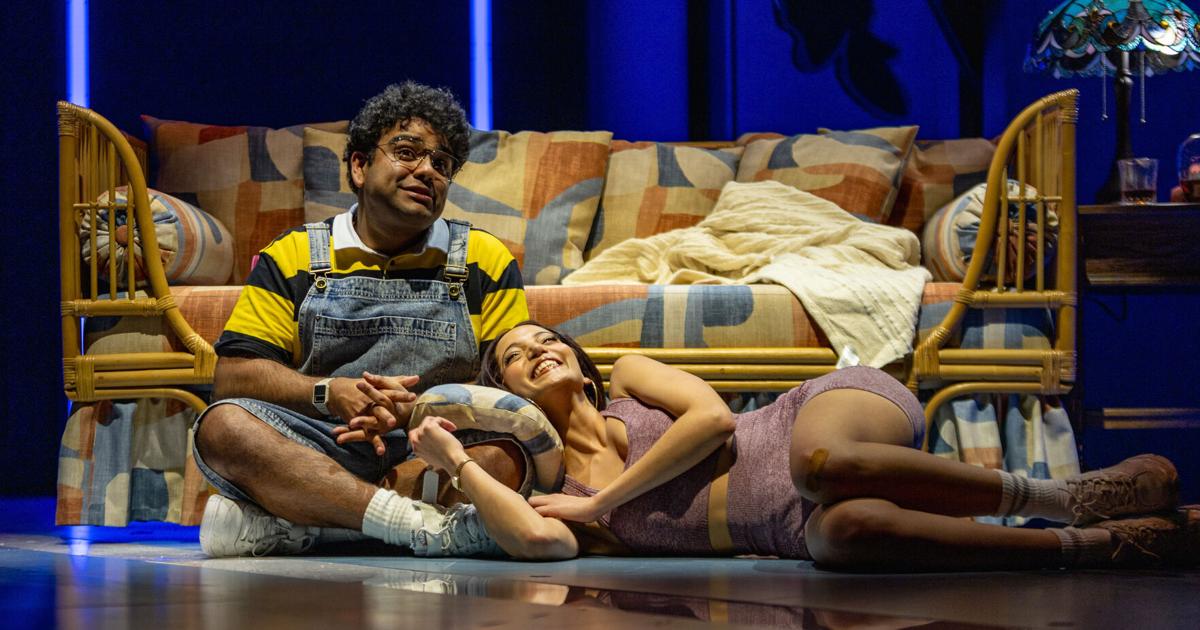
I don’t know how Oscar’s attire is described in the novel or script, but costume designer Raquel Adorno puts him in denim overalls and a black-and-yellow striped top that makes him look like a giant bumblebee. Some of the other costumes are equally unfathomable.
“The Brief Wondrous Life of Oscar Wao” has some very funny moments and is moving at times, but overall, it strikes me as a work in progress. Oscar has been compared to other characters in contemporary plays, but in some ways, he reminded me most of Don Quixote.
‘ The preceding article may include information circulated by third parties ’
‘ Some details of this article were extracted from the following source www.hpherald.com ’