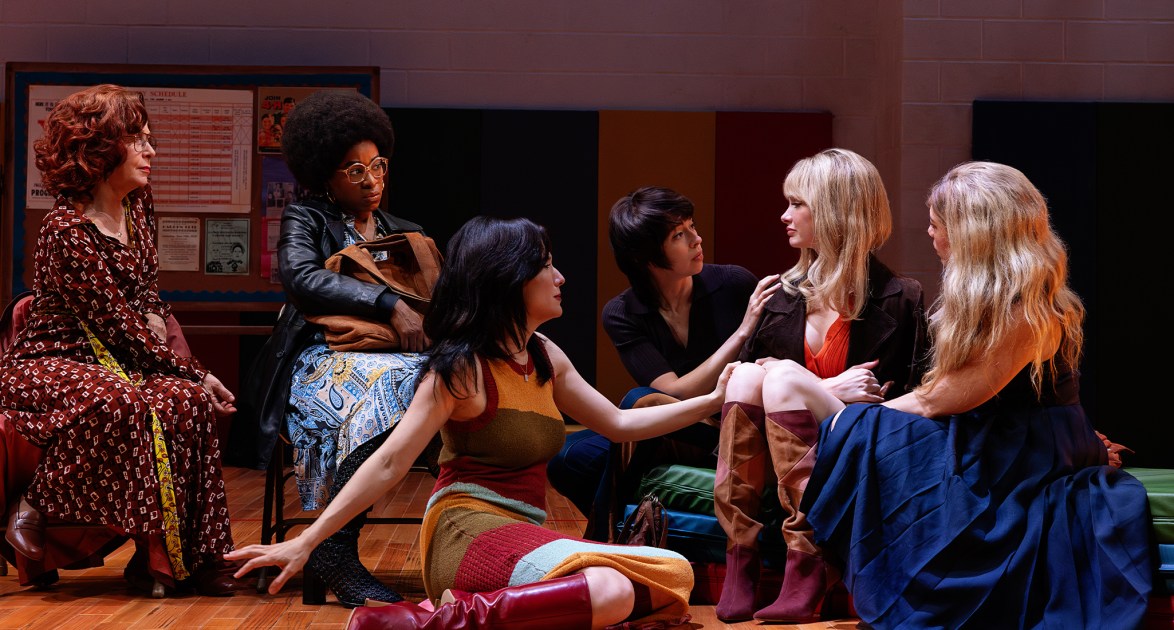
About the women: The group features Lizzie’s mother (also named Lizzie and also played by Flood), plus Dora (Audrey Corsa), a driven receptionist; Susan (Adina Verson), a bold, gender-non-conforming writer; Isidora (Irene Sofia Lucio), who at first comes across as a fiery Sicilian stereotype but soon proves she’s far more radical and layered than anyone expects; Margie (Betsy Aidem), the lone traditionally married woman, who seems the most unsure about turning women’s liberation into action; and Celeste (Kristolyn Lloyd), the only Black woman in the group, who’s reluctantly back home caring for her dying mother.
As the story unfolds, we get to know each woman—their fears, frustrations, and the very different ways “fighting for equality” shows up in their lives. It also raises a powerful question: What are you willing to sacrifice to get what you want? For many women at that time, the answer could mean risking job security or the financial stability that came with marriage.
Even though most of Liberation takes place in the 1970s, it feels almost too relevant today—because, let’s be honest, women are still fighting for equality. What I loved most is how the show leans into nuance. Freedom and equality aren’t one-size-fits-all concepts. For some, it might mean choosing to be a stay-at-home mom; for others, it’s about climbing the corporate ladder and calling the shots. And for most of us, it’s somewhere in between. At the end of the day, it’s about having the choice.
‘ The preceding article may include information circulated by third parties ’
‘ Some details of this article were extracted from the following source www.purewow.com ’