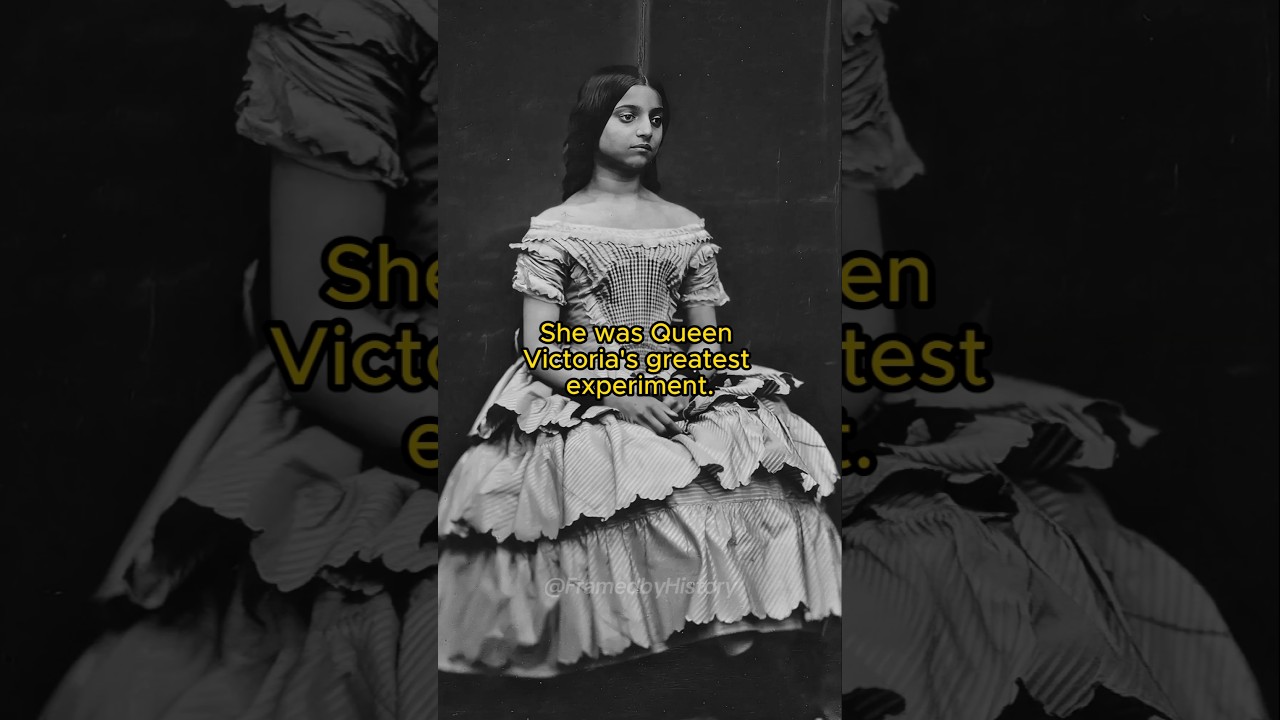
Her story begins not in a palace, but on its ruins. Princess Gouramma was the daughter of the last king of Coorg, a lush, mountainous kingdom in Southern India. When the British deposed her father, she became a princess without a throne, a ghost of a lost kingdom. In a desperate bid to secure her future, her father took a radical step: he brought his young daughter to England and placed her directly into the hands of the most powerful woman in the world, Queen Victoria.
What followed was one of the 19th century’s greatest social experiments. Fascinated by the exotic little princess, Queen Victoria adopted her as a goddaughter. Gouramma was given a new, English name—Victoria—and was raised in the heart of the British court. She was baptized into Christianity, educated by the finest tutors, and dressed as an English lady. The Queen’s intention, it seemed, was to mold this Indian princess into a perfect, civilized Christian aristocrat.
But this gilded cage was a lonely one. Torn from her culture, her religion, and her home, Gouramma was a perpetual outsider. She was paraded at court as a curiosity, a living symbol of the reach and “benevolence” of the British Empire. Despite the Queen’s affection, she was adrift, caught between two worlds and belonging to neither.
The experiment’s tragic conclusion was perhaps inevitable. Her arranged marriage was unhappy, and her spirit seemed to fade under the grey English skies. Plagued by poor health and a deep-seated melancholy, the vibrant princess from a sun-drenched kingdom withered.
She died in 1864, at the tragically young age of 22. Her story, largely forgotten by history, is a haunting reminder of the human cost of empire. She was a daughter, a princess, and a pawn in a grand imperial game, leaving behind the powerful question of whether she was ever truly seen as a person, or just a project.
#history #royalty #india #britishempire #queenvictoria
Video Source