Read more Featured Stories like this in The Strad Playing Hub
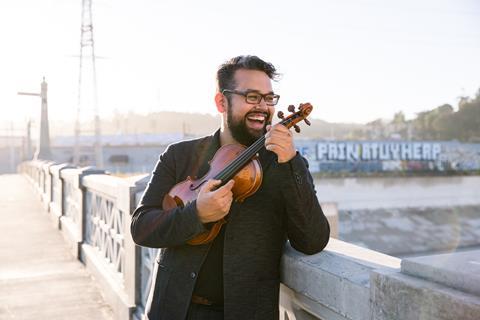
Vijay Gupta had played Carnegie Hall as a child, studied at Juilliard and Yale, and joined the Los Angeles Philharmonic when he was only 19, making him one of the youngest violinists to enter the ranks of a major American orchestra. At an early age, he seemed already to have reached the destination so many young string players are trained to imagine as success.
Gupta’s new book, Restrung: A Memoir of Music and Transformation (Da Capo Press), tells a more complicated story: of growing up between Bengali and American worlds, where, as he writes, ‘code-switching was our mother tongue’; of family expectation and prodigy culture; and of the personal unraveling that followed elite musical success. It also asks what that life demanded of his body, his sense of self and his relationship to the violin.
Gupta later became known well beyond the orchestral world through his 2012 TED Talk, ‘Between Music and Medicine’, which explored music, mental health and his work with Nathaniel Ayers, the Juilliard-trained musician whose story inspired The Soloist. That encounter formed part of the path towards Street Symphony, the Los Angeles organisation Gupta founded to bring live music into shelters, clinics, jails and prisons.
Much of Restrung asks what music can mean in those spaces – and what musicians may learn from listeners who have no obligation to observe the rituals of the concert hall. Speaking to The Strad’s US correspondent Thomas May, Gupta discusses the violin as identity, burnout, Street Symphony’s work beyond the concert hall and why ‘good playing’ has to mean more than polished execution.
Restrung is rooted in your own story, but it keeps opening out onto bigger questions about what music is for. Why did this story need to take the form of a memoir rather than a more direct argument about music and social change?
Vijay Gupta: When I started writing Restrung, I meant to write a guidebook for my organisation, Street Symphony, which brings music to people recovering from homelessness and addiction. I was asked for a blueprint. But I couldn’t write a social justice manifesto, or a call for advocacy, without owning where the work came from, which was my own spiritual and moral transformation.
The lessons that became Street Symphony started in my Suzuki training with Louise Behrend, and later with the famed Glenn Dicterow, then the concertmaster of the New York Philharmonic, who taught me that playing the Bach Chaconne was like ‘praying with a violin in your hands’.
My teachers made it clear that music was sacred. But after I got into the LA Philharmonic at 19, playing the most celebrated music with the most celebrated musicians of our time, the sacred was hard to find. In the years that followed, I started asking inconvenient questions: was the concert hall the only sacred space?
I found the sacred in Skid Row shelters, in clinics and county jails – not because I was there to enact ‘social change’ upon people recovering from incarceration and addiction, but because the people I met in those places demanded to know why I was a musician, and why they should listen to anything I had to play.
I went to Skid Row thinking I was there to bring beauty to broken people. Instead, I was confronted with the broken parts of myself. My hope is that Restrung can begin an honest conversation about how the music we love was created – and is brought alive – by fallible, aching human beings longing for beauty and connection.
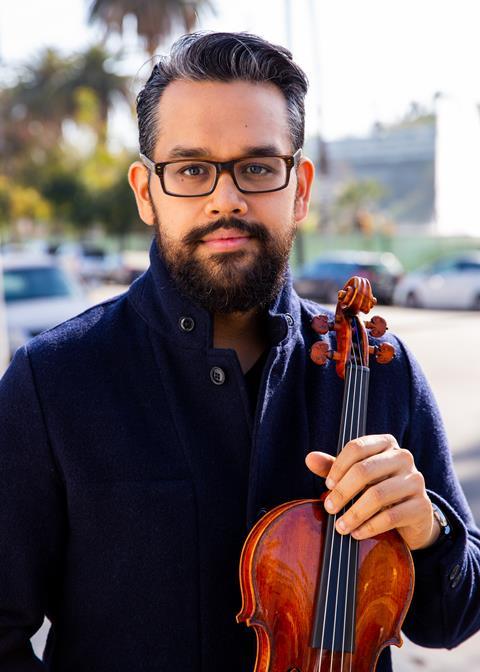
You write candidly about growing up as a violin prodigy. How did early success shape your relationship with the violin – both as an instrument and as an identity?
Vijay Gupta: Being a prodigy cuts both ways. I was lucky to have parents who pushed me and teachers who moved me into places of prestige. But those were also parents I knew I could never let down, and teachers who were intensely cruel. The label only lasts as long as you never disappoint anyone. And what I was truly prodigious at wasn’t learning music quickly or memorising my Paganini Caprices. I became prodigiously good at reading a room and telling people exactly what they wanted to hear, so good that I lost track of when I was performing and when I wasn’t.
Early success is early, and successful, because of a lack of friction. Later, I learned that professionalism worked the same way: stiff upper lip. Even after I joined the orchestra, I played through a constant, burning pain – tendinitis and bursitis from performing four concerts a week for 44 weeks a year – but the deeper pain was the way I had learned how to treat my body like a kind of object. Once music became a job, I felt that it was something extracted from me, at a tremendous cost – physical, psychological and spiritual.
Success blinded me to the tools of connection I would have to build for myself later, even after I left the LA Philharmonic. For all the years I spent learning to sight-read, I had not learnt to listen. What I understand now is that I am the instrument, not only the one I get to play. The real work ahead of me is to turn myself into a kind of Stradivari, to sing and speak with the clarity and depth that reveals every layer of who I am.
At the end of my book, Restrung, I write about going back to my childhood home, after years of estrangement from my family, to find my first, tiny, 1/16-size violin in a cupboard surrounded by piles of trash. The bridge had collapsed, but the strings were still attached. Our very lives are a metaphor of stringing and restringing: we need to learn how to live in the tension.
Our very lives are a metaphor of stringing and restringing: we need to learn how to live in the tension
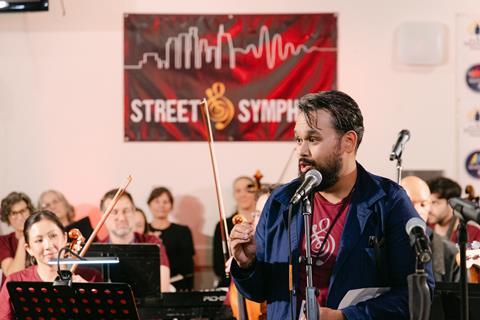
Through Street Symphony in Los Angeles, you have spent years bringing live music into shelters, clinics, jails and prisons. What has that work taught you about the role of a violinist beyond the concert hall?
Vijay Gupta: The great cellist Pablo Casals thought of himself as a human being first, a musician second, a cellist third. The phrase ‘beyond the concert hall’ assumes the stage is the centre and everywhere else is the margin. Making music in shelters, clinics, jails and prisons has taught me the opposite.
We forget that the concert hall is a recent invention. It was Wagner who darkened the hall at Bayreuth, sank the orchestra into a pit and trained audiences to sit in silence until the end of an act. It was never our only job to hand people a polished product to admire in the dark.
In the rooms where Street Symphony plays, no one is obligated to pretend to be moved, because no one paid for the right to enjoy what we play. If the music does nothing, they tell you, or they leave. So I stopped performing at people – as I had been trained to do – and started communicating, both as a musician and a human being.
So my work now is to bring that connection back into the concert hall, through storytelling and through music that lets us tell each other how we want to be seen. This is not about doing good beyond the concert hall. It is a reminder that the power of what we do is not a commodity to be admired. We are far more powerful than we think.
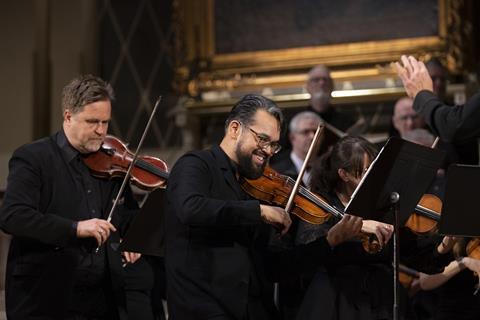
You write, ‘Art is not a noun’. At this point in your life, what does ‘good playing’ mean to you?
Vijay Gupta: In The Gift, the writer Lewis Hyde argues that art was never a commodity to be bought and sold, but rather a current of connection between the giver and the receiver, offering the possibility of transcendence. However, once we reduce any art to a transaction, or into a thing to be judged or valued on the market, that generous and generative spark is extinguished. Art is something that happens between people, or it does not happen at all.
Of course good playing means good technique. Technique is a form of hygiene. I am not making an excuse to play out of tune or out of time. Rote perfection that moves no one is precisely the thing a machine does better than we ever will, and yet, in an age already terrified that machines will replace us, we keep chasing, and celebrating, that which reduces us to mindless automatons. We are ruled by the binary of right and wrong, and we have forgotten what we came for.
Classical music needs a new why: ‘good playing’ is playing with intention, offered to someone who needs to hear it.
Restrung is frank about burnout and ambition – the cost of attaching one’s worth to musical achievement. What do you hope younger musicians, especially string players trying to build a life in music now, might recognise in your account of coming undone and finding a different way to make music?
Vijay Gupta: Stop chasing success on everyone else’s terms. Most of the ambition burning young players out is not even theirs. We hold up the orchestral job as the only legitimate outcome, and faculty celebrate only the students who win auditions, when we graduate far more players each year than there will ever be jobs. That is not mentorship. It is selling a lottery ticket and calling it a career.
We have also denigrated the young people who wanted to improvise, or play jazz, or write their own music, because we still believe the myth that classical music is great. The truth is, there is no such thing as classical music. It is a category invented by 19th-century Victorians, calcifying art into a museum of finished masterworks to be reproduced as perfectly as possible. And even though the early music and historically informed movements have brought back some of the fire of improvisation that informed Bach, Mozart and Beethoven, we have done little to rekindle the human and social contexts from which their masterpieces emerged.
So when I tell a young musician to be rigorous, I do not mean obedient, but rather ruthlessly curious. Play in tune, but also be in tune with yourself, the people on stage with you, and the people in the room with you. The only way to make music that matters is to insist on what matters: anything less, and we haven’t played anything worth hearing.
Restrung: A Memoir of Music and Transformation is published by Da Capo Press.
‘ The preceding article may include information circulated by third parties ’
‘ Some details of this article were extracted from the following source www.thestrad.com ’