Once upon a time, the Super Bowl halftime show was purely defined by spectacle. The bigger, the flashier, the better to lure millions of watchful fans to tune into the most important football game of the year.
In recent years, however, a new standard has seemingly emerged from the halftime show’s greatest-hits trend, one that asks artists stepping onto one of the biggest global stages to deliver not just showmanship but substance that can truly enrapture audiences for the year’s hotly anticipated performance.
The latest stars to carry on the wave this decade have been Kendrick Lamar, who performed solo at the 2025 halftime show, and Bad Bunny, the headliner for this year’s Super Bowl LX.
The performers both delivered unforgettable shows that captivated onlookers in distinct yet equally potent ways — Lamar staging his politicized version of “The Great American Game” narrated by Uncle Sam (Samuel L. Jackson) and Bad Bunny honoring his Puerto Rican roots through a joyous celebration of heritage — each igniting conversations that have lingered well beyond the game-day broadcast.
Even now, audiences are still decoding and dissecting every little detail of Bad Bunny’s historic set (performed almost entirely in Spanish), from the star-studded appearances of Ricky Martin, Lady Gaga and others to the nod to his historic Grammy win to the countless overt references to Puerto Rican life and Latin culture.
Both headliners’ groundbreaking shows have surpassed what we’ve come to expect from most halftime performers, except for a small few. Between one’s pointed political statement and the other’s celebratory message of Boricua resilience, each laced with historically specific symbolism, the bar for cultural resonance on the Super Bowl stage has been officially raised high.
It makes you wonder if such a precedent will last, and if so, who possesses the range and cachet to shoulder such a tall task?
So far, there’s no word on who the NFL might select for next year’s coveted headlining slot, although one artist seems to have already thrown his name into the ring.
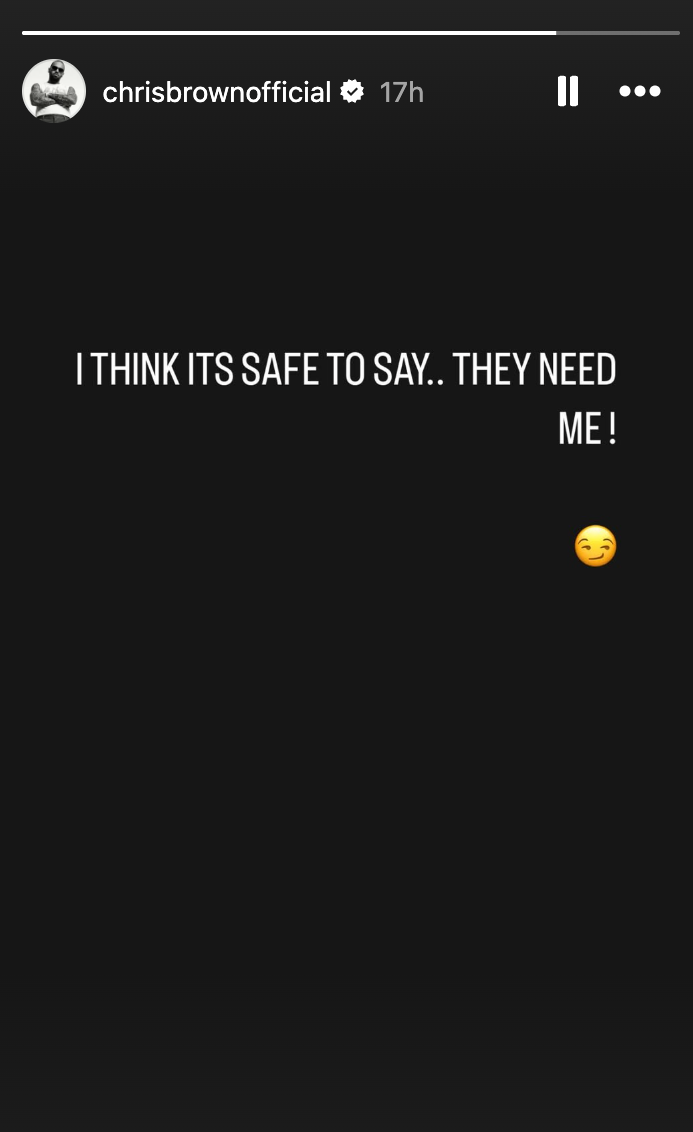
Shortly after Bad Bunny’s performance on Sunday, Chris Brown posted a cryptic Instagram story seemingly shading the Latin star, writing, “I think it’s safe to say.. they need me!”
Screenshot via Chris Brown’s Instagram
It remains unclear whether the R&B singer’s message was a response to the Puerto Rican superstar’s Super Bowl display — or even a direct challenge to the NFL itself — though the timing is hard to ignore. If it was, it raises larger questions about what the Super Bowl halftime show could, and perhaps should, become in the wake of the model that Lamar and Bad Bunny have set.
Which other artists are capable of meeting the moment on that grand a scale? What kind of cultural worldview might they choose to project to a global audience if given the opportunity? More pointedly, is the world even prepared for a halftime show that more openly engages with sociopolitical commentary?
The latter depends on how much leeway the NFL is willing to grant artists to address such matters, especially after so many MAGA meltdowns over Bad Bunny simply being this year’s halftime pick. This is, after all, the same risk-averse league that, less than a decade ago, stood by as Colin Kaepernick’s football career unraveled after he took a knee during the national anthem. Even with Jay-Z’s Roc Nation producing the show, there are limits to how much protest and provocation the NFL will allow on its own stage.
Still, Lamar’s and Bad Bunny’s performances are proof that when artists have something urgent to say about the state of the world and the issues shaping our time, and with an audience willing to listen, the Super Bowl stage can, in fact, make room for it.
These two performers aren’t alone, though. Their example follows in the footsteps of previous stars like Beyoncé, whose memorable 2016 appearance alongside Coldplay and special guest Bruno Mars included an unapologetic homage to the Black Panther Party and a reference to the Black Lives Matter movement during her performance of “Formation.”
Other halftime performers have also leveraged the Super Bowl stage for isolated political moments — whether through Eminem’s kneeling tribute to Kaepernick, Jennifer Lopez’s “kids in cages” reference condemning Trump’s immigration policy, Lady Gaga singing her LGBTQ anthem “Born This Way,” or Madonna’s outraged call for world peace.
However, as solo Super Bowl headliners, Bad Bunny and Lamar have established the blueprint for a 13-minute cultural showcase that others could one day emulate, so long as the NFL’s mainstream viewership remains receptive to it.
Some argue that these culturally rich and politically charged performances (yes, even joyful art like Bad Bunny’s can be considered political in today’s climate) are only a timely reaction to the current administration’s tyranny and wouldn’t exist otherwise. Others contend that such moments won’t even last, predicting that the halftime show could soon revert to its familiar, status-quo formula of apolitical entertainment.
Only time will tell which direction the league will take. But once you set a standard for unprecedented artistic audacity, it’s hard to imagine the halftime show going back to the safe, predictable affair it once was.
Audiences have already seen what’s possible when creativity, culture and courage collide on the Super Bowl stage. Stripping that away would simply be a slap in the face to hard-won progress.
Then again, there would be nothing more American than the NFL regressing to the days of stifled expression.
‘ The preceding article may include information circulated by third parties ’
‘ Some details of this article were extracted from the following source www.celebrity.land ’