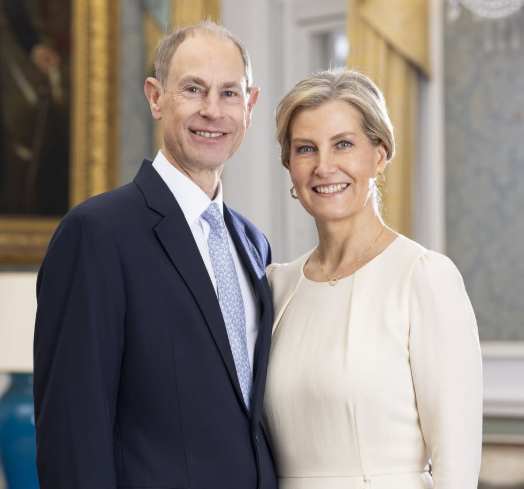
The Duke and Duchess of Edinburgh have sent a heartfelt message
at the end of a special royal event that’s gone largely
unnoticed.
Edward and Sophie said a big thank you to the people of Portugal
after an official visit to the country that lasted several
days.
However, the important visit has taken place with little
fanfare.
The couple arrived in Portugal on June 1 where they were plunged
into royal history as they marked the anniversary of a treaty that
began with a regal wedding.
This year is the 640th anniversary of the Treaty of Windsor
which consolidated the alliance between England and Portugal, one
of the oldest diplomatic allegiances in the world. As part of that
treaty, the King of Portugal, Joao I, married Philippa, a
granddaughter of King Edward III. Philippa became Queen of Portugal
and an expert politician and diplomat.
Over six centuries on, the diplomacy was placed in the hands of
the Duke and Duchess of Edinburgh whose official visit to Portugal
included several key moments. The trip began with Edward and Sophie
helping to initiate the exhibition at the Portuguese National
Archive about the treaty. The display includes the first showing of
the English and Portuguese copies side by side since they were
signed in 1386.
Edward and Sophie won plenty of fans by making like Lisbon
locals and hopping on one of the trams which form the backbone of
the city’s public transport network. The Duke of Edinburgh looked
particularly delighted to be presented with a model of one of the
iconic trams.
Both the Duke and Duchess of Edinburgh’s work includes
supporting young people and Prince Edward spent part of the visit
at an international school. During his time at St. Julian’s, the
Duke joined in tile painting and saw the work of CERCICA, an
organisation that helps young people and adults with
disabilities.
The Duke also met some of Portugal’s star Paralympians during a
session on inclusive sports activities. He was shown some of the
secrets of success in boccia, one of the sports that Portugal’s
Paralympic team has excelled in and he also met Portuguese
Paralympic Committee members.
A large part of Prince Edward’s work has been centred around the
Duke of Edinburgh Award, of which he is President. It didn’t take
long for the prince to meet up with some of those taking part in
the International Award in Lisbon. During his time with
participants and leaders, he helped pitch a tent or two as he heard
about the Award’s work in Portugal where over 50 schools and
colleges now participate.
Sophie headed to the National Defence Institute where she joined
students for a model NATO, an initiative of the British
Embassy Lisbon which has brought together young people from
Portugal and the UK for the past four years. During the session,
the students take part in their own version of NATO’s North
Atlantic Council and this time, they had a keynote speech from the
Duchess of Edinburgh as part of their session.
Bringing another of her passions to the conference, Sophie spoke
about Women, Peace and Security – she has carried out intense work
around the issue and is part of the UK’s Preventing Sexual Violence
in Conflict Initiative.
As their second day in Portugal ended, the Duke and Duchess of
Edinburgh came together again to visit TEKEVER, which is a leading
UK-Portuguese aerospace company. The visit also included a display
of flight technology including watching an Unmanned Aircraft System
being put together by a team from both countries.
A moving visit to Batalha Monastery followed with the Duke of
Edinburgh laying a wreath at the Tomb of the Unknown Soldier.
Meanwhile, Sophie had an historic tribute to make. She visited
the Tomb of King Joao and Queen Philippa of Portugal, whose
marriage had helped cement the Treaty of Windsor, and left flowers
in remembrance.
There was another poignant moment for Edward and Sophie as they
headed to the Veterans Museum near the Monastery. One of the
exhibits there is the preserved wreath of flowers that was laid at
the Tomb of King Joao and Queen Philippa in 1957 by Queen Elizabeth
II during her visit to Batalha Monastery.
The visit of the Duke of Duchess of Edinburgh to Portugal ended
in the city of Porto, where they were greeted by the mayor, Pedro
Duarte, and the President of the Municipal Assembly, Marta
Massada.
There was a special honour for Edward and Sophie as they were
presented with the Keys to the City.
Their time in Porto also saw them head to the British School
where Prince Edward met more students involved in the Duke of
Edinburgh International Award and once again followed in the
footsteps of his parents as both Queen Elizabeth II and Prince
Philip visited there.
It wouldn’t be a visit to Portugal without a glass of port and
the final stages of this unheralded official visit saw the Duke and
Duchess of Edinburgh at the British Factory House which was the hub
of the trade around the drink in the 18th century, when it was a
lucrative business for London merchants.
The tour ended, as it had begun, with the story of Joao and
Philippa, the king and queen who helped cement ties between
Portugal and England. At Porto Cathedral, the Duke and Duchess of
Edinburgh were given a tour of the church in which the couple had
been married and they saw the cloister of the church which had been
built in honour of the new queen and which is decorated with
another emblem of Portugal, the famous blue and white tiles known
as azulejos.
Just before they left, Edward and Sophie enjoyed some music and
dance shows and then made their own mark. At Graham’s Port Lodge,
they were asked to ‘christen’ a barrel of port, a traditional
ceremony during a royal visit. Both threw a glass of port over the
barrel where new port is now maturing. It provided another link to
the past for Edward and Sophie during a visit that helped cement
old ties with new diplomacy.
‘ The preceding article may include information circulated by third parties ’
‘ Some details of this article were extracted from the following source royalcentral.co.uk ’