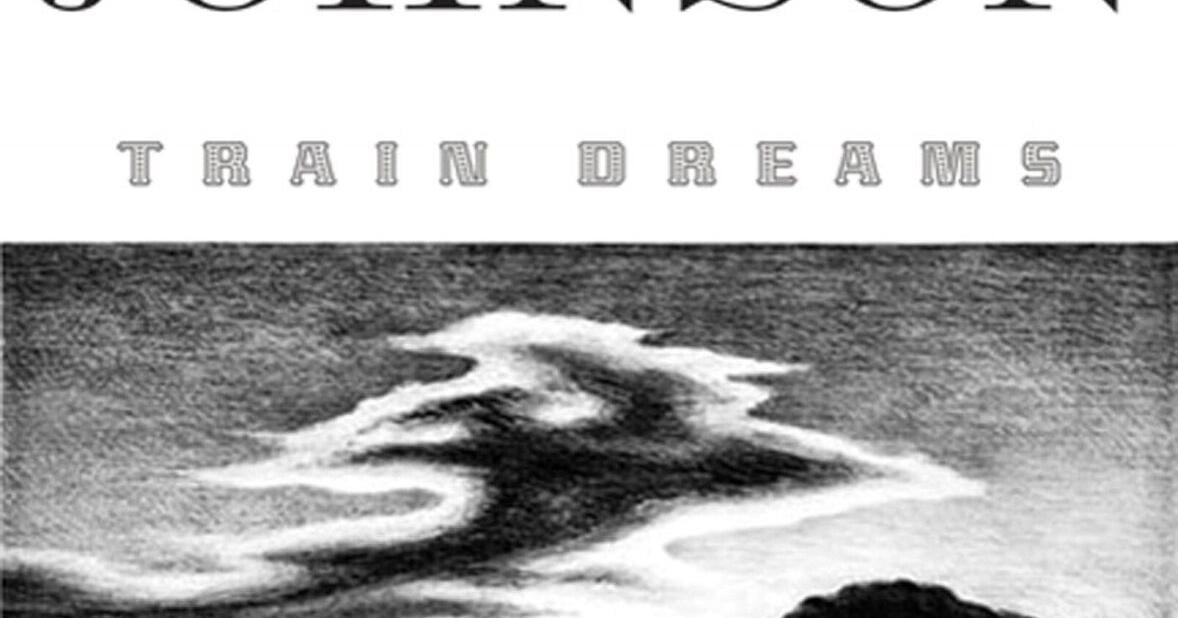
Denis Johnson’s “Train Dreams,” the novella that inspired the Oscar-nominated (and made-in-Washington) film, is the slimmest of books: a tiny paperback, just over a hundred pages, whose weight barely seems to register in your hand. But within those pages lies a lifetime, and a world not too far from our own.
Like the movie, the book is the biography of one man, whose life on its surface seems mostly unremarkable: Robert Grainier, a quiet day laborer at home in the forests and trainways of Idaho and Washington, who was born in the 1880s and died in the 1960s, watching the world change around him. He was fascinated by his work on the railroads, “where swarms of men did away with portions of the forest and assembled structures as big as anything going, knitting massive wooden trestles in the air of impassable chasms, always bigger, longer, deeper.” He loved his wife and daughter. In his life, he owned one acre of rural property, two horses and a wagon. He never, in all his years, spoke into a telephone. And, for a man who loved trains, he didn’t get around much, traveling in his lifetime “west to within a few dozen miles of the Pacific, though he’d never seen the ocean itself, and as far east as the town of Libby, forty miles inside Montana.”
Unlike that of his fictional creation, author Johnson’s life spanned the globe: Born in Munich in 1949, the son of a State Department officer, he lived in Germany, Japan, the Philippines and multiple U.S. states before settling in remote North Idaho in the 1990s, where he would live most of the remainder of his life. (Johnson died of cancer in 2017, at 67.) He is best known for the short story collection “Jesus’ Son,” which drew on his longtime struggle with drug addiction, and for the Vietnam War-set novel “Tree of Smoke,” which won the 2007 National Book Award. Johnson’s work is no stranger to the big screen: “Jesus’ Son” became a film in 1999, and his novel “Stars at Noon” was adapted for the screen in 2022. He was also a poet and a playwright, with a trilogy of his plays presented at Seattle’s Theater Schmeater two decades ago.
Though “Train Dreams,” a finalist for the 2012 Pulitzer Prize for fiction, wasn’t published in book form until 2011 (the literary periodical Paris Review published an earlier, slightly different version in 2002), Johnson began work on it in his early years in Idaho, inspired by facts and stories he found in old newspaper archives, and by his own observations of the area. The book, like the movie, has a pleasantly hallucinatory quality to it; you can sense the bits and pieces, floating around and somehow fitting together, like an abstract jigsaw puzzle. Robert Grainier’s story is not told in strictly chronological order, and some of its most devastating plot points happen without fanfare and in few words, as if tragedy and everydayness held the same weight.
Among those bits and pieces, in Johnson’s spare yet elegant prose: A brief, disturbing scene in which Grainier is one of a “party of executioners” who attempt to kill a Chinese immigrant accused of stealing from the company store. A late night, in the remote cabin he shares with his wife and daughter, as a distant rail whistle blows and Grainier tries to keep his wife talking; “it was dark, and he wanted to keep hearing her voice.” A day in Montana, when by chance he happened to be standing near a railway car “carrying the strange young hillbilly entertainer Elvis Presley.” A haunting sequence, which may or may not have been a dream, in which a lost loved one found her way home, if only for a moment. A man who claimed to have been shot by his own dog. A brief, astonishing flight in an airplane, at a county fair, when suddenly “all the mysteries of this life were answered,” only to return to mysteries when back on solid ground again. And, always, ever-present reminders that a life can end just like that, with the felling of a tree or an unexpected train or a young man who suddenly felt dizzy, “removed his hat, flopped over sideways, and died.” Much of this finds its way into Clint Bentley’s hypnotically lovely film, which features a narrator (Will Patton) dictating the story to us as if reading the book aloud.
Reading the book after seeing the film is an almost eerie experience, like having the same dream twice. You leave Johnson’s book thinking about the weight of silence, about being alone in a cabin filled with memories and firelight and “the enclosing shifting curtain of utter dark” — and about how quickly, how uncannily, time passes, and life carries on.
‘ The preceding article may include information circulated by third parties ’
‘ Some details of this article were extracted from the following source www.yakimaherald.com ’