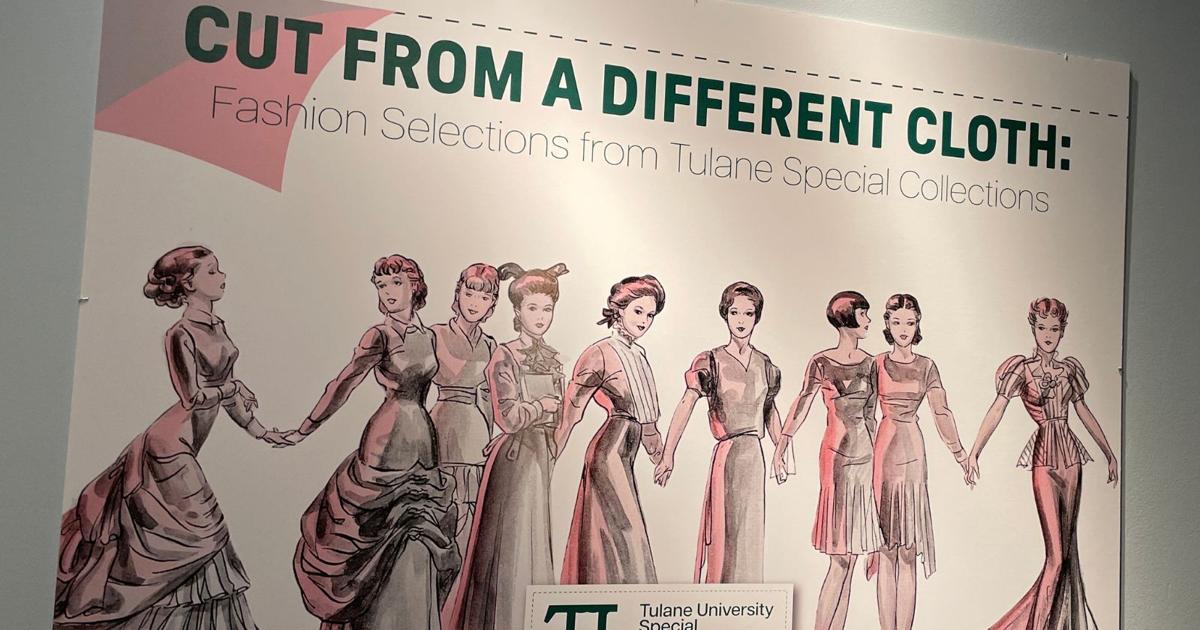
The objects, images and garments on view in the exhibition “Cut from a Different Cloth: Fashion Selections from Tulane Special Collections” track the importance of apparel through many levels of the New Orleans community, from grand society dames and Carnival royalty to Black Masking Indians, college students and titans of world couture.
“New Orleans is not one of the great fashion capitals of the world, like we think of New York or Paris,” said co-curator Faye Daigle. “(But) clothing is still as essential as food, as our culinary culture, as our music.”
To co-curator Kevin Williams, the exhibit demonstrates that there’s a lot of material in the university’s Special Collections of very varying interests.
“If (researchers are) looking for building plans, if they’re looking for photographs of families, if they’re looking for Carnival original designs, Carnival jewelry — we have things like that here, things that they might not normally think of when they think of archives.”
Williams said the holdings of the Special Collections — which entail the Hogan Archive of New Orleans Music and New Orleans Jazz, the Louisiana Research Collection, the Southeastern Architectural Archive, University Archives and Rare Books — would stretch, if organized end-to-end, 7.5 linear miles.
‘A lot of opening boxes’
On the title wall, text advises that the exhibit “does not reflect a comprehensive material history of New Orleans fashion,” but rather that history as reflected in Tulane’s holdings and a few items loaned for the exhibit.
Sections are arranged by “Society and Carnival,” “Campus Style,” “Sewing: Dressmaking and Textile Art,” “Shopping,” and displays dedicated to drag and LGBT material culture. The narrative begins with silhouette designs by James Rogers Lamantia Jr., an instructor at Tulane’s School of Architecture, created for a Metropolitan Museum of Art exhibit “The Art of Fashion” at the time of the 1967 Met Ball. It concludes with an Italian-made, pink suede jacket worn by Louis Prima.
Louis Prima’s Italian-made pink suede jacket from the early 1970s.
About midway around the gallery is a tribute to Samuel Albert Bozeman Jr., who attended Tulane as a pre-med student for a bit in the 1940s. As Geoffrey Beene, he would become one of the most celebrated fashion designers of the late 20th century.
Traversing all of the potential material for the exhibit entailed “a lot of opening boxes,” Daigle said.
“Even if you do that two hours a day and find nothing, if you do that five days a week, you’re bound to find something. And certain patterns emerge. You can often find interesting things in the last box of a family’s papers, the ‘miscellaneous’ boxes, boxes that say ‘ephemera,’ boxes that are oddly shaped. So, little things like that catch your eye, and it’s a lot of just pulling and looking.”
Williams said he and Daigle worked on the exhibit for more than five months, all while maintaining other duties as, respectively, coordinator for exhibits and outreach, and research services library associate.

The Society & Carnival section of “Cut from a Different Cloth” documents a century of local couture, including designs for Carnival ball gowns.
“Faye was phenomenal in the way she was just going through these barely described boxes … and she found quite a bit of material,” he said.
Evolving student fashion
The “Campus Style” section is notable for its cheerleading uniforms from 1913 and 1957 (with accompanying photographs of the students who wore them), but also for its chronicling of evolving student fashions, some as recorded in the campus magazine Urchin, produced at mid-century for Tulane and Loyola students. A 1936 cover headline promised readers “sports, humor, gossip.”
“During the 30s and even well into the 40s, a lot of students dressed like their parents,” Daigle said. “There was very little idea of a youth culture and youth dressing. But as soon as you move further into the 50s, you can see the sleeves go up (and) the cardigans come out.
“Even further into the 60s, the hemlines rise, the hair gets shorter. And, into the 70s, you have more natural hair, you have flared pants. You can see the students start to experiment with their own sense of style, which I think is really special.”

A Tulane cheerleading uniform worn by Roberta Carr in 1957.
“Cut from a Different Cloth” is on view through May 29 at the Tulane University Special Collections second floor gallery in Joseph Merrick Jones Hall on Tulane’s Uptown campus. Hours are 10 a.m. to 4 p.m. Monday through Friday. Admission is free and open to the public.
Museum calendar
- Rodger Kamenetz will discuss his new book “Seeing Into the Life of Things: Imagination and the Sacred Encounter” at 5:45 p.m. Feb. 2 at the Museum of the Southern Jewish Experience. More: msje.org.
- At a meet-the-author event at 5:30 p.m. Feb. 4 at the National WWII Museum, Nicholas Evan Sarantakes will discuss his book “The Battle of Manila: Poisoned Victory in the Pacific War.” A 4:30 p.m. reception will precede the presentation, which will be offered in-person and online. More: nationalww2museum.org.
- The exhibition “The Moss Mystique: Southern Women and Newcomb Pottery” opens Feb. 5 at the Newcomb Art Museum of Tulane. More: newcombartmuseum.tulane.edu.
- At 5 p.m. Feb. 5, the National WWII Museum will offer free after-hours access to the traveling exhibit “Degenerate! Hitler’s War on Modern Art.” The event will feature presentations by local artists, hands-on art-making stations and live music. More: nationalww2museum.org.
- Harmonia Rosales will discuss her book “Chronicles of Ori: An African Epic” with actor and art collector CCH Pounder at 5:30 p.m. Feb. 11 at the New Orleans Museum of Art. Admission is free, but preregistration is suggested as space is limited. More: noma.org.
‘ The preceding article may include information circulated by third parties ’
‘ Some details of this article were extracted from the following source www.nola.com ’