When Quentin Tarantino‘s “Pulp Fiction” exploded onto the world’s movie screens in 1994, it became immediately and ubiquitously influential, inspiring dozens of similarly pitched cocktails of black comedy and violent crime: “2 Days in the Valley,” “Lock, Stock and Two Smoking Barrels,” and “Love and a .45” are just a few obvious examples.
None of these movies, even the good ones, came close to equaling the entertainment value or literary qualities of Tarantino‘s masterpiece, but their proliferation had a weird side effect: keeping critics and audiences from recognizing and appreciating the handful of post-“Pulp Fiction” crime films that actually were great.
More from IndieWire
In the years following “Pulp Fiction,” a kind of cinematic Gresham’s Law set in, where there were so many movies featuring guys with guns on their posters that they became indistinguishable from one another. By the fall of 1997, when writer/director Jim Kouf’s “Gang Related” came out, it was not only difficult to distinguish the film from the myriad other crime movies flooding the marketplace, it was difficult to distinguish it from other Tupac Shakur vehicles — the rapper was so prolific that “Gang Related” was his third posthumously released movie to come out in the year following his murder.
“Gang Related” was the last Shakur performance to make it to the screen, and one of the last gasps of several 1990s subgenres. Not only was it guilty by association with all the post-“Pulp Fiction” Tarantino knockoffs; it also intersected with the 1990s explosion of “hood” movies that came in the wake of John Singleton’s “Boyz N the Hood” and The Hughes Brothers’ “Menace II Society,” and played as a kind of dark inversion of the buddy cop movies that had been dominant since “Lethal Weapon” in 1987.
A late entry in several traditions that audiences, and especially critics, had by this point had their fill of, “Gang Related” debuted to minimal business and mixed reviews. Yet sometimes the late movies in a cycle can be among the best, because they’re the ones most interested in and capable of truly examining, critiquing, and reinventing the cycle’s conventions — “Risky Business” appearing several years into the wave of “Porky’s”-inspired teen sex comedies is perhaps the most obvious example. (Spike Lee’s own hood movie, “Clockers,” is another.) “Gang Related” is a case in point, and 28 years after its release, the virtues we took for granted then seem both obvious and vital.
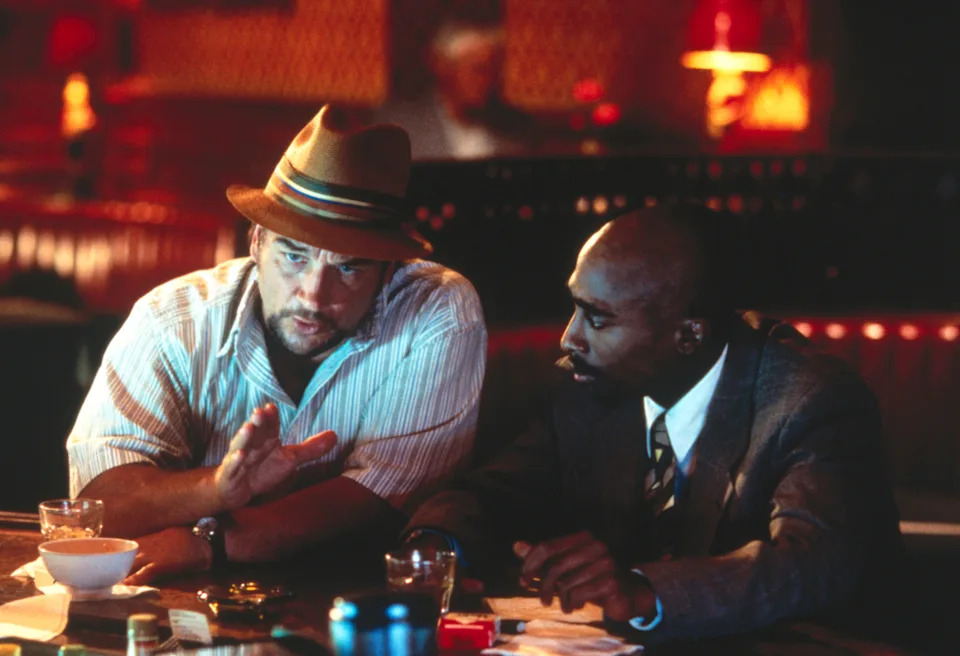
‘Gang Related’©Orion Pictures Corp/Courtesy Everett Collection
“Gang Related” follows two cops (Shakur and a delightfully scuzzy James Belushi) who have figured out a great racket: They steal drugs from LAPD storage, sell them on the street, then murder the buyers, taking the money and returning the reacquired drugs to the evidence lock-up. When they inadvertently kill an undercover DEA agent, all hell breaks loose, as a massive federal investigation begins and the corrupt buddies — who have been placed in charge of the investigation, thus ironically assigned to hunt themselves — have to find somebody to pin the murder on before it can get traced back to them.
This is the premise of “Gang Related,” but not the story. That’s because, as was so often the case with film noir movies of the 1940s — another tradition to which “Gang Related” owes a considerable debt — “Gang Related” doesn’t just establish a concept but tells a story that keeps unfolding from beginning to end. The synopsis above only covers the first 20 minutes or so of the movie; after that, Kouf keeps throwing twist after twist into the mix, constantly drawing the viewer in with developments that are both emotionally impactful and thematically rich.
Without revealing any of those developments, since Kouf’s ability to keep the audience guessing is one of the film’s greatest pleasures, I’ll just say that each of them builds on what came before to create a textured, complex, and chilling portrait of institutional corruption — Belushi and Shakur may be the bad guys, but their behavior is seen less as an aberration than an organic outgrowth of both the lingering culture of a post-Daryl Gates, post-Rodney King LAPD and a society that values the pursuit of money above nearly everything else.
Kouf’s screenplay constantly pokes and prods at questions related to crime and consequences — unsurprisingly, the consequences tend to shift depending on the wealth and power of the characters — and his satirical commentary on class and politics grows in potency, power, and insight as the film progresses. The fascinating thing about Kouf’s scathing assault on the status quo is that he delivers it via a formula previously used primarily to protect it: the buddy cop movie.
Richard Donner’s “Lethal Weapon” movies, the last of which arrived in theaters less than a year after “Gang Related,” represent the genre distilled to its purest form, depicting a pair of cops (Mel Gibson and Danny Glover) operating without regard for the law in an end-justifies-the-means series of comic adventures where a great deal of the entertainment value comes from the total lack of guardrails on the police. Like Clint Eastwood’s Dirty Harry Callahan, Mel Gibson’s Martin Riggs is appealing not in spite of his unrestrained violence but because of it — since most of us constantly find ourselves powerless in daily life, it’s fun to relate to a character who has nothing but power and exercises it without restriction and without reflection.
While the “Dirty Harry” movies (particularly the one Eastwood directed himself, “Sudden Impact”) traffic in a certain amount of moral complexity and ambiguity, the “Lethal Weapon” films strip the formula down to its primal essence, to the point that they became not just apologies for but celebrations of police violence and civil rights violations — as Jonathan Rosenbaum pointed out in his review of “Lethal Weapon 3,” a movie that, astonishingly, rode to box office supremacy only a year after the Rodney King beating, the movie could just as accurately have been titled “How to Have Fun in a Police State.”
“Gang Related” uses aspects of the “Lethal Weapon” formula as a template, but veers closer to “Dirty Harry” territory — and then goes beyond it — by depicting its buddies as morally vacant sharks, in constant motion with no other purpose than self-protection and the accumulation of some extra cash. Kouf gets extra mileage out of his actors by casting against type; seeing comic everyman Belushi as a nihilistic fascist and anti-cop rapper Tupac Shakur as a policeman (albeit one who’s more of a criminal than the criminals he’s supposed to be arresting) gives the whole movie an added sense of electric energy.

Tupac Shakur, director Jim Kouf, and James Belushi on the set of ‘Gang Related’©Orion Pictures Corp/Courtesy Everett Collection
Much as “Gang Related” is an aberration in the buddy cop genre, it’s also a bit of an aberration in Kouf’s career — not that he was the kind of writer or director who was ever limited to one type of film. The main thing his best movies have in common isn’t genre but that they’re transcendent examples of their genre — as is the case with “Gang Related,” Kouf is rarely the first filmmaker to do whatever he’s doing, but he’s often one of the best.
In the early 1980s, Kouf wrote a series of teen-oriented comedies that contained far more wit and energy than most of their brethren — the now nearly forgotten “Up the Creek,” about a college river raft race, consists of pretty much wall-to-wall laughs, and the 1985 “Secret Admirer” plays like an Ernst Lubitsch roundelay for high schoolers. Among his other credits, ironically, are a pair of John Badham buddy cop movies — “Stakeout” and “Another Stakeout” — that deliver the more traditional satisfactions of the genre.
“Stakeout” in particular is a flawlessly engineered entertainment machine, a structural marvel of action, comedy, and romance that’s a perfect example of its ilk. And a year after “Gang Related,” Kouf returned to the buddy movie with another supremely effective entry — one of the last — in the genre’s classic form, the Jackie Chan-Chris Tucker vehicle “Rush Hour.”
The fact that Kouf is so good at writing buddy movies in the traditional manner is key to why “Gang Related” is so effective — it’s like when Robert Altman made “McCabe and Mrs. Miller” after spending decades directing TV Westerns like “Bonanza” and “Maverick.” Kouf knows the genre’s conventions inside and out; he knows what works and why, and he knows how to twist the clichés into something real and potent. Kouf is as solid a Hollywood craftsman as anyone in the business (he was one of the writers on “National Treasure,” one of the more satisfying and clever entertainments of Jerry Bruckheimer’s 2000s output), but there’s something extra fun about seeing him apply his talents to a piece of work as dark, nasty, and trenchant as “Gang Related.”
While the virtues of “Gang Related” may have been less apparent when it got lost in the shuffle of 1990s genre films, now that those kinds of movies are theatrically released with far less frequency, it’s hard to see how its greatness could ever have been ignored. A new Blu-ray from boutique label Cinématographe is finally giving “Gang Related” a worthy physical media release, with a pristine new 4K restoration from the original camera negative and hours of extra features; there’s also a beautiful accompanying booklet with terrific essays by Quatoyiah Murry, Brandon Streussnig, and modern noir expert Travis Woods.
It’s not only one of the best Blu-rays of 2025, but a reminder that time is the ultimate critic — and that “Gang Related” has not only passed and stood the test of time but gets better with every passing year.
“Gang Related” is currently available on Blu-ray from Cinématographe.
Best of IndieWire
Sign up for Indiewire’s Newsletter. For the latest news, follow us on Facebook, Twitter, and Instagram.
‘ The preceding article may include information circulated by third parties ’
‘ Some details of this article were extracted from the following source www.yahoo.com ’