What makes people evil? It’s a question that’s been asked since time immemorial, but it applies in particular to the Nazis. You don’t need me to explain World War II to you, and if you do, you should probably spend more time learning about history than reading movie reviews. However, if you want to do both, you can do a lot worse than Nuremberg.

While most WWII movies focus on the war itself, Nuremberg is about the aftermath, the lingering ambivalence towards Nazi ideology, and the first-ever international criminal court that tried the remaining Nazi leadership for their crimes against humanity. The result is a movie defined by incredible performances from its leads, working from an electric script that keeps things moving at a steady clip. Basically, it’s an educational and necessary flick, but with enough cinematic sugar to get the medicine to go down easy.
Russell Crowe plays Hermann Göring, the de facto leader of the Nazi regime after Hitler’s suicide, and Michael Shannon plays Supreme Court Justice Robert Jackson. The entire film builds to the much-hyped courtroom confrontation between the two, and it doesn’t disappoint. In hindsight, I find it curious that the verbal combat between Shannon and Crowe carries way more impact than that one time they had a physical tussle in Man of Steel back in 2013, but it’s still fun to see these two acting titans trade blows any way you cut it.
Despite the focus on these two larger-than-life figures, the real lead of the film is Remi Malek as psychiatrist Douglas Kelley, who maybe oversteps his boundaries by getting too close to Göring. Kelley is there to assess the competency of Göring (and the rest of the Nazi leadership), but he has an ulterior motive. He plans to write a book about his interactions with these Nazis, hoping to learn about the nature of evil and what makes men become monsters like the Nazi regime. Kelley is a deeply flawed character, and Remi Malek portrays him as a unique kind of ‘hero,’ marred by substance abuse problems and his dreams of literary glory, but nevertheless with a sense of both justice and empathy.
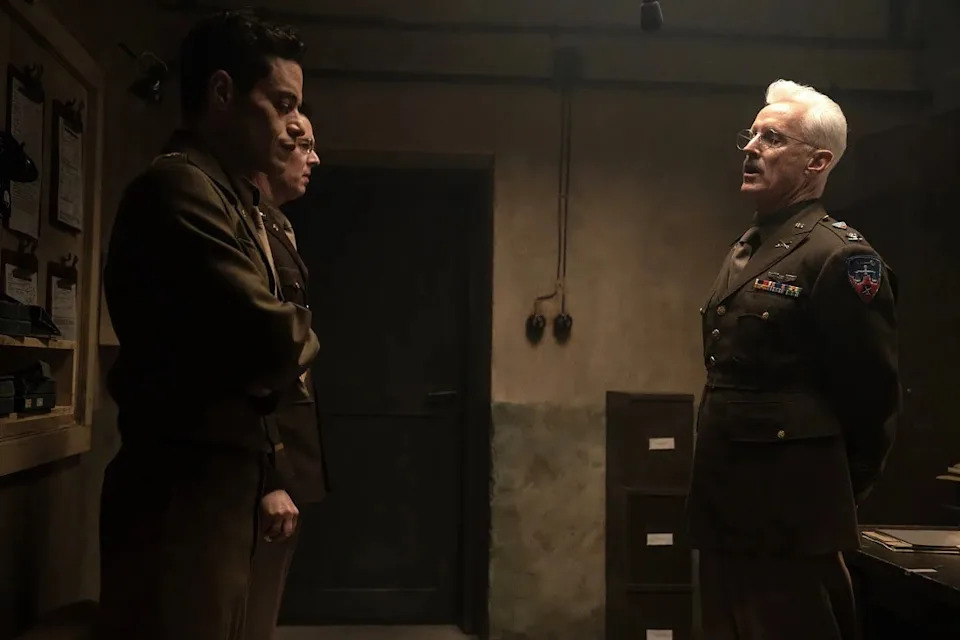
While the big battle between Michael Shannon and Russell Crowe is the centerpiece of the film, it hits as hard as it does because of the way both characters bounce off of Malek’s character. With a runtime of nearly 2.5 hours, there’s certainly enough room for Nuremberg to take its time and examine its characters from every angle and support a broad emsemble cast that also includes John Slattery, Leo Woodall, Colin Hanks, and Richard E. Grant, who plays the co-prosecutor alongside Shannon. Every once in a while, the movie feels a bit like a powerpoint presentation, but it’s all in service of making sure the entire audience is on the same page with regards to the degree of Nazi depravity and their horrific war crimes.

Nuremberg also doesn’t pull its punches when it comes to its central theme, its answer to the question of “What makes people evil?” and connects it to today. In real life, Nazis were inspired by the United States’ racial policies at the time, a fact that is pointed out in the film. It’s also worth noting that the 1961 film, The Trials at Nuremberg, used this as a theme, drawing direct parallels between Nazis and the Jim Crow South, but that’s a different story.
Writer/director James Vanderbilt adds enough visual flair to keep Nuremberg from feeling like a filmed stage play, and the cinematography goes a long way towards keeping the energy level up. While the film knows when to focus on straightforward closeups of its leads doing what they do best, it also knows when to keep the camera moving and to allow other elements of the production design, like the costumes and sets, have their chance to shine. Nuremberg is a showpiece for its actors, but it doesn’t just wind them up and let them go nuts right away. The grandiose dramatic outbursts are few and far between, but they feel earned when they do arrive, and always carry the intended emotional impact.
All of this is to say, Nuremberg is deeply resonant and highly informative, but also surprisingly mainstream. It’s a character-focused story of good and evil. The film is about how the Nazi regime came to an end, but it also examines how it began, and how it could begin again, and it lets the viewer surmise that, in the present-day United States of America, it already has.
Final Score: 8/10
‘ The preceding article may include information circulated by third parties ’
‘ Some details of this article were extracted from the following source www.yahoo.com ’