Kerr, a performance artist, doesn’t care if her work is enjoyable. Art is an act of will.
“I dreamed not of entertaining an audience, but attacking it,” she says. “I dreamed of audiences heroic enough to survive.”
Inspired by the Futurists of the early 20th century, Kerr devises a piece in which the audience will remove her clothing one piece at a time until she is “buck naked.” All the while she recites the Song of Solomon, from the Old Testament.
Stripped down to bare flesh, “I never felt more essentially beautiful,” says Kerr, played by Elizabeth Ledo. She stretches her arms out, Christlike, as gentle music plays.
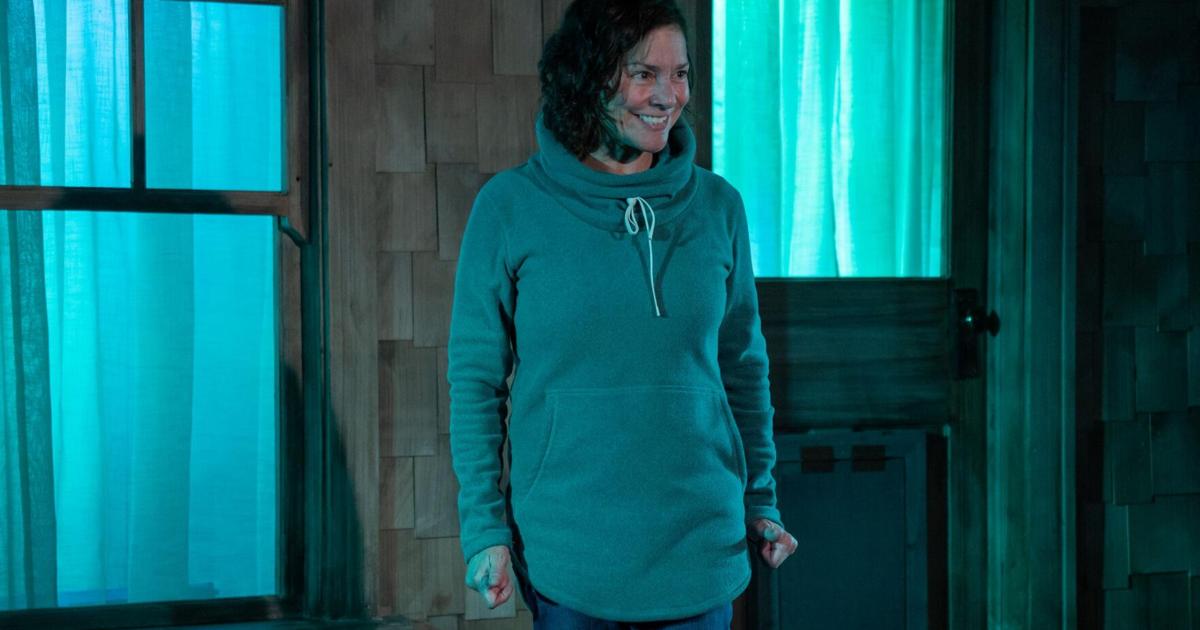
Elizabeth Ledo plays all the parts in Lee Blessing’s “Chesapeake,” produced by Two Crows Theatre Co. Christopher R. Dunham designed the set at the Slowpoke Lounge & Cabaret.
These themes — of our animal nature, of resurrection, of grace — echo through “Chesapeake,” a 1999 play by Lee Blessing (“Going to St. Ives,” “A Walk in the Woods”).
Ledo, a familiar face from American Players Theatre, performs this solo show through April 26 at the Slowpoke Lounge & Cabaret in Spring Green. It is the final play in Two Crows Theatre’s season, and though it’s broadly comic in places, the sinister undertones fit Two Crows’ intimate, unsettling vibe.
The title “Chesapeake” refers both to the bay on the Atlantic and a dark brown retriever named Lord Ratliff of Luckymore, Rat or Lucky for short. Lucky is the “most effective political pet in the entire Congress.” He’s been essential to the campaign of Therm Pooley, a hateful Southern senator.
When Pooley uses Kerr’s Song of Solomon striptease as a political bargaining chip, coasting to a win on allegations of “po-or-nography,” Kerr devises a dognapping in retaliation. She will retrain Lucky to love her best, document the whole thing and make that the centerpiece of her next show. It will be a “real-life protest.”
Ledo has such an impish quality to her, one that has for several summers now made her fantastic to watch in Shakespearean bit parts — she’s a scene-stealer. Directed by Marcus Truschinski with incrementally increasing tension, Ledo’s eyes flash as Kerr plots her next move, delighting in her own ingenuity.
Over nearly two hours, Ledo wraps herself in the greatest performance of Kerr’s life. Sliding sideways into various accents, she embodies the molasses-mouthed senator, his icily ambitious wife, the good Christian assistant who’s sleeping with the senator, and Lucky himself.
Watching Ledo lick and wag as she waxes poetic about her “superpower” sense of smell (“like a library”) feels like watching the best storytellers we’d get as kids. The world has gone sideways but here, listen, come along — the tale is a leash, pulling us forward.

Elizabeth Ledo plays Kerr, a performance artist, among other roles in “Chesapeake.”
“Chesapeake” is not Blessing’s best play — as mentioned, it’s awfully broad at times — but even when it feels most like a soapy primetime thriller, I wouldn’t turn it off. As Kerr attempts to wrestle Lucky into her minivan, her eyes gone wild, we can practically see the struggling dog.
Set designer Christopher R. Dunham must have built ships in a bottle as a kid for how much detailed set he’s able to fit in the tiny Slowpoke space. Off a weathered wooden porch with windows that shift in color to reflect Kerr’s emotions, Dunham piles driftwood and pale sand. (Lea Branyan designed the lights.) Sound designer Brian Grimm fills the space with incessant barking that curls Ledo’s spine.
Occasionally the time period of this play — the late 1990s, not indicated in the program — enters the chat. An activist fighting this hard for the federal government to fund the arts sounds impossibly quaint during a second Trump presidency.
But just as Kerr starts to lose us with her more indulgent ideas about the power of disruptive art on a very small scale, she pulls back to something that has sadly aged too well.
“Who’s running this country?!” she cries. Fair enough. Sic ’em, Lucky.
Lindsay Christians is the food and culture editor at the Cap Times. She earned a master’s degree in theater research from UW-Madison and has been a member of the American Theatre Critics/Journalists Association since 2007.
Email story ideas and tips to Lindsay at [email protected].
Please consider supporting Lindsay’s work by becoming a Cap Times member or sponsor. Sustaining local journalism in Madison depends on readers like you.
‘ The preceding article may include information circulated by third parties ’
‘ Some details of this article were extracted from the following source captimes.com ’