“Wish You Were Here”
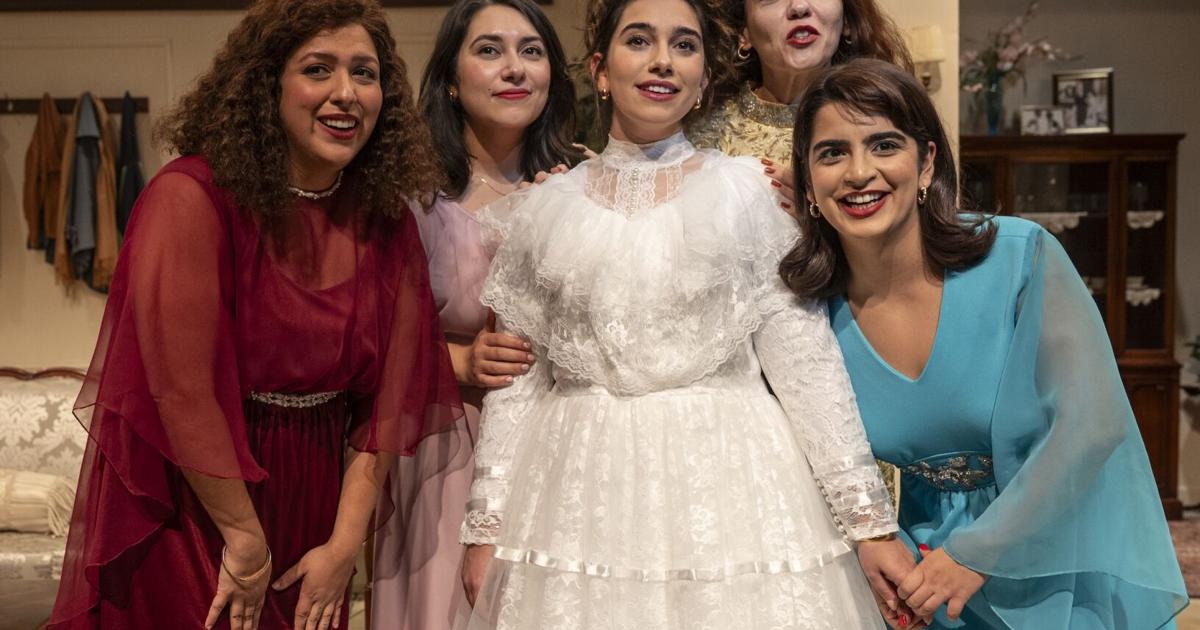
There’s more to Sanaz Toossi’s “Wish You Were Here” than meets the eye. At first, the Chicago premiere, which is kicking off Remy Bumppo Theatre Company’s 30th anniversary season, seems to be about five frivolous young women who have nothing better to do than chatter and joke about sex, bodily functions and other girly stuff while primping for a wedding.
But Toossi, who won the Pulitzer Prize for “English” (staged at Goodman Theatre last year), opens a window onto a world that is foreign to many of us and illuminates the ways the political can shape the personal.
The 100-minute-plus one-act is set in a comfortably affluent suburban living room designed by Lauren M. Nichols, but that living room is not in some American city but in Karaj, Iran. The story unfolds in short scenes from 1978 to 1991, with the years projected in light on a back wall. During that time, the women will experience the unraveling of the seemingly unshakable bonds of friendship. They also will find their hopes shaken and dreams shattered, often by forces beyond their control as the ouster of the shah, the revolution and other events of history take place in the world outside.
At the same time, their shifting alliances conflict with the decisions each has to make about the course her life should take. Whether to stay in Iran or emigrate plays as big a role as whether or not to marry; in fact, husbands (and men, in general) are only mentioned in passing, if at all, even though they’re increasingly in control as the Islamic Republic takes over.
What makes “Wish You Were Here” work are the beautifully crafted performances under Azar Kazemi’s astute direction. Replete with details and nuances, they show us women who are flawed but resilient, competitive but supportive, strong but desperate to be loved.
In the opening scene, they’re preparing for the wedding of Salme (Gloria Imseih Petrelli), who is resplendent in her fairy tale gown, as Rana (Joan Nahid) and Nazanin (Shadee Vossoughi) fuss over her. Shideh (Tina Arfaee), who has hopes of becoming a doctor and applying to schools in the U.S., is over on the couch insulting the toes of Zari (Yourtana Sulaiman), who may be the vainest of them all with her flipped-out hair and bright red nails.
Though it is not all that pronounced, the closest bond at this point seems to be between Rana and Nazanin, who want to move somewhere warm and escape the traditional norms for women. The others also see Rana as the coolest in the group but not as tightly a part of it.
That, it turns out, is probably because Rana is Jewish. By the second scene, which centers on Zari’s impending wedding, Rana also has disappeared. Everyone is worried about her, but Nazanin says not to call because, if she wanted to be found, she would be.
Later, Salme, a devoted Muslim, is the one who tries to locate Rana and who, more than anyone else, holds the group together. Her fate is one of the few things in the play I didn’t understand fully.
Through all the various twists and turns, Nazanin eventually becomes the center of attention. She’s the one who stays in Iran but, as she knows all too well, she’s pushed the others away. The true cost comes crashing down in the final scene, the most overtly political and a shattering exposé of irreparable loss. It is all-too-timely and not to be missed.
“Rome Sweet Rome”
Political mayhem and murder take center stage in “Rome Sweet Rome,” the latest “add-rap-tation” of Shakespeare by The Q Brothers Collective (GQ, JQ, JAX and POS). Developed in collaboration with Chicago Shakespeare artistic director Edward Hall and Ericka Ratcliff, the 90-minute take on “Julius Caesar” ingeniously fuses hip-hop and theater into a satire that skewers all sides and is scarily timely given current events. The only people who get any love are the interns.
I won’t spoil the fun by revealing the plot, except to say that it sticks surprisingly close to the Bard’s but for one big bone of contention: Julius Caesar, the charismatic, narcissistic, authoritarian Emperor of Rome incites the opposition by banning bread. Also, Halloween is the doom date rather than the Ides of March. And, yes, there are riffs on everything from sandwiches to Caesar salad, as well plenty of repurposed hip-hop standards of the 1980s and 1990s.
The main difference from earlier Q Brothers shows I’ve seen, aside from more elaborate staging, is that the cast has expanded to 10. Three of the original four are among them, but substitutes were standing in for all three the night I saw the production. That included Curtis Bannister for Postell Pringle (POS) as Caesar (and Octavius).
Some in the ensemble are better rappers than others, but I wish there were super titles like for opera because it’s hard to catch all the clever lyrics, which fly by fast and furiously. One tip: Try to go to a performance that has open captioning.
‘ The preceding article may include information circulated by third parties ’
‘ Some details of this article were extracted from the following source www.hpherald.com ’