When a scheduled musician cannot perform, it is interesting to observe the resourcefulness of those who must make new arrangements. Last week the Academy of St. Martin in the Fields Wind Ensemble learned less than a day before their Friday evening performance at Mandel Hall that they were losing their oboe player; he had to return to London because his son had been hospitalized. The group engaged a replacement from New York Friday morning, and he met with the ensemble for a first rehearsal three hours before the UChicago Presents performance.
I hope that the son of John Roberts is doing well, and I can report that the young player found to sit in the oboe chair, Lucian Avalon, rose to the occasion. Lucian is the brother of Phoenix Avalon, a violinist in the Isidore String Quartet, which performed at Mandel Hall a few years ago. Lucian’s Mandel debut may have been at the shortest notice possible, yet he came through with flying colors. The concert was a delight and only required a small bit of program rejigging to accommodate the last-minute substitute.
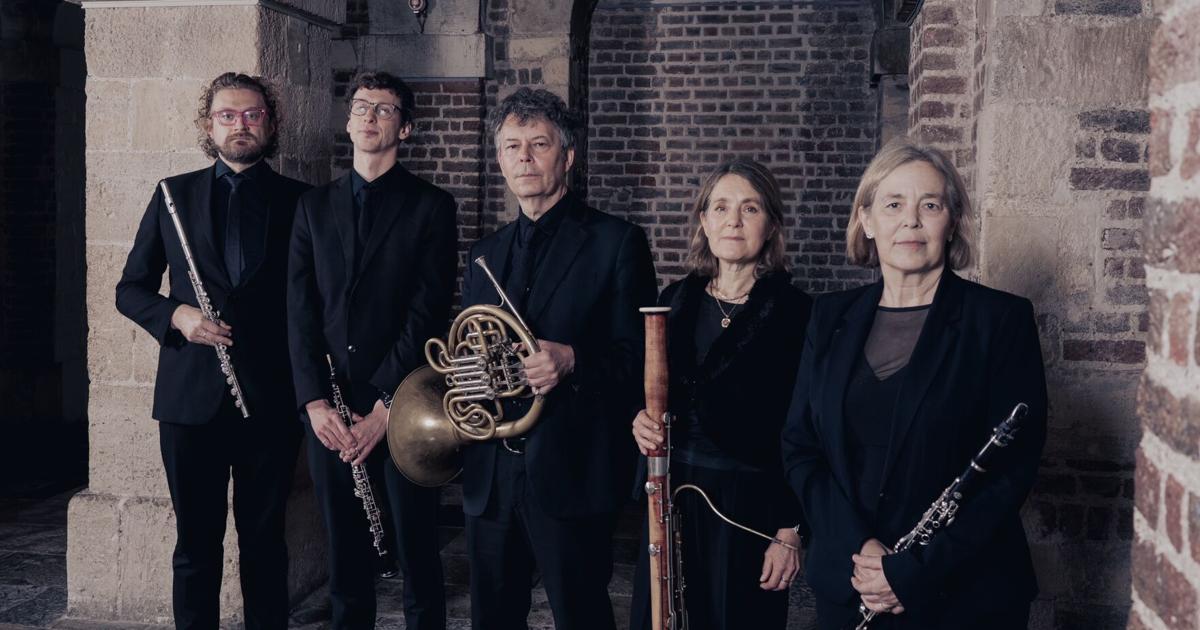
The Academy of St. Martin in the Fields Wind Ensemble is made up of Harry Winstanley, flute; John Roberts (replaced by Lucian Avalon for this concert), oboe; Fiona Cross, clarinet; Julie Price, bassoon; and Stephen Stirling, horn. They opened with Mozart’s Adagio and Allegro in F Minor for musical clock, K. 594, arranged for wind quintet. The Adagio was appropriately somber, as it was composed as a funeral mass to be performed on a mechanical organ clock in the mausoleum of a deceased field marshal. The Allegro was far more animated, with the ensemble providing a performance with a lovely spring in its step.
The work that made the biggest impression was the longest one on the program: Carl Nielsen’s Quintet, Op. 43. The Allegro ben moderato opened with a beautiful bassoon line introducing the main theme, which was performed with admirable flexibility. The Menuet blossomed into a big, rustic sound. The final movement was enhanced by the use of the English horn, adding yet more color and sparkle to the work’s overall impression. The theme and variations were splendid, opening with Nielsen’s marvelous choral. The variations were pleasing, featuring the low powers of the horn and bassoon, a froggy bassoon joined to a mosquito-like clarinet, and horn calls with bell-like tones. It was a delight from start to finish.
Also admirably performed was György Ligeti’s Six Bagatelles (1953), based on his “Musica ricercata,” a work for piano with 11 movements, starting with only two pitches, with each subsequent movement increasing the number of pitches used by one until a complete chromatic scale is represented. Six of these movements were used for the bagatelles for winds.
The ensemble drew out the strong Hungarian feeling of the second movement. The third movement was gorgeous, and the players seemed determined to make the beauty of the music sparkle. There was spirited playing as well as some craziness, with the final movement offering an almost circus-like energy and ending on a stylish clarinet gulp.
J.S. Bach’s Concerto No. 2 in D minor after Vivaldi was arranged for wind quintet by Mordechai Rechtmann. It was music that created swirls of glorious sound and had an almost magical quality to it. The slow middle movement had dignity, while the conclusion was spellbinding until the end.
Freya Wales-Cohen’s “Small Plinths” (2026) was commissioned for this tour, and Julie Price told the audience the group found working on the piece “incredibly joyful.” Yet she also said, “You don’t have to love it,” clearly conceding that the piece would not charm all ears. The music was episodic and seemed to be a collection of sounds that were oddly juxtaposed, such as what sounded like a regal setting suddenly interrupted by a squeaking mouse.
By Sunday afternoon, UChicago Presents was again hosting music, this time it was the final installment of this year’s “CSO Chamber Music at the University of Chicago,” a popular series featuring musicians from the Chicago Symphony performing chamber music. The musicians who came to the Logan Center for this event were Cynthia Yeh, percussion; Jennifer Gunn, flute; Kenneth Olsen, cello; and Christopher Guzman, piano.
This concert was made up primarily of music by living composers, opening with Molly Joyce’s “Light and Dark,” which started in the dark, and after a few lines from the flute the lights came up. In spite of this silly melodramatic beginning, the work was effective, with Gunn offering alluring sound from the flute and Yeh providing stylish work on vibraphone and other percussion, creating sound that seemed to glow.
Composer Chen Yi has written that the concept of “Qi” is “filled into the dancing lines of Chinese calligraphy, it’s the spirit of the human mind.” Her composition “Qi” was the only piece on the program that employed all four musicians, and they gave a compelling performance with tight ensemble playing that was atmospheric, with the piece evoking eastern sound using western instruments. The cello and piano at times were engrossingly furious, there was notably intense work in percussion and the flute sometimes seemed to profoundly wail as if issuing a warning.
“Assobio a Jato” (Jet Whistle) for flute and cello by Heitor Villa-Lobos offered Olsen a chance to put some meaty cello work on display while Gunn fired off a series of wispy phrases and later delivered lines with a strong meditative flair. Near the end the cello had a kind of frenzied sound you associate more with electric guitar. It was an effective performance.
Some of the works were overburdened by gimmicks. Caroline Shaw’s “Boris Kerner” for cello + flower pots (yes, the “+” is in the title) had program notes that are incomprehensible. The composer wrote that the person named in the title lives in Stuttgart and is the author of “Modern Traffic Flow Theory and Control: The Long Road to Three-Phase Traffic Theory.” How this music relates to that is a mystery more interesting than the score itself, although Olsen on cello and Yeh on flower pots (she struck them with mallets, and as they were empty, no flowers were harmed in the making of this performance) seemingly did everything in their power to render the notes appropriately.
Annie Gosfield’s “Daughters of the Industrial Revolution” had extensive notes that discussed numerous elements not present in the performance, as these notes related to aspects of guitar lines, electronic sounds, and a drum duet, none of which was possible here as it was performed with only one cello and one percussionist. Who made the arrangement was not disclosed. Both Yeh and Olsen appeared crisp and precise in their performance and committed to the music, which did not seem to add anything new to the idea that musical scores can incorporate industrial sounds and rhythms.
“WAKE UP!” for piccolo and alarm clock by Tilman Dehnhard was the pleasing little joke of the afternoon. Yeh started a clock blaring its alarm, left the stage, and Gunn stepped up and played a duet with the incessant clock siren. Her last note was spit out simultaneously with her stepping on the clock to silence it.
The final work on the program was the only one that had no modernist feel. Yet Louise Farrenc’s Trio in E Minor for flute, cello, and piano, Op. 45 was marvelously done and a welcome element to the program. It opened with enchanting music, with invigorating runs distributed through all the instruments in an expressive theme. The Andante was more reserved, although the music remained richly melodic with gentle singing phrases at the end. The Scherzo opened with exciting racing passages and a more relaxed line introduced by the cello before the movement concluded with more excitement. The final movement was even faster, being a presto, which the players executed with beautiful articulation. It was a satisfying 19th-century work (written in 1857) by a woman who taught at the Paris Conservatory and who, after ten years of doing exactly the same work as her male colleagues and being paid less, insisted on being paid the same. She won that battle. Today her work is experiencing a renewed interest, thanks to performers like those in this concert.
‘ The preceding article may include information circulated by third parties ’
‘ Some details of this article were extracted from the following source www.hpherald.com ’