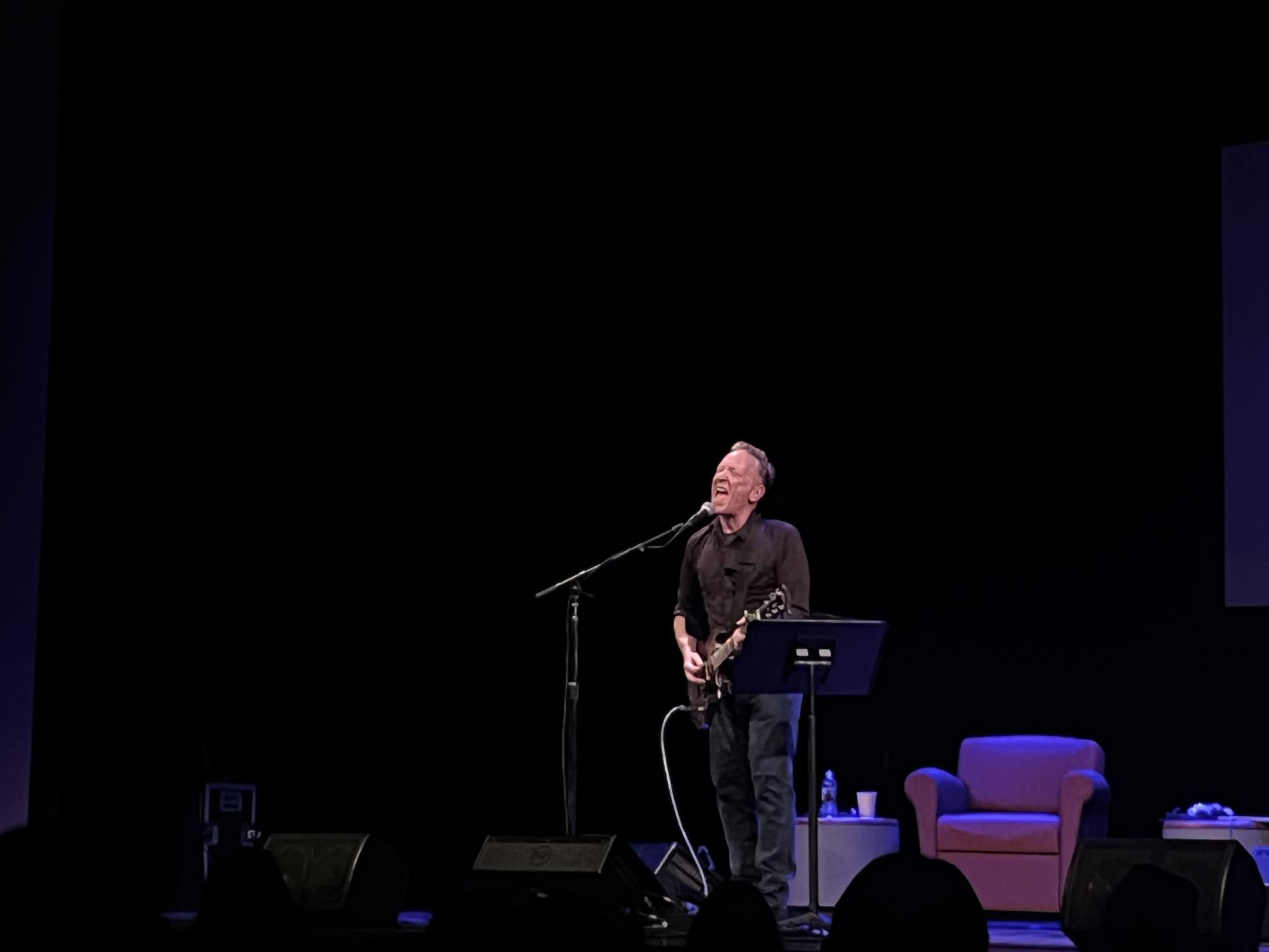
It’s a Wednesday evening, Oct. 22, and the house lights glow warm in Stockbridge Hall’s Bowker Auditorium. On the stage are two armchairs and a stack of books. To the left, an electric guitar.
The event, titled “Words and Music: An Evening with Singer-songwriter and Author Bill Janovitz,” invited University of Massachusetts alum Bill Janovitz back to campus after the release of his fourth book, “The Cars: Let the Stories be Told.”
Janovitz attended UMass from 1985 to 1989, during which he formed the alt-rock band Buffalo Tom with friends Chris Colbourn and Tom Maginnis. Hosting and moderating the conversation was Jim Neill, a former WMUA program director and current manager of the Old Chapel who attended UMass at the same time.
Neill began by introducing Janovitz, moving through his “career highlights” in rapid succession. He’s a musician, an author and he owns a real estate company. As Neill pointed out, he’s “kind of a Renaissance man.” But, as Janovitz joked, he prefers the term “hustler.”
In 2018, Janovitz joined Pearl Jam onstage at Fenway Park to perform “Taillights Fade,” Buffalo Tom’s most popular song off of their 1992 album “Let Me Come Over.” A fan video of the performance was projected behind Janovitz as he turned away, squirming uncomfortably in his chair. When the video ended, he humbly concluded, “That’s enough … You get the idea … It’s painful to sit there.”
Janovitz described the experience as “a weird, surreal moment.” He recalled the Saturday night when he received a text from Pearl Jam’s Eddie Vedder that said, “Bill, how about ‘Taillights Fade’ in center field at Fenway Park?” Janovitz agreed, and within half an hour, he was in an empty Fenway Park doing a sound check.
Janovitz said he was shocked at the audience’s enthusiastic reception. “I thought people would be like, oh who the f— is this guy, you know?”
But, as Neill indicated, Pearl Jam fans knew Buffalo Tom because the two bands emerged around the same time in the early 1990s. Janovitz and Vedder had met in the early days of their careers when they played a show together in Boston; Pearl Jam was at the bottom of the bill below Buffalo Tom. Neill told Janovitz, “you were part of the Genesis, and you were a seminal influence on a band that went on to be Pearl Jam.”
Janovitz formed Buffalo Tom with bandmates Chris Colbourn and Tom Maginnis during the Fall of 1986, his junior year at UMass. The three friends would see shows together, but they had all been in separate bands. “So, we were just like, let’s just see what happens, you know?” Janovitz said.
They had an example in Amherst’s own Dinosaur Jr., which Buffalo Tom gets compared to often. Janovitz recalled meeting the band’s singer and guitarist, J Mascis, and “being struck by what an enigma he is and remains.” By the time Buffalo Tom formed, Dinosaur Jr. was touring Europe. Janovitz said he remembered thinking, “if we could only achieve something like that, you know, that would be amazing.”
And they did. For 10 years, Buffalo Tom was a full-time career. The band released five records during the 1990s and their work was met with critical acclaim. At the end of the decade, between an unsuccessful major U.S. label deal, the changing music industry and the demands of their personal lives it was time for a break.
“I’m almost certain if Buffalo Tom had not started when I was a junior or senior and gotten going in my senior year, that I probably would have preferred to stay on in school and gone for an MFA or something,” Janovitz said. “I was really interested in writing. I took some great courses here, but Buffalo Tom got going.”
While at UMass, Janovitz majored in communication, with minors in comparative literature and sociology.
After 10 years playing in a rock band, he started writing again. Janovitz made his foray into music journalism in the early 2000s, writing song reviews online for $25 each. “A lot of people were just writing even two-paragraph song descriptions, but I was writing my 3,000-word essays about these songs. For, still, 25 bucks a pop,” he said.
Feeling drawn to longer-form media, Janovitz wrote a short book about The Rolling Stones’ “Exile on Main Street” for the 33 1/3 series. He widened the scope of his storytelling with “Rocks Off: 50 Tracks That Tell the Story of the Rolling Stones,” and then completed his most involved project thus far, his New York Times bestselling biography on the influential musician Leon Russell.
Janovitz originally pitched his idea for a book about the 80s new-wave band The Cars before writing the Leon Russell biography, but it wasn’t until after the first book’s success and the death of The Cars’ frontman, Ric Ocasek, that the band came around to the idea.
According to Janovitz, keyboardist Greg Hawkes said, “Let the stories be told!” The line became the title of Janovitz’s biography exploring the impact and inner tensions of the ubiquitous yet enigmatic band.
The book opens with a story about the first time Janovitz heard The Cars. He was 12 years old, over at his friend Jeff’s house when Jeff’s cool, orange Camaro-driving older brother brought back The Cars’ debut album from college. Upon hearing the record, Janovitz recalled thinking, “I’m all in with this. This is mine.”
That debut album was produced by Roy Thomas Baker, the English producer best known for working on Queen’s first five albums. Baker wanted to tone down the instrumentals for The Cars record and make them sparser. “With The Cars, he saw this opportunity to kind of do something new and it was. It was old and new at the same time, that debut album,” Janovitz said.
Much of Janovitz’s book focuses on The Cars’ band dynamic. Janovitz shared that he was surprised to learn that Ric Ocasek, the band’s primary vocalist and guitarist, was credited as the sole songwriter for nearly all their work. Though Greg Hawkes, who was often in the studio with Ocasek, received some credit, other band members and producers never did even though they made significant contributions to the music.
Ocasek, Janovitz explained, was the leader and ultimate decision-maker of The Cars. Janovitz contrasted it to the power dynamics of his own band and emphasized that they “were friends that formed a band together rather than, [saying] ‘I’m gonna try this band, I’m gonna try this band, now I’m gonna try these different guys,’ which is what The Cars were.”
What surprised Janovitz most in his research, however, was The Cars’ co-founder Benjamin Orr’s personal history. According to Janovitz, Orr and Ocasek became “like brothers in ‘68” when they moved to Boston to form the band. Their relationship acts as “the main thread” throughout “Let the Stories be Told,” Janovitz said.
After increasing tensions and the band’s breakup in 1988, Orr struggled with addiction and mental health. Janovitz expressed the tension as an author between including dark, personal information for context and avoiding sensationalism. “You know, I’m not interested in shock value stuff … But you know that this is a big compelling part of, or a really important part of the story.”
Janovitz interviewed 80 people for the book, including the three surviving Cars: guitarist Elliot Easton, drummer David Robinson and keyboardist Greg Hawkes. He also spoke to Paulina Porizkova, Czech model and Ocasek’s wife.
Janovitz said having the three band members’ “blessing” to the project helped tremendously with securing sources. It also helped that his Leon Russell book was successful. “It’s the access that’s really important,” Janovitz emphasized.
He described himself as an “opinionated biographer.” Instead of simply recounting the history of The Cars, Janovitz said, “I’m delving into the music and saying why I feel certain music works,” adding that he feels it is important for readers to know where an author stands on a topic.
After the talk, Neill exited the stage and Janovitz picked up his guitar to take a few audience song requests. He played Buffalo Tom’s “All be Gone” from their last album — “maybe the last Buffalo Tom album,” Janovitz interjected — ”Quiet Peace.”
Then, encouraging the audience to sing along, Janovitz moves into The Cars’ “My Best Friend’s Girl.” The catchy tune filled the auditorium as audience members danced in their seats and repeated the lyric, “Here she comes again.”
Janovitz warned the audience before he attempted Elliot Easton’s technical, rockabilly-inspired guitar solo. He struggled through his first attempt, batting away applause to say “No, no, forget that happened.” Laughing, he tried again.
Finally, Janovitz played Buffalo Tom’s 1993 hit “Sodajerk,” off of “Big Red Letter Day.” The evening closed with a book signing onstage.
Janovitz said he is thinking about a particular book, but he did not want to share the idea as it likely will not work out.
“It comes back to like, does the subject want to be involved or not,” Janovitz said. “And if not, then, you know, I’m not going to write a book despite them.”
Riley Greenberg can be reached at [email protected].
‘ The preceding article may include information circulated by third parties ’
‘ Some details of this article were extracted from the following source dailycollegian.com ’