
US consumers are “more wary than willing” to engage with entertainment content created using generative AI, according to a new study from Luminate.
That finding comes from AI & Media: Audience Attitudes, a report from Luminate Intelligence published on Friday (July 24).
The report draws on Luminate’s US Entertainment 365 survey to assess consumers’ own use of generative AI applications, and how its use in creating songs, movies and TV shows affects their willingness to engage.
Overall, consumer attitudes were mixed, with some respondents ambivalent about whether AI had been involved at all, Luminate said.
Attitudes were broadly similar across the different media types, though consumers were most opposed to reading news written with generative AI.
Consumers were least opposed to a video game containing AI assets, with 40% neither more nor less interested in a game whose characters, environments or dialogue were made with AI.
That compared with about a third of those surveyed who were ambivalent toward the uses of AI in other media, according to the report.
Net interest in AI-assisted content, defined as those more interested minus those less interested, differed by age, Luminate said.
Media consumers aged 55 and older were “the most deeply negative” on engaging with AI-assisted content, across movies, TV shows, music, social media and video games.
The 13-17 age cohort, by contrast, was net positive across all media types.
That stood in contrast to the 18-24 cohort, with the report recording 58-point gaps between the two for AI-scripted movies and TV, and for AI-generated social media content.
Older members of Gen Z, along with Millennials and Gen X, sat closer to breakeven, the report said.
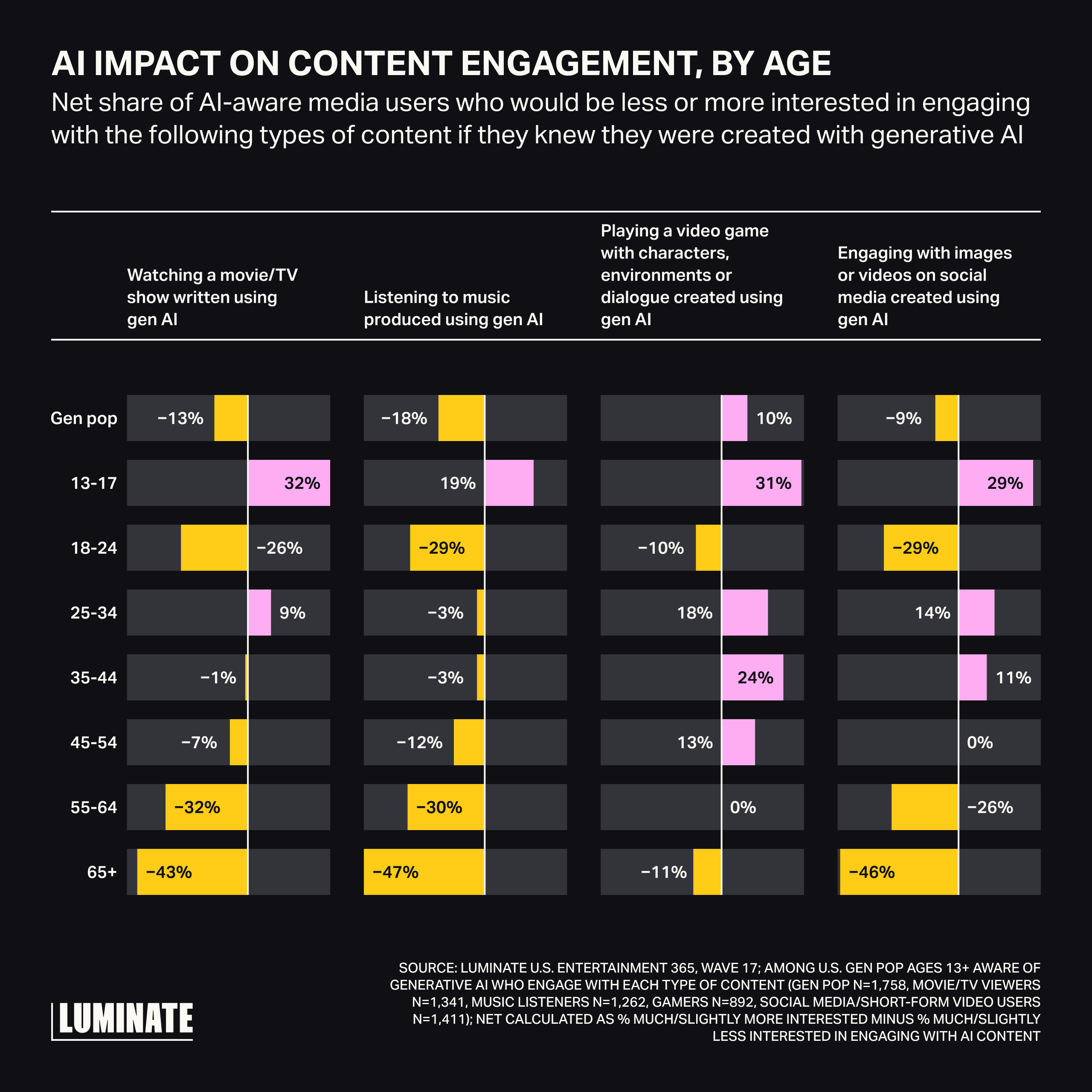
At a minimum, the findings suggest “it would be a mistake to regard Gen Z as a monolith in its attitudes toward AI content,” Luminate said, adding that it “may be increasingly important to understand intragenerational faultlines.”
Luminate has previously measured US listeners’ attitudes to the use of AI in music specifically.
In its 2025 Year-End Music Report, the company found that around 44% of US respondents said they would be less interested in music if they knew generative AI had produced it, as previously reported by MBW.
The item that made US listeners most uncomfortable was “a new original song performed by an AI voice,” with 46% very or somewhat uncomfortable with it.
Teenagers and Millennials were the most comfortable with AI in music, the company found, with 37% of teenagers and 36% of Millennials saying they had no problem with AI-generated lyrics.
Separately, a peer-reviewed study by researchers at Stanford University and Reed College, published earlier this year, found that people engaged less deeply with music labeled as AI than with music labeled as human-made, even when a human had composed it.
Several streaming services have introduced AI labeling this year, with Apple Music and Spotify adding systems that flag when AI has been used in a track.
Deezer, which detects and flags AI music at the platform level, reported earlier this month that around 90,000 fully AI-generated tracks were being uploaded to its service each day.
That amounted to over 50% of the platform’s daily uploads for the first time in June.Music Business Worldwide
‘ The preceding article may include information circulated by third parties ’
‘ Some details of this article were extracted from the following source www.musicbusinessworldwide.com ’